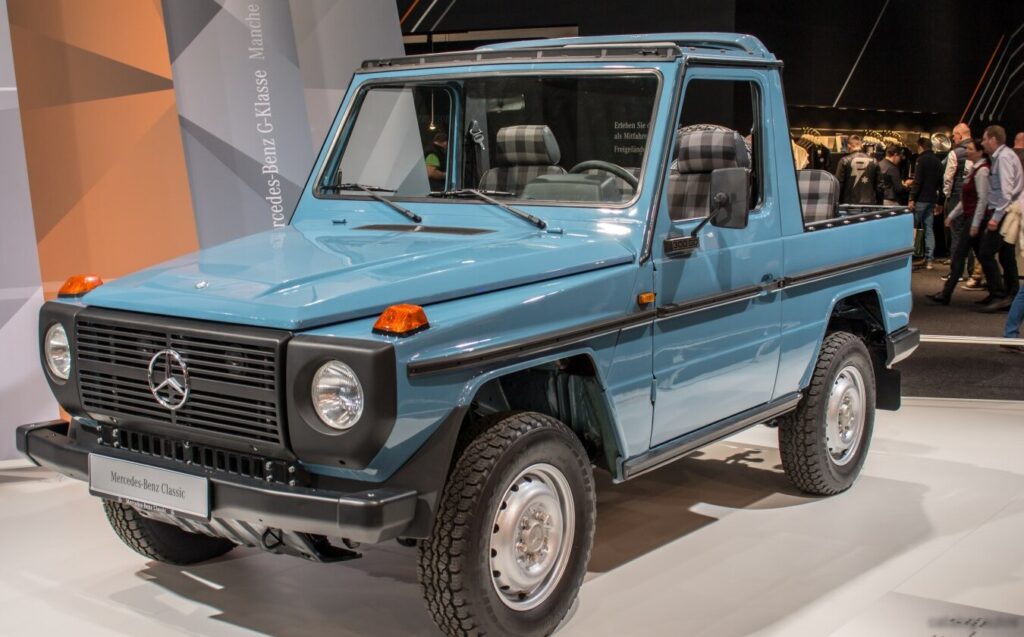
The Mercedes-Benz G 270 CDI 4MATIC, produced from December 2001 to August 2006, represents a significant iteration of the iconic G-Class (W463) following the 2000 facelift. This variant, powered by a 2.7-liter five-cylinder turbodiesel engine producing 156 horsepower, occupied a middle ground in the G-Class lineup, offering a balance between capability, fuel efficiency, and relative affordability compared to the more potent G 500 or AMG models. It was primarily marketed in Europe and other regions where diesel engines were favored, and it built upon the G-Class’s established reputation as a supremely capable and durable off-road vehicle.
Technical Specifications
| Brand | Mercedes-Benz |
| Model | G-class |
| Generation | G-class (W463, facelift 2000) |
| Type (Engine) | G 270 CDI (156 Hp) 4MATIC Automatic |
| Start of production | December, 2001 |
| End of production | August, 2006 |
| Powertrain Architecture | Internal Combustion engine |
| Body type | Off-road vehicle |
| Seats | 5 |
| Doors | 3 |
| Fuel consumption (economy) – urban (NEDC) | 13.7 l/100 km (17.2 US mpg, 20.6 UK mpg, 7.3 km/l) |
| Fuel consumption (economy) – extra urban (NEDC) | 9.9 l/100 km (23.8 US mpg, 28.5 UK mpg, 10.1 km/l) |
| Fuel consumption (economy) – combined (NEDC) | 11.3 l/100 km (20.8 US mpg, 25 UK mpg, 8.8 km/l) |
| CO2 emissions (NEDC) | 289 g/km |
| Fuel Type | Diesel |
| Acceleration 0 – 100 km/h | 13.2 sec |
| Acceleration 0 – 62 mph | 13.2 sec |
| Acceleration 0 – 60 mph | 12.5 sec |
| Maximum speed | 156 km/h (96.93 mph) |
| Emission standard | Euro 3 |
| Weight-to-power ratio | 14.6 kg/Hp, 68.6 Hp/tonne |
| Weight-to-torque ratio | 5.7 kg/Nm, 175.8 Nm/tonne |
| Power | 156 Hp @ 3800 rpm |
| Power per litre | 58.1 Hp/l |
| Torque | 400 Nm @ 1800-2600 rpm (295.02 lb.-ft. @ 1800-2600 rpm) |
| Engine layout | Front, Longitudinal |
| Engine Model/Code | OM 612.966 |
| Engine displacement | 2685 cm3 (163.85 cu. in.) |
| Number of cylinders | 5 |
| Engine configuration | Inline |
| Cylinder Bore | 88 mm (3.46 in.) |
| Piston Stroke | 88.3 mm (3.48 in.) |
| Compression ratio | 18:1 |
| Number of valves per cylinder | 4 |
| Fuel injection system | Diesel Commonrail |
| Engine aspiration | Turbocharger, Intercooler |
| Valvetrain | DOHC |
| Engine oil capacity | 7.5 l (7.93 US qt | 6.6 UK qt) |
| Coolant | 8 l (8.45 US qt | 7.04 UK qt) |
| Kerb Weight | 2275 kg (5015.52 lbs.) |
| Max. weight | 2850 kg (6283.17 lbs.) |
| Max load | 575 kg (1267.66 lbs.) |
| Trunk (boot) space – minimum | 250 l (8.83 cu. ft.) |
| Trunk (boot) space – maximum | 1580 l (55.8 cu. ft.) |
| Fuel tank capacity | 96 l (25.36 US gal | 21.12 UK gal) |
| Max. roof load | 150 kg (330.69 lbs.) |
| Permitted trailer load with brakes (12%) | 2850 kg (6283.17 lbs.) |
| Permitted trailer load without brakes | 750 kg (1653.47 lbs.) |
| Length | 4230 mm (166.54 in.) |
| Width | 1760 mm (69.29 in.) |
| Width including mirrors | 2007 mm (79.02 in.) |
| Height | 1931 mm (76.02 in.) |
| Wheelbase | 2400 mm (94.49 in.) |
| Front track | 1475 mm (58.07 in.) |
| Rear (Back) track | 1475 mm (58.07 in.) |
| Ride height (ground clearance) | 205 mm (8.07 in.) |
| Drag coefficient (Cd) | 0.54 |
| Minimum turning circle (turning diameter) | 11.3 m (37.07 ft.) |
| Approach angle | 36° |
| Departure angle | 27° |
| Ramp-over (brakeover) angle | 23° |
| Climb angle | 38.7° |
| Wading depth | 500 mm (19.69 in.) |
| Drivetrain Architecture | The Internal combustion engine (ICE) drives permanently the four wheels of the vehicle. |
| Drive wheel | All wheel drive (4×4) |
| Number of gears and type of gearbox | 5 gears, automatic transmission |
| Front suspension | Coil spring, Rigid axle suspension, Trailing arm |
| Rear suspension | Rigid axle suspension, Trailing arm, Coil spring |
| Front brakes | Ventilated discs |
| Rear brakes | Disc |
| Assisting systems | ABS (Anti-lock braking system) |
| Steering type | Cone worm with recirculation balls |
| Power steering | Hydraulic Steering |
| Tires size | 265/70 R 16 |
| Wheel rims size | 7.5 J x 16 |
Powertrain & Engine Architecture
The heart of the G 270 CDI is the OM 612.966, a 2.7-liter inline five-cylinder diesel engine. This engine, a member of Mercedes-Benz’s OM612 family, utilizes a common rail direct injection system, delivering fuel at extremely high pressure for improved combustion efficiency and reduced emissions. A turbocharger with an intercooler further enhances performance, boosting power and torque. The engine features a double overhead camshaft (DOHC) valvetrain with four valves per cylinder, optimizing gas flow. The engine’s robust construction and relatively simple design contribute to its longevity and reliability. The engine is longitudinally mounted in the chassis. The G 270 CDI was exclusively offered with a five-speed automatic transmission, providing smooth and convenient gear changes. This transmission was chosen to broaden the appeal of the G-Class, making it more accessible to drivers who preferred the ease of an automatic.
Driving Characteristics
The 156 horsepower and 295 lb-ft of torque produced by the 2.7-liter diesel engine provide adequate, though not exhilarating, performance for the G 270 CDI. Acceleration from 0-60 mph takes around 12.5 seconds, and the top speed is limited to 97 mph. The automatic transmission, while smooth, can feel somewhat sluggish, particularly during kickdown maneuvers. The engine’s torque peak is available from 1800-2600 rpm, providing good low-end grunt for off-road driving and towing. Compared to the more powerful G 500, the G 270 CDI feels noticeably slower, but it offers significantly better fuel economy. The G 270 CDI’s off-road prowess remains exceptional, thanks to its permanent four-wheel drive system, low-range gearing, and robust suspension.
Equipment & Trim Levels
The G 270 CDI typically came equipped with a respectable level of standard features, including air conditioning, power windows, central locking, and an AM/FM radio. Interior upholstery was typically cloth, though leather was available as an option. The dashboard layout was functional and utilitarian, reflecting the G-Class’s focus on practicality rather than luxury. Optional extras included a sunroof, heated seats, and upgraded audio systems. The G 270 CDI was positioned as a mid-range offering within the G-Class lineup, bridging the gap between the more basic commercial versions and the more luxurious G 500.
Chassis & Braking
The G 270 CDI utilizes a body-on-frame construction, providing exceptional strength and durability. The suspension consists of coil springs and rigid axles with trailing arms, offering a comfortable ride both on and off-road. Front brakes are ventilated discs, while rear brakes are solid discs. An anti-lock braking system (ABS) is standard. The G 270 CDI’s robust chassis and capable suspension allow it to tackle challenging terrain with ease. The vehicle’s high ground clearance and impressive approach, departure, and breakover angles further enhance its off-road capabilities.
Market Reception & Comparison
The G 270 CDI was generally well-received by critics, who praised its off-road capability, fuel efficiency, and durability. However, some reviewers noted its relatively slow acceleration and somewhat dated interior. Compared to the G 500, the G 270 CDI offered a more affordable entry point into the G-Class world, but it sacrificed some performance and luxury. Fuel economy was a significant advantage for the G 270 CDI, particularly in Europe, where diesel fuel was often cheaper than gasoline. The G 270 CDI proved to be a popular choice for those who needed a capable and reliable off-road vehicle without the high price tag of the more powerful models.
Legacy
The OM 612 engine family, including the OM 612.966 found in the G 270 CDI, is known for its longevity and reliability. With proper maintenance, these engines can easily exceed 200,000 miles. The G 270 CDI remains a sought-after vehicle in the used car market, particularly among enthusiasts who appreciate its classic design and off-road capabilities. While parts availability can sometimes be a challenge, the G-Class’s robust construction and relatively simple mechanicals make it a relatively easy vehicle to maintain. The G 270 CDI represents a unique and capable iteration of the iconic G-Class, offering a blend of practicality, durability, and off-road performance.