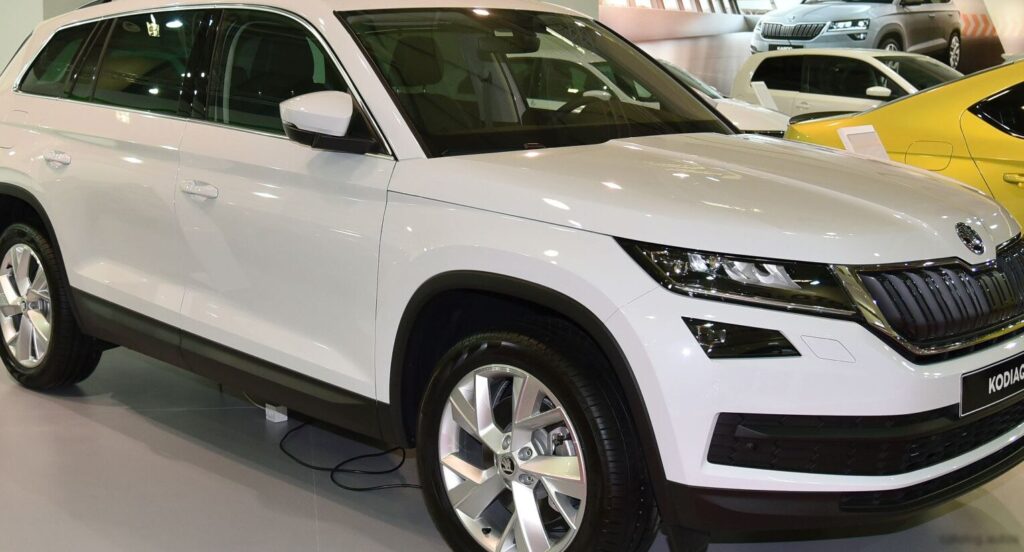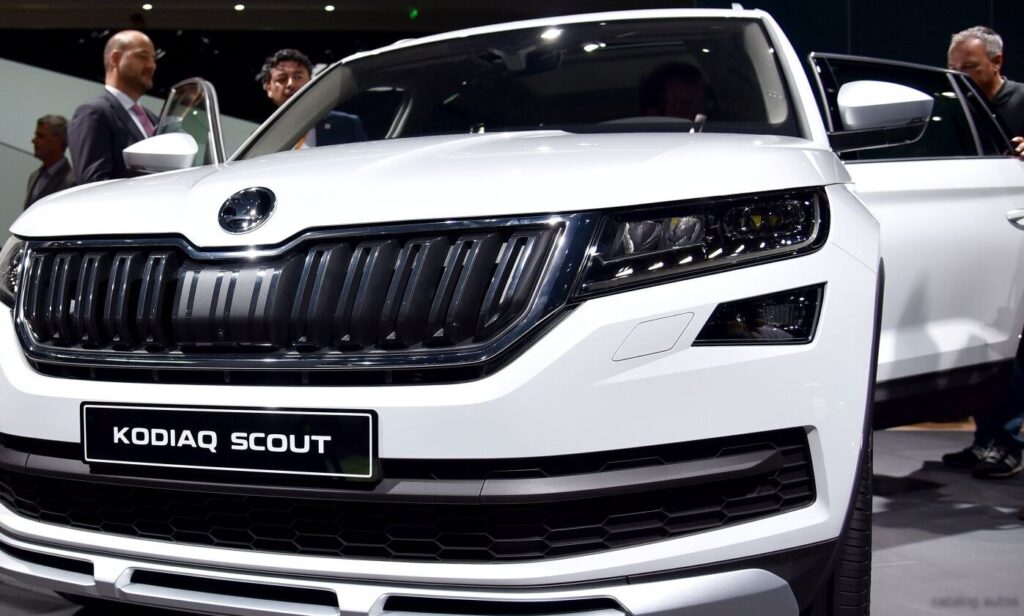
The Skoda Kodiaq I Scout 1.5 TSI 4×4 DSG represents a compelling blend of practicality, capability, and efficiency within the Kodiaq range. Introduced in 2018 and continuing through 2019, this variant occupied a significant middle ground in the Kodiaq lineup, offering all-wheel drive and a responsive turbocharged engine paired with a dual-clutch transmission. It was designed to appeal to families and drivers seeking a versatile SUV capable of handling diverse road conditions, particularly in European markets where the Scout trim signified enhanced off-road styling and capability. The Kodiaq itself is built on the Volkswagen Group’s MQB platform (A7 variant), shared with models like the Volkswagen Tiguan and SEAT Ateca.
Technical Specifications
| Brand | Skoda |
| Model | Kodiaq |
| Generation | Kodiaq I Scout |
| Type (Engine) | 1.5 TSI (150 Hp) 4×4 DSG |
| Start of production | 2018 |
| End of production | 2019 |
| Powertrain Architecture | Internal Combustion engine |
| Body type | SUV |
| Seats | 5 |
| Doors | 5 |
| Fuel consumption (urban) | 8.4-8.5 l/100 km (28 – 27.7 US mpg) |
| Fuel consumption (extra urban) | 6.2-6.3 l/100 km (37.9 – 37.3 US mpg) |
| Fuel consumption (combined) | 7.0-7.1 l/100 km (33.6 – 33.1 US mpg) |
| CO2 emissions | 161-163 g/km |
| Fuel Type | Petrol (Gasoline) |
| Acceleration 0 – 100 km/h | 9.9 sec |
| Acceleration 0 – 62 mph | 9.9 sec |
| Acceleration 0 – 60 mph | 9.4 sec |
| Maximum speed | 195 km/h (121.17 mph) |
| Emission standard | Euro 6d-Temp |
| Weight-to-power ratio | 10.6 kg/Hp |
| Weight-to-torque ratio | 6.3 kg/Nm |
| Power | 150 Hp @ 5000-6000 rpm |
| Torque | 250 Nm @ 1500-3500 rpm (184.39 lb.-ft.) |
| Engine layout | Front, Transverse |
| Engine Model/Code | EA211 evo / DADA |
| Engine displacement | 1498 cm3 (91.41 cu. in.) |
| Number of cylinders | 4 |
| Engine configuration | Inline |
| Number of valves per cylinder | 4 |
| Fuel injection system | Direct injection |
| Engine aspiration | Turbocharger, Intercooler |
| Valvetrain | DOHC |
| Engine oil capacity | 4.3 l (4.54 US qt | 3.78 UK qt) |
| Kerb Weight | 1586-1801 kg (3496.53 – 3970.53 lbs.) |
| Max. weight | 2286 kg (5039.77 lbs.) |
| Max load | 485-700 kg (1069.24 – 1543.24 lbs.) |
| Trunk (boot) space – minimum | 650 l (22.95 cu. ft.) |
| Trunk (boot) space – maximum | 2065 l (72.92 cu. ft.) |
| Fuel tank capacity | 60 l (15.85 US gal | 13.2 UK gal) |
| Max. roof load | 75 kg (165.35 lbs.) |
| Permitted trailer load with brakes (12%) | 2000 kg (4409.25 lbs.) |
| Permitted trailer load without brakes | 750 kg (1653.47 lbs.) |
| Permitted towbar download | 100 kg (220.46 lbs.) |
| Length | 4706 mm (185.28 in.) |
| Width | 1882 mm (74.09 in.) |
| Height | 1660-1681 mm (65.35 – 66.18 in.) |
| Wheelbase | 2790 mm (109.84 in.) |
| Front track | 1586 mm (62.44 in.) |
| Rear track | 1576 mm (62.05 in.) |
| Ride height (ground clearance) | 191 mm (7.52 in.) |
| Drag coefficient (Cd) | 0.338 |
| Minimum turning circle | 12.2 m (40.03 ft.) |
| Drivetrain Architecture | All wheel drive (4×4) |
| Number of gears | 7 |
| Type of gearbox | automatic transmission DSG |
| Front suspension | Independent type McPherson, Wishbone |
| Rear suspension | Independent multi-link suspension |
| Front brakes | Ventilated discs |
| Rear brakes | Disc |
INTRODUCTION
The Skoda Kodiaq Scout 1.5 TSI 4×4 DSG, launched in 2018, builds upon the foundation of the first-generation Kodiaq (introduced in 2016). The Kodiaq was Skoda’s first foray into the seven-seat SUV segment, aiming to provide a spacious, practical, and value-oriented alternative to more established competitors. The Scout trim level, specifically, added rugged styling cues – such as silver underbody protection and black plastic cladding – and, crucially, Skoda’s all-wheel-drive system. This variant was positioned as a mid-range offering, slotting between the entry-level Kodiaq models with smaller engines and the more powerful, often diesel-powered, higher-spec trims.
Powertrain & Engine Architecture
At the heart of the Kodiaq Scout 1.5 TSI 4×4 DSG lies the EA211 evo series 1.5-liter turbocharged four-cylinder gasoline engine, internally designated as DADA. This engine is a key component of Volkswagen Group’s modular engine family, known for its efficiency and responsiveness. It utilizes direct fuel injection and a Miller cycle combustion process to improve thermal efficiency. The turbocharger, coupled with an intercooler, provides a boost in power and torque. The engine produces 150 horsepower at 5000-6000 rpm and 250 Nm (184 lb-ft) of torque between 1500-3500 rpm. This torque curve provides good low-end grunt, making it suitable for everyday driving and towing. The engine is paired with a seven-speed dual-clutch transmission (DSG), which offers quick and smooth gear changes. The 4×4 system employs a multi-plate clutch to distribute power between the front and rear axles as needed, providing enhanced traction in slippery conditions.
Driving Characteristics
The 1.5 TSI engine, while not the most powerful option in the Kodiaq range, provides a respectable level of performance. Acceleration from 0-62 mph takes approximately 9.9 seconds, and the top speed is 195 km/h (121 mph). The DSG transmission contributes to a responsive driving experience, with quick shifts and a generally smooth operation. Compared to the higher-output 2.0 TDI diesel variants, the 1.5 TSI feels less effortless when fully loaded or tackling steep inclines. However, it offers a more refined and quieter driving experience than the diesel. The all-wheel-drive system provides added stability and confidence, particularly on loose surfaces. The gear ratios are tuned for a balance between fuel efficiency and performance, with taller gears for highway cruising and shorter gears for quicker acceleration.
Equipment & Trim Levels
The Scout trim level came standard with a generous amount of equipment. Interior features typically included comfortable cloth seats, a leather-wrapped multi-function steering wheel, and an 8-inch touchscreen infotainment system with Apple CarPlay and Android Auto compatibility. Standard safety features included automatic emergency braking, lane departure warning, and adaptive cruise control. Optional extras included leather upholstery, a panoramic sunroof, a Canton sound system, and electrically adjustable front seats. The Scout trim also featured unique interior trim elements, such as aluminum pedals and Scout-branded door sills.
Chassis & Braking
The Kodiaq Scout utilizes an independent suspension setup, with McPherson struts at the front and a multi-link suspension at the rear. This configuration provides a comfortable ride quality and good handling characteristics. The Scout trim often featured slightly stiffer suspension components compared to the standard Kodiaq to improve stability when carrying a load or driving off-road. Braking duties are handled by ventilated discs at the front and solid discs at the rear. The anti-lock braking system (ABS) and electronic stability control (ESC) are standard features, enhancing safety and control.
Market Reception & Comparison
The Kodiaq Scout 1.5 TSI 4×4 DSG was generally well-received by automotive critics. It was praised for its spacious interior, comfortable ride, and versatile all-wheel-drive system. The 1.5 TSI engine was considered a good compromise between performance and fuel economy. Compared to the 2.0 TDI models, the 1.5 TSI offered lower running costs but slightly less outright performance. Fuel economy figures averaged around 7.0-7.1 l/100 km (33.6-33.1 US mpg), making it a relatively efficient SUV for its size. Reliability reports have been generally positive, with few major issues reported with the EA211 engine and DSG transmission.
Legacy
The Skoda Kodiaq Scout 1.5 TSI 4×4 DSG has proven to be a reliable and practical SUV in the used car market. The EA211 engine is known for its durability, and the DSG transmission, while requiring regular maintenance, is generally robust. The Kodiaq’s spacious interior and versatile all-wheel-drive system continue to appeal to families and drivers seeking a capable and comfortable SUV. As a mid-range offering, it represents a good value proposition, offering a compelling blend of features, performance, and efficiency.