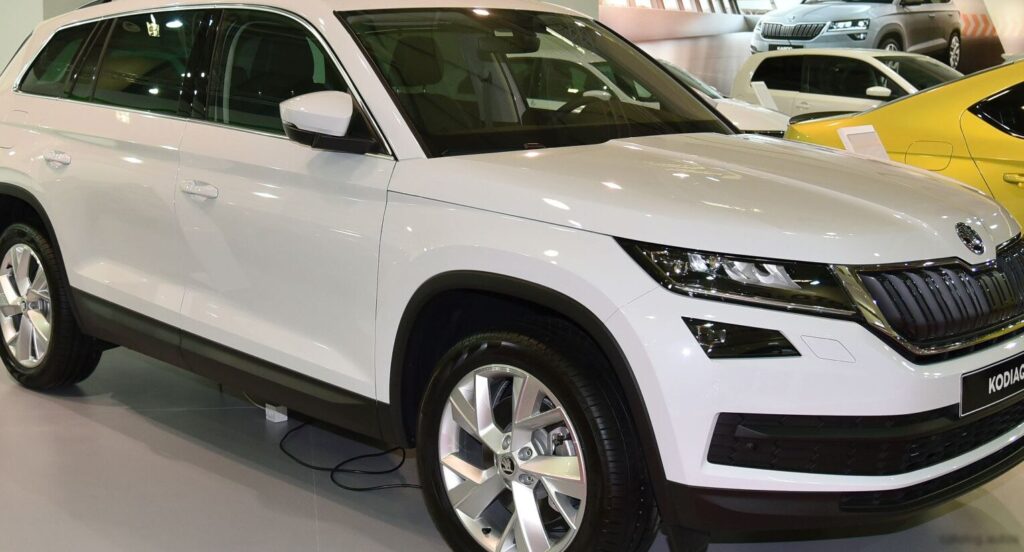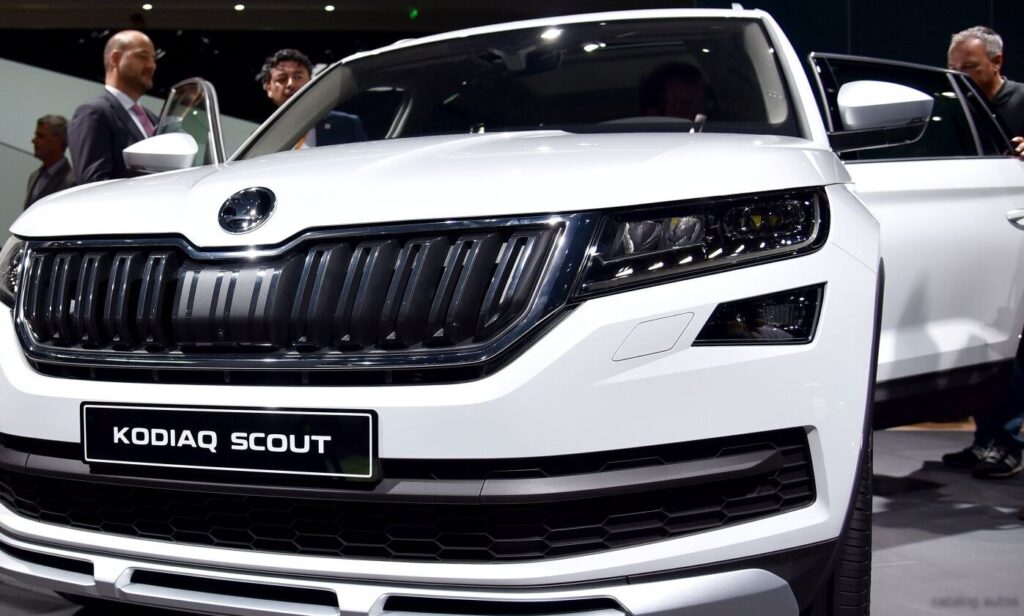
The Skoda Kodiaq Scout 2.0 TDI, produced from 2017 to 2020, represents a significant offering in Skoda’s lineup as a versatile, all-wheel-drive SUV with seven-passenger capability. Positioned as a more rugged and adventure-oriented variant of the standard Kodiaq, the Scout model aimed to broaden the Kodiaq’s appeal to families and individuals seeking a vehicle capable of both everyday commuting and occasional off-road excursions. This particular configuration, equipped with the 2.0-liter TDI engine producing 150 horsepower and paired with a six-speed manual transmission, occupied a middle ground within the Kodiaq range, offering a balance between fuel efficiency, performance, and price. It was part of the first generation Kodiaq (Typ NS7), based on the Volkswagen Group’s MQB platform.
Technical Specifications
| Brand | Skoda |
| Model | Kodiaq |
| Generation | Kodiaq I Scout |
| Type (Engine) | 2.0 TDI (150 Hp) 4×4 7 Seat |
| Start of production | 2017 year |
| End of production | 2020 year |
| Powertrain Architecture | Internal Combustion engine |
| Body type | SUV |
| Seats | 7 |
| Doors | 5 |
| Fuel consumption (economy) – urban | 6.4 l/100 km (36.8 US mpg, 44.1 UK mpg, 15.6 km/l) |
| Fuel consumption (economy) – extra urban | 4.8 l/100 km (49 US mpg, 58.9 UK mpg, 20.8 km/l) |
| Fuel consumption (economy) – combined | 5.4 l/100 km (43.6 US mpg, 52.3 UK mpg, 18.5 km/l) |
| CO2 emissions | 142 g/km |
| Fuel Type | Diesel |
| Acceleration 0 – 100 km/h | 9.9 sec |
| Acceleration 0 – 62 mph | 9.9 sec |
| Acceleration 0 – 60 mph | 9.4 sec |
| Maximum speed | 195 km/h (121.17 mph) |
| Emission standard | Euro 6 |
| Weight-to-power ratio | 11.2 kg/Hp, 89.7 Hp/tonne |
| Weight-to-torque ratio | 4.9 kg/Nm, 203.2 Nm/tonne |
| Power | 150 Hp @ 3500-4000 rpm |
| Power per litre | 76.2 Hp/l |
| Torque | 340 Nm @ 1750-3000 rpm (250.77 lb.-ft. @ 1750-3000 rpm) |
| Engine layout | Front, Transverse |
| Engine Model/Code | EA288 / DFGA |
| Engine displacement | 1968 cm3 (120.09 cu. in.) |
| Number of cylinders | 4 |
| Engine configuration | Inline |
| Cylinder Bore | 81 mm (3.19 in.) |
| Piston Stroke | 95.5 mm (3.76 in.) |
| Compression ratio | 16.2:1 |
| Number of valves per cylinder | 4 |
| Fuel injection system | Diesel Commonrail |
| Engine aspiration | Turbocharger, Intercooler |
| Engine oil capacity | 4.7 l (4.97 US qt | 4.14 UK qt) |
| Kerb Weight | 1673 kg (3688.33 lbs.) |
| Max. weight | 2383 kg (5253.62 lbs.) |
| Max load | 710 kg (1565.28 lbs.) |
| Trunk (boot) space – minimum | 270 l (9.53 cu. ft.) |
| Trunk (boot) space – maximum | 2005 l (70.81 cu. ft.) |
| Fuel tank capacity | 60 l (15.85 US gal | 13.2 UK gal) |
| Max. roof load | 75 kg (165.35 lbs.) |
| Length | 4706 mm (185.28 in.) |
| Width | 1882 mm (74.09 in.) |
| Height | 1655 mm (65.16 in.) |
| Wheelbase | 2791 mm (109.88 in.) |
| Front track | 1586 mm (62.44 in.) |
| Rear (Back) track | 1576 mm (62.05 in.) |
| Ride height (ground clearance) | 189 mm (7.44 in.) |
| Drag coefficient (Cd) | 0.341 |
| Minimum turning circle (turning diameter) | 12.2 m (40.03 ft.) |
| Drive wheel | All wheel drive (4×4) |
| Number of gears and type of gearbox | 6 gears, manual transmission |
| Front suspension | Independent type McPherson |
| Rear suspension | Independent multi-link suspension |
| Front brakes | Ventilated discs |
| Rear brakes | Disc |
| Assisting systems | ABS (Anti-lock braking system) |
| Steering type | Steering rack and pinion |
| Power steering | Electric Steering |
| Tires size | 215/65 R17; 235/55 R18 |
| Wheel rims size | 6.5J x 17; 7.0J x 18 |
INTRODUCTION
The Skoda Kodiaq Scout 2.0 TDI 4×4, launched in 2017, built upon the success of the initial Kodiaq release. Skoda aimed to capitalize on the growing SUV market with a vehicle that offered practicality, space, and a degree of off-road capability. The “Scout” designation, historically used by Skoda to denote vehicles with enhanced all-terrain features, signaled a more adventurous spirit compared to the standard Kodiaq. This variant, with its 150 horsepower diesel engine and all-wheel-drive system, was designed to appeal to European buyers seeking a family vehicle capable of handling varied road conditions and occasional light off-roading. The Kodiaq itself was a landmark vehicle for Skoda, representing a move upmarket and a broadening of the brand’s product portfolio.
Powertrain & Engine Architecture
At the heart of the Kodiaq Scout 2.0 TDI lies the EA288 series diesel engine. This 1968cc, four-cylinder engine utilizes a common-rail direct injection system, delivering fuel at extremely high pressure for optimized combustion. The engine code DFGA is commonly associated with this specific output. A single turbocharger with an intercooler provides forced induction, boosting power and torque. The engine features four valves per cylinder and a compression ratio of 16.2:1. The 150 horsepower peak is achieved between 3500 and 4000 rpm, while the 340 Nm (250.77 lb-ft) of torque is available from 1750 to 3000 rpm. This broad torque curve provides good low-end responsiveness, making it suitable for towing and driving in challenging conditions. The engine is transversely mounted in the front of the vehicle. The six-speed manual transmission provides a traditional driving experience, offering drivers full control over gear selection.
Driving Characteristics
The Kodiaq Scout 2.0 TDI with the manual transmission delivers a competent, if not particularly exhilarating, driving experience. The 150 horsepower engine provides adequate power for everyday driving, but acceleration is not its strong suit. The 0-62 mph (0-100 km/h) time of 9.9 seconds reflects this. However, the generous torque output makes it feel more responsive in real-world situations, particularly when overtaking or climbing hills. The manual gearbox is well-matched to the engine, with smooth shifts and a reasonably precise feel. The all-wheel-drive system provides enhanced traction and stability, particularly on slippery surfaces. While not designed for serious off-roading, the Scout model can handle mild off-road trails and unpaved roads with confidence. The suspension is tuned for comfort, providing a relatively smooth ride, although it can feel slightly firm when the vehicle is fully loaded.
Equipment & Trim Levels
The Scout trim level added several features over the base Kodiaq models. Standard equipment typically included alloy wheels, roof rails, off-road driving mode selection, and unique Scout-specific interior trim. Interior upholstery was often a combination of fabric and Alcantara, with silver stitching and Scout badging. Infotainment systems varied depending on the year and optional packages, but generally included a touchscreen display with navigation, Apple CarPlay, and Android Auto compatibility. Optional extras included leather upholstery, a panoramic sunroof, adaptive cruise control, and a premium sound system. The seven-seat configuration provided flexibility for families, although the third-row seats were best suited for children or shorter adults.
Chassis & Braking
The Kodiaq Scout utilizes an independent McPherson strut suspension at the front and an independent multi-link suspension at the rear. This setup provides a good balance between ride comfort and handling. The all-wheel-drive system employs a Haldex clutch to distribute torque between the front and rear axles as needed. The braking system consists of ventilated discs at the front and solid discs at the rear. Anti-lock braking system (ABS) is standard, along with electronic stability control. The steering is electrically assisted, providing a light and precise feel.
Market Reception & Comparison
The Kodiaq Scout 2.0 TDI was generally well-received by automotive critics. It was praised for its spacious interior, practicality, and all-weather capability. The 150 horsepower engine was considered adequate for most drivers, but some reviewers noted that it could feel strained when the vehicle was fully loaded or towing a trailer. Compared to the higher-powered 2.0 TDI variants (190 hp), the 150 hp version offered better fuel economy but less outright performance. Compared to the petrol-powered Kodiaq models, the diesel version provided significantly better fuel efficiency, making it a popular choice for long-distance drivers. Reliability reports have generally been positive, with the EA288 engine proving to be a durable and dependable unit.
Legacy
The Skoda Kodiaq Scout 2.0 TDI has established itself as a reliable and practical family SUV in the used car market. The EA288 engine, while subject to some scrutiny regarding emissions in earlier iterations, has proven to be relatively robust when properly maintained. The all-wheel-drive system and seven-seat configuration continue to be attractive features for buyers seeking a versatile vehicle. As with any used vehicle, potential buyers should carefully inspect the maintenance history and ensure that all necessary servicing has been carried out. The Kodiaq Scout remains a popular choice for those seeking a comfortable, capable, and well-equipped SUV at a reasonable price point.