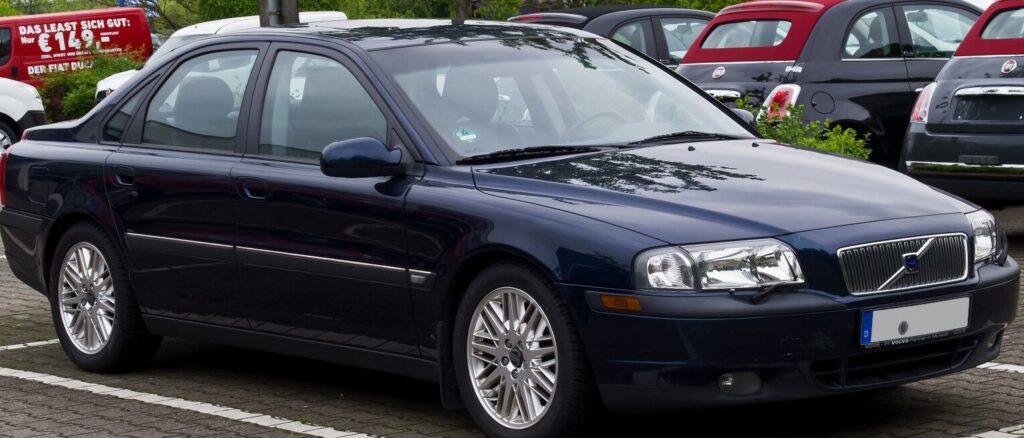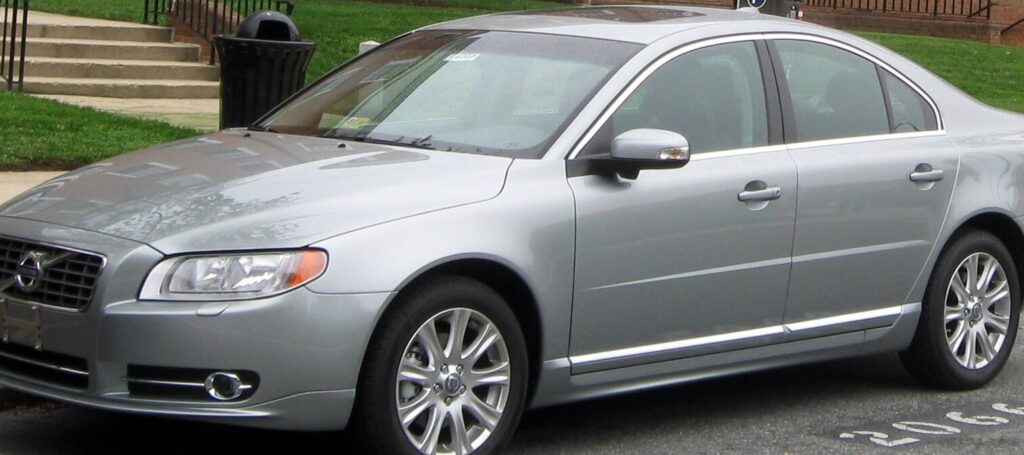
The Volvo S80 II (facelift, 2009) 2.0 F, producing 145 horsepower and designed to run on gasoline or E85 ethanol, represented a specific offering within Volvo’s flagship sedan range. Introduced during the mid-cycle refresh of the second-generation S80 (platform designation P24), this variant was primarily marketed in Europe and other regions where flexible-fuel vehicle (FFV) technology was gaining traction. Production spanned from 2009 to 2010, positioning it as an entry-level to mid-range option within the S80 lineup, appealing to buyers seeking a balance of fuel efficiency and reasonable performance. The 2.0 F aimed to provide a more economical alternative to the higher-displacement, more powerful engines available in the S80 range.
Technical Specifications
| Brand | Volvo |
| Model | S80 |
| Generation | S80 II (facelift 2009) |
| Type (Engine) | 2.0 F (145 Hp) Ethanol |
| Start of production | 2009 |
| End of production | 2010 |
| Powertrain Architecture | Internal Combustion engine |
| Body type | Sedan |
| Seats | 5 |
| Doors | 4 |
| Fuel consumption (urban) | 11.4 l/100 km (20.6 US mpg) |
| Fuel consumption (extra urban) | 6.5 l/100 km (36.2 US mpg) |
| Fuel consumption (combined) | 8.3 l/100 km (28.3 US mpg) |
| CO2 emissions | 199 g/km |
| Fuel Type | Petrol / Ethanol – E85 |
| Acceleration 0 – 100 km/h | 10.9 sec |
| Acceleration 0 – 62 mph | 10.9 sec |
| Acceleration 0 – 60 mph | 10.4 sec |
| Maximum speed | 205 km/h (127.38 mph) |
| Weight-to-power ratio | 11.2 kg/Hp |
| Weight-to-torque ratio | 8.6 kg/Nm |
| Power | 145 Hp @ 6000 rpm |
| Torque | 190 Nm @ 4500 rpm (140.14 lb.-ft. @ 4500 rpm) |
| Engine layout | Front, Transverse |
| Engine Model/Code | B4204S4 |
| Engine displacement | 1999 cm3 (121.99 cu. in.) |
| Number of cylinders | 4 |
| Engine configuration | Inline |
| Piston Stroke | 87.5 mm (3.44 in.) |
| Fuel injection system | Multi-port manifold injection |
| Engine aspiration | Naturally aspirated |
| Engine oil capacity | 4.3 l (4.54 US qt | 3.78 UK qt) |
| Coolant capacity | 7.5 l (7.93 US qt | 6.6 UK qt) |
| Kerb Weight | 1630 kg (3593.53 lbs.) |
| Max. weight | 2160 kg (4761.98 lbs.) |
| Max load | 530 kg (1168.45 lbs.) |
| Trunk (boot) space – minimum | 480 l (16.95 cu. ft.) |
| Fuel tank capacity | 70 l (18.49 US gal | 15.4 UK gal) |
| Length | 4851 mm (190.98 in.) |
| Width | 1861 mm (73.27 in.) |
| Height | 1493 mm (58.78 in.) |
| Wheelbase | 2835 mm (111.61 in.) |
| Front track | 1588 mm (62.52 in.) |
| Rear track | 1585 mm (62.4 in.) |
| Minimum turning circle | 11.7 m (38.39 ft.) |
| Drivetrain Architecture | Front wheel drive |
| Number of gears | 5 |
| Gearbox type | Manual transmission |
| Assisting systems | ABS (Anti-lock braking system) |
| Steering type | Steering rack and pinion |
Powertrain & Engine Architecture
The heart of the S80 2.0 F was the B4204S4 engine, a 1.999-liter (2.0-liter) inline-four cylinder powerplant. This engine belonged to Volvo’s modular engine family, designed for flexibility and adaptability. The B4204S4 featured multi-port fuel injection and a dual overhead camshaft (DOHC) valvetrain. Crucially, it was engineered as a flexible-fuel vehicle (FFV), capable of running on gasoline or a blend of up to 85% ethanol (E85). The engine management system automatically detected the fuel composition and adjusted parameters like ignition timing and fuel injection accordingly. The 5-speed manual transmission was the only transmission option offered with this engine, prioritizing fuel economy over outright performance. The transmission’s gear ratios were tuned for everyday drivability and efficiency, rather than aggressive acceleration.
Driving Characteristics
The 145 horsepower and 190 Nm (140 lb-ft) of torque delivered by the 2.0 F engine provided adequate, but not exhilarating, performance. Acceleration from 0-60 mph took around 10.4 seconds, and top speed was limited to 127 mph. Compared to the more powerful S80 variants, such as the 3.2-liter inline-six or the turbocharged T6, the 2.0 F felt noticeably less responsive. However, the engine’s torque curve was relatively flat, providing decent pulling power in everyday driving situations. The manual transmission allowed for a degree of driver engagement, but the relatively long gear ratios emphasized fuel efficiency over sporty driving. The focus was on providing a comfortable and economical driving experience, making it well-suited for commuting and long-distance journeys.
Equipment & Trim Levels
The S80 2.0 F typically came equipped with a reasonable level of standard features, reflecting its position as an entry-level to mid-range model. Standard equipment generally included air conditioning, power windows and mirrors, a basic audio system, and ABS brakes. Higher trim levels, often denoted by suffixes like “SE” or “Executive,” added features such as leather upholstery, automatic climate control, upgraded audio systems, and parking sensors. Optional extras included a sunroof, navigation system, and premium sound systems. Interior upholstery was typically cloth on the base models, with leather available as an upgrade. The dashboard layout was consistent across the S80 range, featuring a clean and functional design.
Chassis & Braking
The S80 II utilized a MacPherson strut front suspension and a multi-link rear suspension, providing a comfortable ride quality. The 2.0 F variant typically featured smaller diameter wheels and tires compared to the higher-performance models. Braking was handled by disc brakes on the front wheels and drum brakes on the rear wheels, a cost-saving measure common in entry-level trims. Anti-lock Braking System (ABS) was standard. Stabilizer bars were fitted to both the front and rear axles to reduce body roll during cornering, but their thickness was generally less than those found on the more powerful S80 models.
Market Reception & Comparison
The S80 2.0 F was generally well-received as a practical and economical option within the S80 lineup. Critics praised its fuel efficiency, particularly when running on E85, and its comfortable ride. However, some reviewers noted its lack of outright performance compared to the more powerful engine options. Compared to the 3.2-liter S80, the 2.0 F offered significantly better fuel economy but considerably slower acceleration. The 2.0 F’s reliability was generally good, benefiting from Volvo’s reputation for build quality. However, the FFV system added some complexity to the engine, potentially increasing the risk of fuel-related issues over the long term.
Legacy
The Volvo S80 2.0 F (2009-2010) represents a transitional period in Volvo’s history, as the company explored alternative fuel technologies and focused on improving fuel efficiency. While not a performance standout, the 2.0 F offered a compelling combination of practicality, economy, and comfort. On the used car market today, these models are generally affordable and represent a good value for buyers seeking a reliable and fuel-efficient sedan. The B4204S4 engine, while not known for being particularly exciting, has proven to be reasonably durable, and parts availability remains good. The S80 2.0 F serves as a reminder of Volvo’s commitment to innovation and its efforts to reduce the environmental impact of its vehicles.