
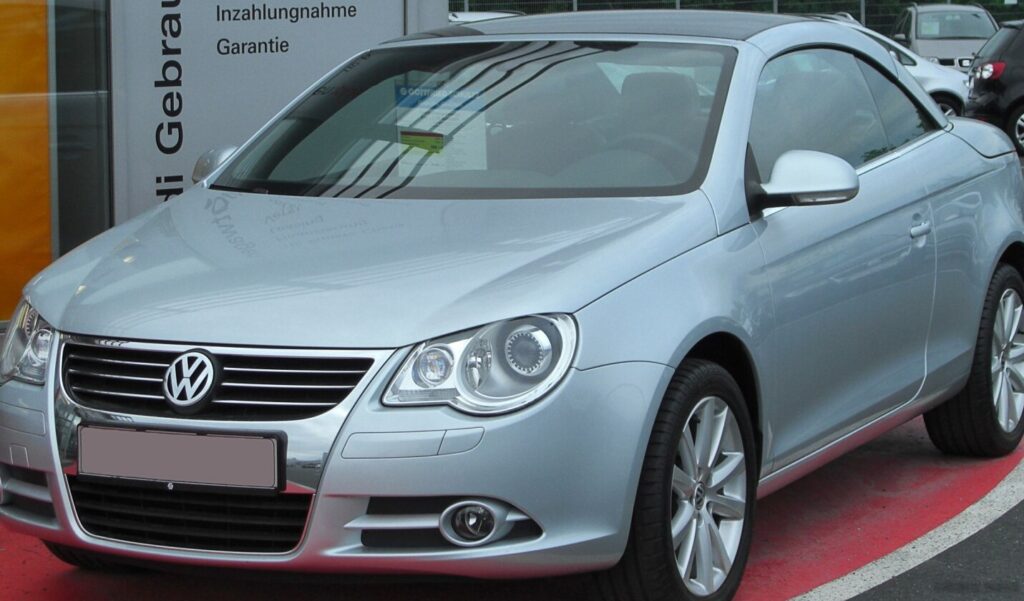
The Volkswagen Eos 1.4 TSI (122 hp) was a front-wheel-drive, two-door coupe-convertible produced between 2007 and 2009. Positioned as a more affordable entry point into the Eos range, it offered a blend of style, practicality, and fuel efficiency. This variant occupied the lower-mid range of the Eos lineup, sitting below the more powerful 2.0 TSI models. It was primarily marketed towards buyers seeking a stylish open-top experience without the higher price tag and performance of its siblings. The Eos itself was built on the Volkswagen Group’s A5 (or 1HX0) platform, shared with the Golf Mk5 and Jetta Mk5.
Technical Specifications
| Brand | Volkswagen |
| Model | Eos |
| Generation | Eos |
| Type (Engine) | 1.4 TSI (122 Hp) |
| Start of production | 2007 |
| End of production | 2009 |
| Powertrain Architecture | Internal Combustion engine |
| Body type | Coupe – Cabriolet |
| Seats | 4 |
| Doors | 2 |
| Fuel consumption (economy) – urban (NEDC) | 8.5 l/100 km (27.7 US mpg, 33.2 UK mpg, 11.8 km/l) |
| Fuel consumption (economy) – extra urban (NEDC) | 5.4 l/100 km (43.6 US mpg, 52.3 UK mpg, 18.5 km/l) |
| Fuel consumption (economy) – combined (NEDC) | 6.5 l/100 km (36.2 US mpg, 43.5 UK mpg, 15.4 km/l) |
| CO2 emissions (NEDC) | 154 g/km |
| Fuel Type | Petrol (Gasoline) |
| Acceleration 0 – 100 km/h | 10.9 sec |
| Acceleration 0 – 62 mph | 10.9 sec |
| Acceleration 0 – 60 mph | 10.4 sec |
| Maximum speed | 196 km/h (121.79 mph) |
| Emission standard | Euro 4 |
| Weight-to-power ratio | 11.4 kg/Hp, 88 Hp/tonne |
| Weight-to-torque ratio | 6.9 kg/Nm, 144.3 Nm/tonne |
| Power | 122 Hp @ 5500 rpm |
| Power per litre | 87.8 Hp/l |
| Torque | 200 Nm @ 1500-4000 rpm (147.51 lb.-ft. @ 1500-4000 rpm) |
| Engine layout | Front, Transverse |
| Engine Model/Code | CAXA |
| Engine displacement | 1390 cm3 (84.82 cu. in.) |
| Number of cylinders | 4 |
| Engine configuration | Inline |
| Cylinder Bore | 76.5 mm (3.01 in.) |
| Piston Stroke | 75.6 mm (2.98 in.) |
| Compression ratio | 10:1 |
| Number of valves per cylinder | 4 |
| Fuel injection system | Direct injection |
| Engine aspiration | Turbocharger, Intercooler |
| Valvetrain | DOHC |
| Engine oil capacity | 3.6 l (3.8 US qt | 3.17 UK qt) |
| Kerb Weight | 1386 kg (3055.61 lbs.) |
| Max. weight | 1930 kg (4254.92 lbs.) |
| Max load | 544 kg (1199.31 lbs.) |
| Trunk (boot) space – minimum | 205 l (7.24 cu. ft.) |
| Trunk (boot) space – maximum | 380 l (13.42 cu. ft.) |
| Fuel tank capacity | 55 l (14.53 US gal | 12.1 UK gal) |
| Permitted trailer load with brakes (8%) | 1600 kg (3527.4 lbs.) |
| Permitted trailer load with brakes (12%) | 1400 kg (3086.47 lbs.) |
| Permitted trailer load without brakes | 750 kg (1653.47 lbs.) |
| Permitted towbar download | 75 kg (165.35 lbs.) |
| Length | 4407 mm (173.5 in.) |
| Width | 1791 mm (70.51 in.) |
| Width including mirrors | 2009 mm (79.09 in.) |
| Height | 1443 mm (56.81 in.) |
| Wheelbase | 2578 mm (101.5 in.) |
| Front track | 1545 mm (60.83 in.) |
| Rear (Back) track | 1553 mm (61.14 in.) |
| Ride height (ground clearance) | 106 mm (4.17 in.) |
| Minimum turning circle (turning diameter) | 10.9 m (35.76 ft.) |
| Approach angle | 14.4° |
| Departure angle | 14.4° |
| Ramp-over (brakeover) angle | 10.7° |
| Drivetrain Architecture | The Internal combustion engine (ICE) drives the front wheels of the vehicle. |
| Drive wheel | Front wheel drive |
| Number of gears and type of gearbox | 6 gears, manual transmission |
| Front suspension | Coil spring, Wishbone, Transverse stabilizer |
| Rear suspension | Independent multi-link suspension, Transverse stabilizer |
| Front brakes | Ventilated discs |
| Rear brakes | Disc |
| Assisting systems | ABS (Anti-lock braking system) |
| Steering type | Steering rack and pinion |
| Power steering | Electric Steering |
| Tires size | 215/55 R16 |
| Wheel rims size | 7J x 16 |
Powertrain & Engine Architecture
The heart of the Eos 1.4 TSI was the CAXA engine code, a 1.4-liter turbocharged inline-four cylinder gasoline engine. This engine utilized direct fuel injection (FSI) and a turbocharger with an intercooler to deliver a respectable 122 horsepower. The engine’s design focused on balancing performance with fuel efficiency. The CAXA engine featured a double overhead camshaft (DOHC) valvetrain with four valves per cylinder, optimizing airflow for improved combustion. The turbocharger provided a boost in power, particularly at lower engine speeds, helping to overcome the limitations of the relatively small displacement. The Eos 1.4 TSI was typically paired with a six-speed manual transmission, although a seven-speed DSG (Direct-Shift Gearbox) dual-clutch automatic was also available as an option. The DSG offered quicker and smoother gear changes compared to a traditional automatic transmission.
Driving Characteristics
The 1.4 TSI engine in the Eos provided adequate performance for everyday driving. Acceleration from 0 to 60 mph took around 10.4 seconds, and the top speed was approximately 122 mph. While not a sports car, the engine offered sufficient power for highway cruising and overtaking maneuvers. The turbocharger provided a noticeable boost in torque, making the car feel responsive in most situations. Compared to the more powerful 2.0 TSI variants, the 1.4 TSI felt less eager to accelerate, but it offered better fuel economy. The six-speed manual transmission allowed for precise control over gear selection, while the optional DSG automatic provided a more relaxed driving experience. The Eos’s suspension was tuned for comfort, providing a smooth ride over most road surfaces. However, it wasn’t as sporty or engaging as some of its competitors.
Equipment & Trim Levels
The Eos 1.4 TSI typically came with a reasonable level of standard equipment. This included air conditioning, power windows, power mirrors, a CD stereo system, and alloy wheels. Higher trim levels offered additional features such as leather upholstery, heated front seats, a sunroof, and a premium sound system. The interior of the Eos was well-designed and comfortable, with a focus on practicality and usability. The dashboard layout was straightforward and easy to navigate. The convertible top was electrically operated and could be lowered or raised in a matter of seconds. Safety features included ABS brakes, traction control, and multiple airbags.
Chassis & Braking
The Eos 1.4 TSI featured a front-wheel-drive chassis with coil spring suspension and a transverse stabilizer bar at the front. The rear suspension was an independent multi-link setup, also with a transverse stabilizer bar. This suspension configuration provided a good balance between comfort and handling. The brakes consisted of ventilated discs at the front and solid discs at the rear. ABS (Anti-lock Braking System) was standard, providing enhanced braking performance in emergency situations. The Eos’s steering was electrically assisted, providing a light and precise feel.
Market Reception & Comparison
The Volkswagen Eos 1.4 TSI was generally well-received by automotive critics. It was praised for its stylish design, comfortable interior, and fuel efficiency. However, some critics noted that the 1.4 TSI engine lacked the punch of the more powerful 2.0 TSI variants. Compared to the 2.0 TSI models, the 1.4 TSI offered better fuel economy but slower acceleration. It was also more affordable, making it an attractive option for buyers on a budget. In terms of reliability, the 1.4 TSI engine was generally considered to be reliable, although some owners have reported issues with the turbocharger and fuel injectors.
Legacy
The Volkswagen Eos 1.4 TSI remains a popular choice in the used car market today. Its combination of style, practicality, and fuel efficiency makes it an appealing option for buyers seeking a stylish convertible. The 1.4 TSI engine is generally reliable, but it’s important to have the car inspected by a qualified mechanic before purchasing. Regular maintenance, including oil changes and tune-ups, is essential to ensure the long-term reliability of the engine. The Eos, while discontinued in 2010, continues to be appreciated for its unique blend of coupe and convertible characteristics, offering a relatively affordable entry point into the world of open-top motoring.
