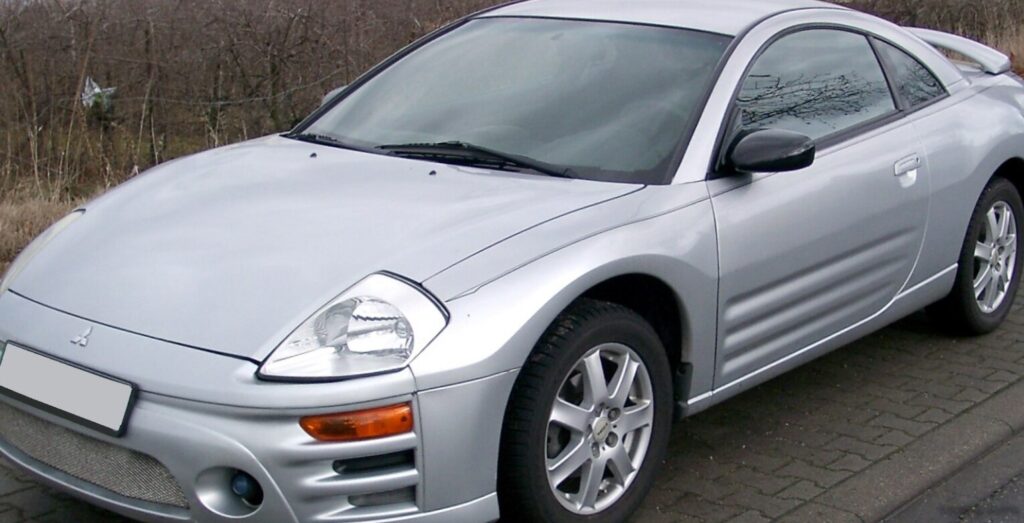
The Mitsubishi Eclipse III (3G), specifically the facelifted version produced from 2003 to 2005, represented a significant evolution for the popular coupe and liftback. This generation, built on the DS platform (shared with the Chrysler Sebring and Dodge Stratus), aimed to blend sporty styling with improved comfort and technology. The 3.0 V6 Automatic variant occupied the top performance tier of the lineup, offering a substantial power upgrade over the base four-cylinder models and the 2.4-liter V6. It was positioned as the premium choice for buyers seeking a powerful and relatively luxurious front-wheel-drive coupe.
Technical Specifications
| Brand | Mitsubishi |
| Model | Eclipse |
| Generation | Eclipse III (3G, facelift 2003) |
| Type (Engine) | 3.0 V6 (200 Hp) Automatic |
| Start of production | 2003 |
| End of production | 2005 |
| Powertrain Architecture | Internal Combustion engine |
| Body type | Coupe, Liftback |
| Seats | 4 |
| Doors | 2 |
| Fuel consumption (urban) | 11.8 l/100 km (19.9 US mpg) |
| Fuel consumption (extra urban) | 8.7 l/100 km (27 US mpg) |
| Fuel Type | Petrol (Gasoline) |
| Weight-to-power ratio | 7.3 kg/Hp |
| Weight-to-torque ratio | 5.2 kg/Nm |
| Power | 200 Hp @ 5500 rpm |
| Power per litre | 67.3 Hp/l |
| Torque | 278 Nm @ 4000 rpm (205.04 lb.-ft. @ 4000 rpm) |
| Maximum engine speed | 6200 rpm |
| Engine layout | Front, Transverse |
| Engine Model/Code | 6G72 |
| Engine displacement | 2972 cm3 (181.36 cu. in.) |
| Number of cylinders | 6 |
| Engine configuration | V-engine |
| Cylinder Bore | 91.1 mm (3.59 in.) |
| Piston Stroke | 76 mm (2.99 in.) |
| Compression ratio | 9:1 |
| Number of valves per cylinder | 4 |
| Fuel injection system | Multi-port manifold injection |
| Engine aspiration | Naturally aspirated engine |
| Valvetrain | SOHC |
| Engine oil capacity | 4.3 l (4.54 US qt | 3.78 UK qt) |
| Coolant capacity | 8 l (8.45 US qt | 7.04 UK qt) |
| Kerb Weight | 1455 kg (3207.73 lbs.) |
| Max. weight | 1820 kg (4012.41 lbs.) |
| Max load | 365 kg (804.69 lbs.) |
| Trunk (boot) space – minimum | 479 l (16.92 cu. ft.) |
| Fuel tank capacity | 62 l (16.38 US gal | 13.64 UK gal) |
| Length | 4490 mm (176.77 in.) |
| Width | 1750 mm (68.9 in.) |
| Height | 1310 mm (51.57 in.) |
| Wheelbase | 2560 mm (100.79 in.) |
| Front track | 1510 mm (59.45 in.) |
| Rear track | 1510 mm (59.45 in.) |
| Ride height (ground clearance) | 150 mm (5.91 in.) |
| Minimum turning circle | 12.2 m (40.03 ft.) |
| Drivetrain Architecture | Front wheel drive |
| Number of gears and type of gearbox | 4 gears, automatic transmission |
| Front suspension | Independent type McPherson, Transverse stabilizer |
| Rear suspension | Independent multi-link suspension, Transverse stabilizer |
| Front brakes | Ventilated discs, 276×26 mm |
| Rear brakes | Disc, 262×10 mm |
| Assisting systems | ABS (Anti-lock braking system) |
| Steering type | Steering rack and pinion |
| Power steering | Hydraulic Steering |
| Tires size | 215/50 R17 |
| Wheel rims size | 6.5J x 17 |
Introduction
The 2003-2005 Mitsubishi Eclipse 3.0 V6 Automatic represented the pinnacle of performance for the third-generation Eclipse. This facelifted version, part of the broader DS platform program, offered a more refined and powerful experience compared to earlier iterations. The Eclipse, historically a competitor to the Honda Prelude, Toyota Celica, and Ford Probe, aimed to deliver a sporty and stylish coupe experience. The 3.0 V6 Automatic trim was specifically targeted at buyers who desired strong acceleration and the convenience of an automatic transmission, without sacrificing the Eclipse’s overall aesthetic appeal.
Powertrain & Engine Architecture
At the heart of the 3.0 V6 Automatic Eclipse lies the 6G72 engine, a 2.972-liter (181.36 cubic inch) naturally aspirated V6. This engine utilizes a single overhead camshaft (SOHC) valvetrain and multi-port fuel injection. The 6G72 is known for its robust construction and relatively simple design, contributing to its reliability. The engine produces 200 horsepower at 5500 rpm and 278 Nm (205.04 lb-ft) of torque at 4000 rpm. The automatic transmission is a conventional four-speed unit, designed to provide smooth shifts and adequate performance for everyday driving. While not a particularly advanced transmission by modern standards, it was well-suited to the engine’s power characteristics. The transmission’s gear ratios were tuned for a balance between acceleration and fuel efficiency, prioritizing comfortable cruising over outright performance.
Driving Characteristics
The 3.0 V6 Automatic Eclipse offered a noticeable performance advantage over the base engine options. Acceleration was brisk, and the V6 provided ample power for merging onto highways and overtaking other vehicles. However, the four-speed automatic transmission did limit the engine’s potential, particularly compared to the available five-speed manual transmission. The automatic’s shift points were programmed for comfort, sometimes resulting in the engine feeling slightly strained during aggressive acceleration. The front-wheel-drive configuration, while common for this class of vehicle, meant that traction could be a limitation, especially under hard acceleration. The suspension, tuned for a balance between comfort and handling, provided a reasonably compliant ride, but didn’t offer the same level of precision as some of its rear-wheel-drive competitors.
Equipment & Trim Levels
The 3.0 V6 Automatic Eclipse typically came well-equipped, reflecting its position as the premium trim level. Standard features often included air conditioning, power windows and locks, a CD player with multiple speakers, and cruise control. Higher-end models could be equipped with optional features such as a sunroof, leather upholstery, upgraded sound systems, and alloy wheels. Interior trim generally featured a combination of cloth and plastic materials, with a focus on durability and ease of maintenance. The dashboard layout was functional and driver-focused, with clearly labeled controls and gauges.
Chassis & Braking
The Eclipse 3G utilized an independent McPherson strut suspension in the front and an independent multi-link suspension in the rear. This setup provided a good balance of ride comfort and handling. The front brakes were ventilated discs, measuring 276x26mm, while the rear brakes were solid discs, measuring 262x10mm. Anti-lock brakes (ABS) were standard, enhancing safety and control during emergency braking situations. The steering system was a rack-and-pinion setup with hydraulic power assist, providing responsive and precise steering feel. Stabilizer bars were included on both the front and rear axles to reduce body roll during cornering.
Market Reception & Comparison
The 3.0 V6 Automatic Eclipse received generally positive reviews from automotive critics. The engine was praised for its smooth power delivery and responsiveness, while the automatic transmission was considered adequate, if not particularly sporty. Fuel economy was typical for a V6-powered coupe of its era, averaging around 19 mpg in the city and 27 mpg on the highway. Compared to the four-cylinder and 2.4-liter V6 models, the 3.0 V6 offered a significant performance upgrade, but at a higher price point. The manual transmission version of the 3.0 V6 was often preferred by enthusiasts for its more engaging driving experience. Reliability was generally good, although some owners reported minor issues with the automatic transmission over time.
Legacy
The Mitsubishi Eclipse 3G, particularly the 3.0 V6 Automatic variant, holds a nostalgic appeal for many enthusiasts. The 6G72 engine is known for its durability and relatively simple maintenance requirements. Today, well-maintained examples of this model are becoming increasingly collectible. While not a high-performance icon, the 3.0 V6 Automatic Eclipse represents a solid and enjoyable coupe from the early 2000s, offering a blend of style, comfort, and respectable performance. The used car market values these vehicles based on condition, mileage, and originality, with lower-mileage, well-preserved examples commanding a premium.