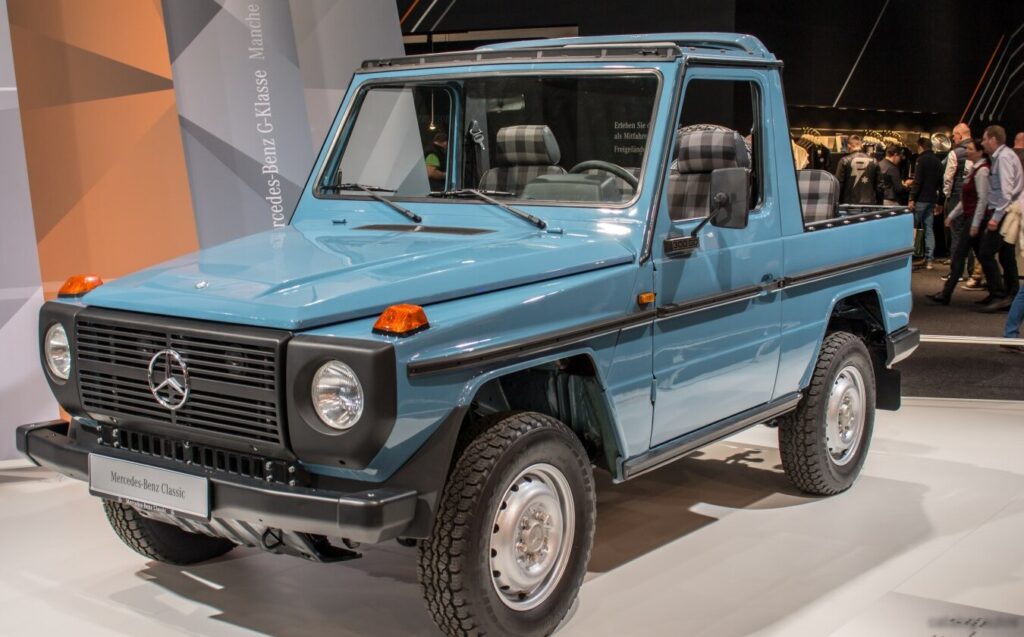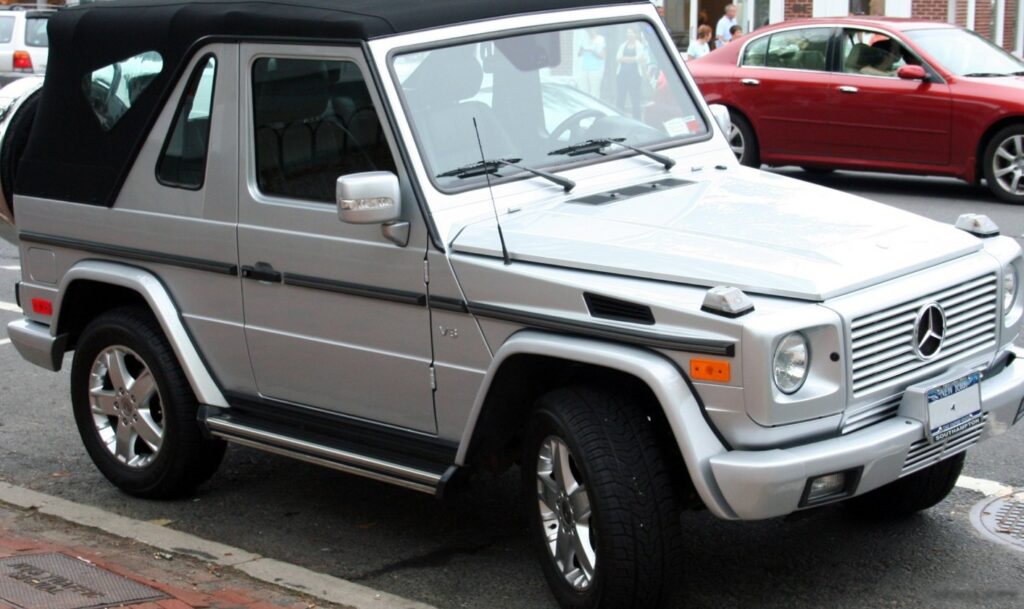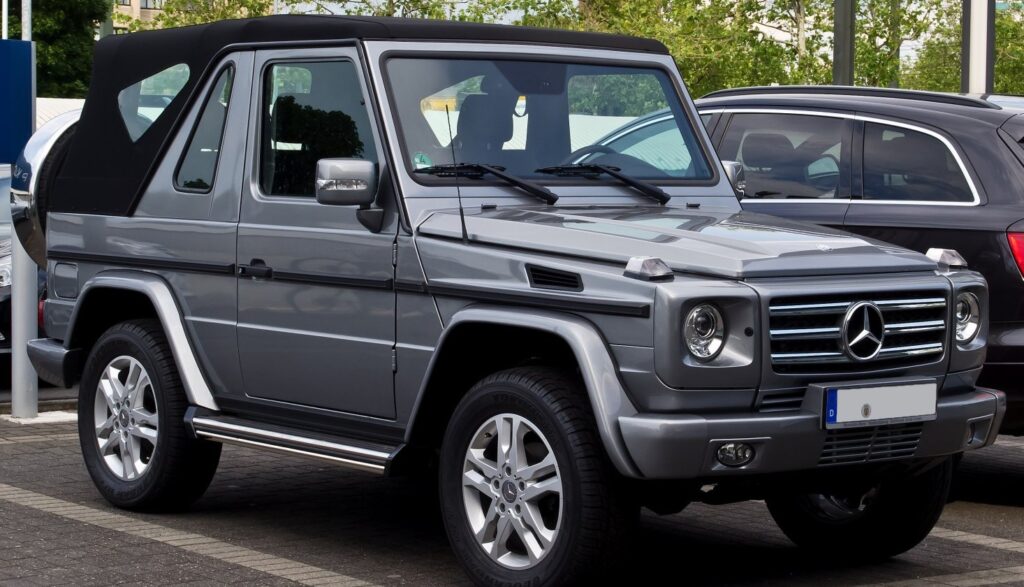
The Mercedes-Benz G 230 4MATIC, produced from September 1993 to July 1994, represents a pivotal point in the evolution of the iconic G-Class (W463). Positioned as the entry-level model within the W463 range, it offered the legendary off-road capability of the G-Class in a more accessible package. This variant aimed to broaden the G-Class’s appeal beyond its traditional military and specialist user base, introducing it to a wider audience seeking a robust and capable vehicle. The G 230 bridged the gap between the more utilitarian early G-Wagens and the increasingly luxurious models that would follow.
Technical Specifications
| Brand | Mercedes-Benz |
| Model | G-Class |
| Generation | G-Class (W463) |
| Type | G 230 (126 Hp) 4MATIC |
| Start of production | September, 1993 |
| End of production | July, 1994 |
| Powertrain Architecture | Internal Combustion engine |
| Body type | Off-road vehicle |
| Seats | 5 |
| Doors | 3 |
| Fuel consumption (urban) | 16.4 l/100 km (14.3 US mpg, 17.2 UK mpg) |
| Fuel consumption (extra urban) | 12.7 l/100 km (18.5 US mpg, 22.2 UK mpg) |
| Fuel Type | Petrol (Gasoline) |
| Acceleration 0 – 100 km/h | 17.7 sec |
| Acceleration 0 – 62 mph | 17.7 sec |
| Acceleration 0 – 60 mph | 16.8 sec |
| Maximum speed | 145 km/h (90.1 mph) |
| Weight-to-power ratio | 16.3 kg/Hp |
| Weight-to-torque ratio | 10.8 kg/Nm |
| Power | 126 Hp @ 5000 rpm |
| Power per litre | 54.8 Hp/l |
| Torque | 190 Nm @ 4000 rpm (140.14 lb.-ft. @ 4000 rpm) |
| Engine layout | Front, Longitudinal |
| Engine Model/Code | M 102.989 |
| Engine displacement | 2298 cm3 (140.23 cu. in.) |
| Number of cylinders | 4 |
| Engine configuration | Inline |
| Cylinder Bore | 95.5 mm (3.76 in.) |
| Piston Stroke | 80.2 mm (3.16 in.) |
| Compression ratio | 9:1 |
| Number of valves per cylinder | 2 |
| Fuel injection system | Multi-port manifold injection |
| Engine aspiration | Naturally aspirated engine |
| Valvetrain | SOHC |
| Engine oil capacity | 6 l (6.34 US qt | 5.28 UK qt) |
| Coolant capacity | 5 l (5.28 US qt | 4.4 UK qt) |
| Kerb Weight | 2060 kg (4541.52 lbs.) |
| Max. weight | 2620 kg (5776.11 lbs.) |
| Max load | 560 kg (1234.59 lbs.) |
| Fuel tank capacity | 96 l (25.36 US gal | 21.12 UK gal) |
| Length | 4185 mm (164.76 in.) |
| Width | 1690 mm (66.54 in.) |
| Height | 1908 mm (75.12 in.) |
| Wheelbase | 2400 mm (94.49 in.) |
| Front track | 1425 mm (56.1 in.) |
| Rear track | 1425 mm (56.1 in.) |
| Drivetrain Architecture | All wheel drive (4×4) |
| Number of gears | 5 |
| Gearbox type | Manual transmission |
| Front suspension | Coil spring, Rigid axle suspension, Trailing arm |
| Rear suspension | Rigid axle suspension, Trailing arm, Coil spring |
| Front brakes | Disc |
| Rear brakes | Drum |
| Assisting systems | ABS (Anti-lock braking system) |
| Steering type | Cone worm with recirculation balls |
| Power steering | Hydraulic Steering |
| Tires size | 205/80 R16 |
| Wheel rims size | 6J x 16 |
Introduction
The G 230 4MATIC, introduced in 1993, marked a significant shift for the G-Class. Prior to this, the G-Wagen had largely maintained its rugged, utilitarian character, appealing to a niche market. The G 230 aimed to broaden that appeal by offering a more affordable and accessible entry point into the G-Class lineup. It utilized the W463 chassis, which represented a substantial modernization over previous generations, incorporating improvements in comfort, refinement, and safety. The G 230 was intended to attract buyers who desired the G-Class’s iconic styling and off-road prowess but didn’t require the higher performance or luxury features of the G 320 or G 500 models.
Powertrain & Engine Architecture
The heart of the G 230 is the M 102.989, a 2.3-liter inline-four cylinder gasoline engine. This engine, a descendant of the well-regarded M102 family, featured a single overhead camshaft (SOHC) valvetrain and multi-port fuel injection. While not a powerhouse, the M 102.989 was known for its durability and relatively smooth operation. The engine produced 126 horsepower at 5000 rpm and 190 Nm (140 lb-ft) of torque at 4000 rpm. The G 230 was exclusively offered with a five-speed manual transmission, which was chosen to maximize fuel efficiency and provide a more engaging driving experience. The engine is longitudinally mounted, driving all four wheels through a robust four-wheel-drive system.
Driving Characteristics
The G 230’s driving experience is defined by its ruggedness and capability rather than outright speed. Acceleration is leisurely, taking approximately 17.7 seconds to reach 100 km/h (62 mph). The 2.3-liter engine provides adequate power for everyday driving, but it requires frequent downshifting, especially when tackling steep inclines or carrying a load. The manual transmission, while offering greater control, demands more driver involvement than the automatic transmissions found in some other G-Class variants. The G 230’s strength lies in its off-road performance. Its permanent four-wheel drive system, coupled with a low-range transfer case, allows it to conquer challenging terrain with ease. The relatively light weight (compared to other W463 models) contributes to its agility in off-road situations.
Equipment & Trim Levels
The G 230 was typically equipped with a relatively basic level of trim, reflecting its position as the entry-level model. Standard features included cloth upholstery, steel wheels, and a simple dashboard layout. Air conditioning and power windows were often optional extras. The interior prioritized functionality and durability over luxury. However, even in its base form, the G 230 offered a level of robustness and build quality that was characteristic of Mercedes-Benz. Optional extras could include a sunroof, upgraded audio system, and various off-road accessories.
Chassis & Braking
The G 230 utilizes a robust ladder-frame chassis, a hallmark of the G-Class design. The suspension consists of coil springs and rigid axles with trailing arms, providing excellent articulation and off-road capability. Front brakes are discs, while rear brakes are drums. An anti-lock braking system (ABS) was standard, enhancing safety on paved roads. The steering is a recirculating ball system, providing a direct and tactile feel. The G 230’s suspension is tuned for off-road performance, resulting in a firm ride on paved surfaces.
Market Reception & Comparison
The G 230 was generally well-received by critics as a more accessible and affordable G-Class. It was praised for its off-road capability and durability, but some reviewers noted its lack of power and relatively basic interior. Compared to the G 320, which featured a larger and more powerful inline-six engine, the G 230 offered significantly less performance. However, the G 230 was more fuel-efficient and less expensive to maintain. Compared to the later G 280, the G 230 offered a slightly simpler and more robust powertrain. The G 230 appealed to buyers who prioritized off-road capability and reliability over outright performance and luxury.
Legacy
The G 230 4MATIC, despite its short production run, holds a special place in G-Class history. It represents a crucial step in the model’s evolution, broadening its appeal and paving the way for the G-Class’s eventual success as a luxury off-road vehicle. The M 102 engine, while not known for its high output, is regarded as a durable and reliable unit. Today, well-maintained G 230s are sought after by collectors and enthusiasts who appreciate their simplicity, ruggedness, and iconic styling. Finding parts can be challenging, but the G 230’s robust construction ensures that many examples remain on the road, continuing to embody the spirit of the original G-Wagen.