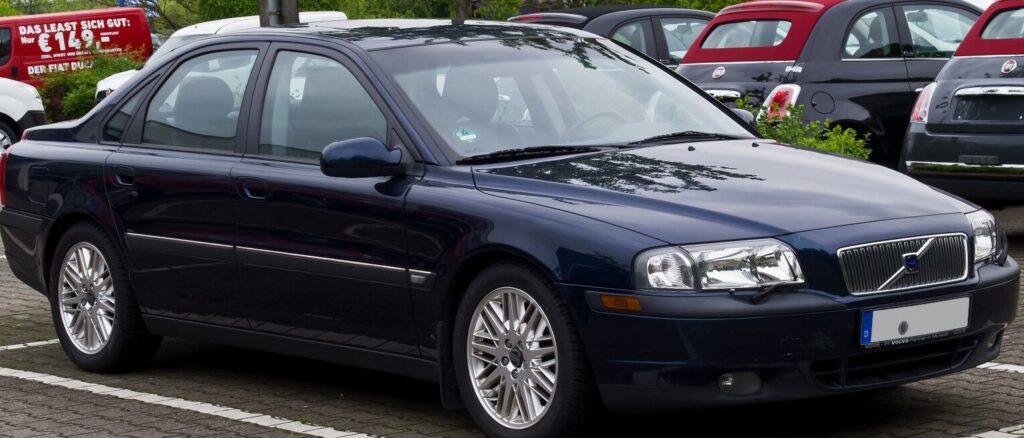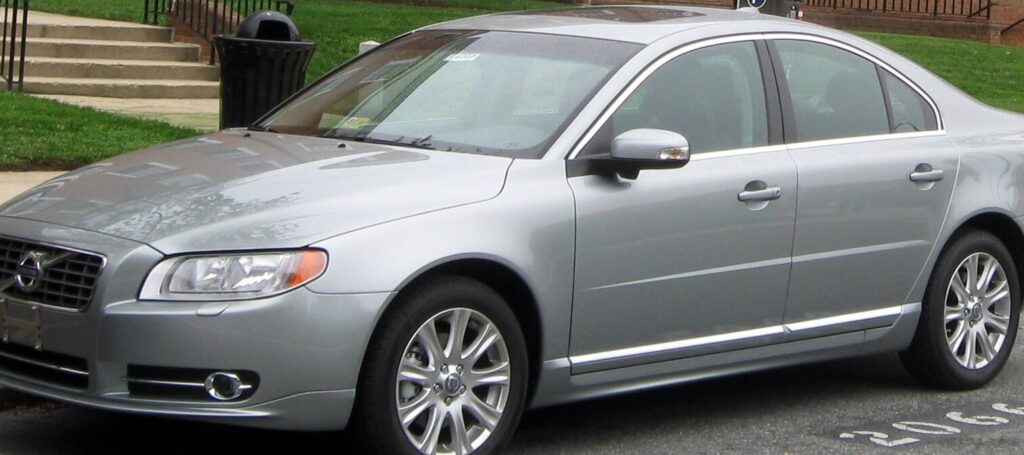
The Volvo S80 II (facelift, 2009) 2.4 D, producing 175 horsepower, represents a significant iteration of Volvo’s flagship sedan. Introduced as part of a mid-cycle refresh for the second-generation S80 (platform designation P24), this variant was marketed from 2009 to 2011. It aimed to balance fuel efficiency with respectable performance, appealing to buyers seeking a comfortable and refined executive car with lower running costs. Positioned as a mid-range offering within the S80 lineup, it sat below the more powerful gasoline engines and above the base-level diesel options.
Technical Specifications
| Brand | Volvo |
| Model | S80 |
| Generation | S80 II (facelift 2009) |
| Type (Engine) | 2.4 D (175 Hp) |
| Start of production | 2009 |
| End of production | 2011 |
| Powertrain Architecture | Internal Combustion engine |
| Body type | Sedan |
| Seats | 5 |
| Doors | 4 |
| Fuel consumption (urban) | 7.9 l/100 km (29.8 US mpg, 35.8 UK mpg, 12.7 km/l) |
| Fuel consumption (extra urban) | 4.7 l/100 km (50 US mpg, 60.1 UK mpg, 21.3 km/l) |
| Fuel consumption (combined) | 5.9 l/100 km (39.9 US mpg, 47.9 UK mpg, 16.9 km/l) |
| CO2 emissions | 155 g/km |
| Fuel Type | Diesel |
| Acceleration 0 – 100 km/h | 8.9 sec |
| Acceleration 0 – 62 mph | 8.9 sec |
| Acceleration 0 – 60 mph | 8.5 sec |
| Weight-to-power ratio | 9.4 kg/Hp, 106.3 Hp/tonne |
| Weight-to-torque ratio | 3.9 kg/Nm, 255 Nm/tonne |
| Power | 175 Hp @ 4000 rpm |
| Power per litre | 72.9 Hp/l |
| Torque | 420 Nm @ 1500-2750 rpm (309.78 lb.-ft. @ 1500-2750 rpm) |
| Engine layout | Front, Transverse |
| Engine Model/Code | D5244T14 |
| Engine displacement | 2400 cm3 (146.46 cu. in.) |
| Number of cylinders | 5 |
| Engine configuration | Inline |
| Piston Stroke | 81 mm (3.19 in.) |
| Fuel injection system | Diesel Commonrail |
| Engine aspiration | Turbocharger, Intercooler |
| Engine oil capacity | 6 l (6.34 US qt | 5.28 UK qt) |
| Coolant | 12.6 l (13.31 US qt | 11.09 UK qt) |
| Kerb Weight | 1647 kg (3631.01 lbs.) |
| Max. weight | 2200 kg (4850.17 lbs.) |
| Max load | 553 kg (1219.16 lbs.) |
| Trunk (boot) space – minimum | 480 l (16.95 cu. ft.) |
| Fuel tank capacity | 70 l (18.49 US gal | 15.4 UK gal) |
| Length | 4851 mm (190.98 in.) |
| Width | 1861 mm (73.27 in.) |
| Height | 1493 mm (58.78 in.) |
| Wheelbase | 2835 mm (111.61 in.) |
| Front track | 1588 mm (62.52 in.) |
| Rear (Back) track | 1585 mm (62.4 in.) |
| Minimum turning circle | 11.7 m (38.39 ft.) |
| Drivetrain Architecture | The Internal combustion engine (ICE) drives the front wheels of the vehicle. |
| Drive wheel | Front wheel drive |
| Number of gears and type of gearbox | 6 gears, manual transmission |
| Assisting systems | ABS (Anti-lock braking system) |
| Steering type | Steering rack and pinion |
Powertrain & Engine Architecture
The heart of the S80 2.4 D is the Volvo D5244T14 engine, a 2.4-liter inline-five cylinder diesel. This engine is a direct descendant of Volvo’s long-running diesel family, known for its robustness and relatively simple design. The ‘D5244T14’ designation indicates a turbocharged engine with common-rail direct fuel injection. The common-rail system, supplied by Bosch, allows for precise control of fuel delivery, optimizing combustion efficiency and reducing emissions. The turbocharger, coupled with an intercooler, provides increased air intake, boosting power output. The engine utilizes a single overhead camshaft (SOHC) valvetrain, operating four valves per cylinder. This configuration strikes a balance between performance and mechanical complexity. The 6-speed manual transmission was standard, offering a good spread of ratios for both fuel economy and acceleration.
Driving Characteristics
The 175 horsepower and 309 lb-ft of torque delivered by the 2.4 D engine provided adequate, though not exhilarating, performance. Acceleration from 0-60 mph took approximately 8.5 seconds, making it competitive with other mid-size executive diesels of the time. The engine’s peak torque, available from a low 1500 rpm, meant that the S80 felt responsive in everyday driving situations, offering good pulling power for overtaking and highway cruising. Compared to the higher-output gasoline versions of the S80, the 2.4 D prioritized fuel economy over outright speed. The manual transmission, while offering driver engagement, had relatively long throws. The gear ratios were tuned for efficiency, with a taller final drive contributing to lower fuel consumption at highway speeds. The 2.4 D offered a more economical and practical alternative to the more powerful, but less fuel-efficient, gasoline engines.
Equipment & Trim Levels
The 2.4 D trim of the S80 II (2009 facelift) typically included a generous level of standard equipment. This included automatic climate control, power windows and mirrors, a leather-wrapped steering wheel, and a basic audio system with CD player. Safety features were a Volvo hallmark, and the 2.4 D came standard with ABS brakes, traction control, and a suite of airbags. Optional extras included a premium audio system, leather upholstery, sunroof, navigation system, and parking sensors. Interior upholstery was typically cloth, though leather was available as an upgrade. The dashboard layout was clean and functional, with a focus on ergonomics. Trim levels varied slightly depending on the market, but the 2.4 D generally represented a well-equipped mid-range offering.
Chassis & Braking
The S80 II utilized a MacPherson strut front suspension and a multi-link independent rear suspension. This setup provided a comfortable ride quality, absorbing bumps and imperfections in the road effectively. The 2.4 D variant, being a lower-weight model compared to the larger-engined versions, benefited from slightly more agile handling. Front disc brakes were standard, while the rear brakes were typically drums on the base models, with discs available as an upgrade. The steering was a rack-and-pinion system, providing precise and responsive control. Stabilizer bars were fitted to both the front and rear axles to reduce body roll during cornering. The suspension tuning prioritized comfort over sporty handling, reflecting the S80’s role as a luxury sedan.
Market Reception & Comparison
The Volvo S80 2.4 D (175 hp) was generally well-received by automotive critics as a practical and efficient executive car. It was praised for its comfortable ride, spacious interior, and strong safety credentials. However, some reviewers noted that the engine lacked the refinement and performance of some of its competitors, particularly the German brands. Fuel economy was a strong point, with the 2.4 D achieving around 40 mpg on the combined cycle. Compared to the higher-output gasoline versions of the S80, the 2.4 D offered significantly better fuel economy, but at the expense of performance. Compared to other diesel-powered executive cars, such as the BMW 5 Series and Audi A6, the S80 2.4 D offered a competitive package, particularly in terms of value for money.
Legacy
The D5244T14 engine, found in the S80 2.4 D, has proven to be a relatively reliable powertrain. With proper maintenance, these engines can accumulate high mileage without major issues. Common issues include turbocharger wear and potential problems with the fuel injectors. However, these are generally addressable with routine servicing. On the used car market, the S80 2.4 D represents a good value proposition, offering a comfortable and well-equipped executive car at an affordable price. Its fuel efficiency and relatively low running costs make it an attractive option for buyers seeking a practical and reliable sedan. The S80 2.4 D remains a testament to Volvo’s commitment to safety, comfort, and durability.