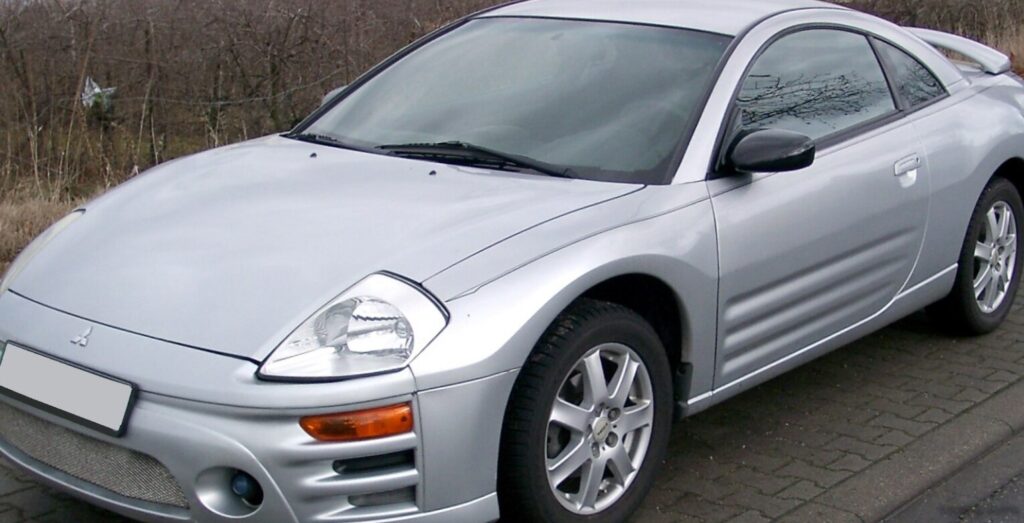
The Mitsubishi Eclipse III (3G), specifically the facelifted version produced from 2003 to 2005, represented a significant evolution for the popular sports coupe. This generation, built on the DS platform (shared with the Chrysler Sebring and Dodge Stratus), aimed to blend sporty styling with improved comfort and technology. The 3.0 V6 variant, producing 210 horsepower, occupied the top performance tier of the Eclipse lineup during these years, offering a more potent alternative to the base 2.4-liter four-cylinder models. It was primarily marketed towards enthusiasts seeking a stylish and relatively affordable performance coupe.
Technical Specifications
| Brand | Mitsubishi |
| Model | Eclipse |
| Generation | Eclipse III (3G, facelift 2003) |
| Type (Engine) | 3.0 V6 (210 Hp) |
| Start of production | 2003 |
| End of production | 2005 |
| Powertrain Architecture | Internal Combustion engine |
| Body type | Coupe, Liftback |
| Seats | 4 |
| Doors | 2 |
| Fuel consumption (urban) | 11.2 l/100 km (21 US mpg) |
| Fuel consumption (extra urban) | 8.4 l/100 km (28 US mpg) |
| Fuel Type | Petrol (Gasoline) |
| Weight-to-power ratio | 7 kg/Hp |
| Weight-to-torque ratio | 5.3 kg/Nm |
| Power | 210 Hp @ 5750 rpm |
| Power per litre | 70.7 Hp/l |
| Torque | 278 Nm @ 3750 rpm (205.04 lb.-ft. @ 3750 rpm) |
| Maximum engine speed | 6200 rpm |
| Engine layout | Front, Transverse |
| Engine Model/Code | 6G72 |
| Engine displacement | 2972 cm3 (181.36 cu. in.) |
| Number of cylinders | 6 |
| Engine configuration | V-engine |
| Cylinder Bore | 91.1 mm (3.59 in.) |
| Piston Stroke | 76 mm (2.99 in.) |
| Compression ratio | 10:1 |
| Number of valves per cylinder | 4 |
| Fuel injection system | Multi-port manifold injection |
| Engine aspiration | Naturally aspirated engine |
| Valvetrain | SOHC |
| Engine oil capacity | 4.3 l (4.54 US qt | 3.78 UK qt) |
| Coolant | 8 l (8.45 US qt | 7.04 UK qt) |
| Kerb Weight | 1470 kg (3240.8 lbs.) |
| Max. weight | 1820 kg (4012.41 lbs.) |
| Max load | 350 kg (771.62 lbs.) |
| Trunk (boot) space – minimum | 479 l (16.92 cu. ft.) |
| Fuel tank capacity | 62 l (16.38 US gal | 13.64 UK gal) |
| Length | 4490 mm (176.77 in.) |
| Width | 1750 mm (68.9 in.) |
| Height | 1310 mm (51.57 in.) |
| Wheelbase | 2560 mm (100.79 in.) |
| Front track | 1510 mm (59.45 in.) |
| Rear (Back) track | 1510 mm (59.45 in.) |
| Ride height (ground clearance) | 150 mm (5.91 in.) |
| Minimum turning circle (turning diameter) | 12.2 m (40.03 ft.) |
| Drivetrain Architecture | Front wheel drive |
| Drive wheel | Front wheel drive |
| Number of gears and type of gearbox | 5 gears, manual transmission |
| Front suspension | Independent type McPherson, Transverse stabilizer |
| Rear suspension | Independent multi-link suspension, Transverse stabilizer |
| Front brakes | Ventilated discs, 276×26 mm |
| Rear brakes | Disc, 262×10 mm |
| Assisting systems | ABS (Anti-lock braking system) |
| Steering type | Steering rack and pinion |
| Power steering | Hydraulic Steering |
| Tires size | 215/50 R17 |
| Wheel rims size | 6.5J x 17 |
INTRODUCTION
The 2003-2005 Mitsubishi Eclipse 3.0 V6 facelift represented the culmination of the third-generation Eclipse design. Building upon the 1999 redesign (the 3G), the facelift brought subtle styling updates and refinements. This model year saw the continuation of the coupe and liftback body styles, offering buyers a choice depending on their preference for practicality or a more traditional sporty look. The 3.0 V6 was positioned as the performance leader within the range, appealing to drivers who desired more power than the standard 2.4-liter engine offered. It competed with other sporty coupes like the Honda Prelude, Nissan 240SX (though the 240SX was discontinued in the US in 1998), and the Ford Probe.
Powertrain & Engine Architecture
At the heart of the Eclipse 3.0 V6 lies the 6G72 engine, a 2.972-liter (181.36 cubic inches) naturally aspirated V6. This engine is a 60-degree V-engine, known for its relatively smooth operation. The 6G72 utilizes a single overhead camshaft (SOHC) valvetrain with four valves per cylinder. Fuel delivery is managed by a multi-port fuel injection system, providing precise fuel metering for optimal performance and efficiency. The engine produces 210 horsepower at 5750 rpm and 278 Nm (205.04 lb-ft) of torque at 3750 rpm. The engine’s design prioritized a balance between power and reliability, making it a durable and relatively easy-to-maintain unit. The 5-speed manual transmission was the standard pairing for this engine, offering drivers full control over the power delivery.
Driving Characteristics
The 3.0 V6 Eclipse offered a noticeable performance upgrade over the four-cylinder models. Acceleration was brisk, and the engine provided ample power for both everyday driving and spirited performance. The manual transmission allowed for precise gear changes, enhancing the driving experience. While not a track-focused machine, the 3.0 V6 provided a satisfying level of performance for its price point. The front-wheel-drive configuration, while common for this class of vehicle, could exhibit some torque steer under hard acceleration. The suspension, tuned for a balance between comfort and handling, provided a reasonably controlled ride, although it wasn’t as firm or precise as some dedicated sports cars.
Equipment & Trim Levels
The 3.0 V6 Eclipse typically came with a more comprehensive list of standard features than the base models. These often included air conditioning, power windows and locks, a CD player, and alloy wheels. Higher trim levels, such as the GT, added features like a premium sound system, leather upholstery, and a sunroof. Optional extras included a rear spoiler, upgraded audio systems, and various cosmetic enhancements. The interior design was generally functional and driver-focused, with a clear instrument cluster and well-placed controls. The liftback configuration offered increased cargo space compared to the coupe, adding to its practicality.
Chassis & Braking
The Eclipse 3.0 V6 utilized an independent McPherson strut suspension in the front and an independent multi-link suspension in the rear. This setup provided a good balance of ride comfort and handling. Front brakes were ventilated discs measuring 276x26mm, while the rear brakes were solid discs measuring 262x10mm. Anti-lock brakes (ABS) were standard, enhancing safety by preventing wheel lockup during hard braking. The chassis was designed to provide a reasonable level of rigidity, contributing to the car’s handling characteristics. A transverse stabilizer bar was included on both the front and rear suspension to reduce body roll during cornering.
Market Reception & Comparison
The 2003-2005 Mitsubishi Eclipse 3.0 V6 was generally well-received by automotive critics. It was praised for its stylish design, strong engine performance, and relatively affordable price. However, some reviewers noted the front-wheel-drive configuration as a limitation, and the interior quality was sometimes criticized for not being as refined as some competitors. Compared to the base 2.4-liter models, the 3.0 V6 offered a significant performance boost, but it also came with a higher price tag and slightly lower fuel economy. Against rivals like the Honda Prelude, the Eclipse offered a more aggressive styling and a slightly more affordable price point, while the Prelude was often lauded for its superior handling.
Legacy
The Mitsubishi Eclipse 3.0 V6 has developed a modest following among enthusiasts. The 6G72 engine is known for its durability and relatively simple maintenance requirements. While not without its flaws, the engine has proven to be reliable over the long term. Today, well-maintained examples of the 2003-2005 Eclipse 3.0 V6 can be found on the used car market at relatively affordable prices. These cars appeal to buyers seeking a stylish and reasonably powerful coupe with a touch of nostalgia. Parts availability is generally good, although some specific trim pieces may become increasingly difficult to find. The Eclipse 3.0 V6 remains a reminder of a time when Mitsubishi offered a compelling range of sporty and affordable vehicles.