
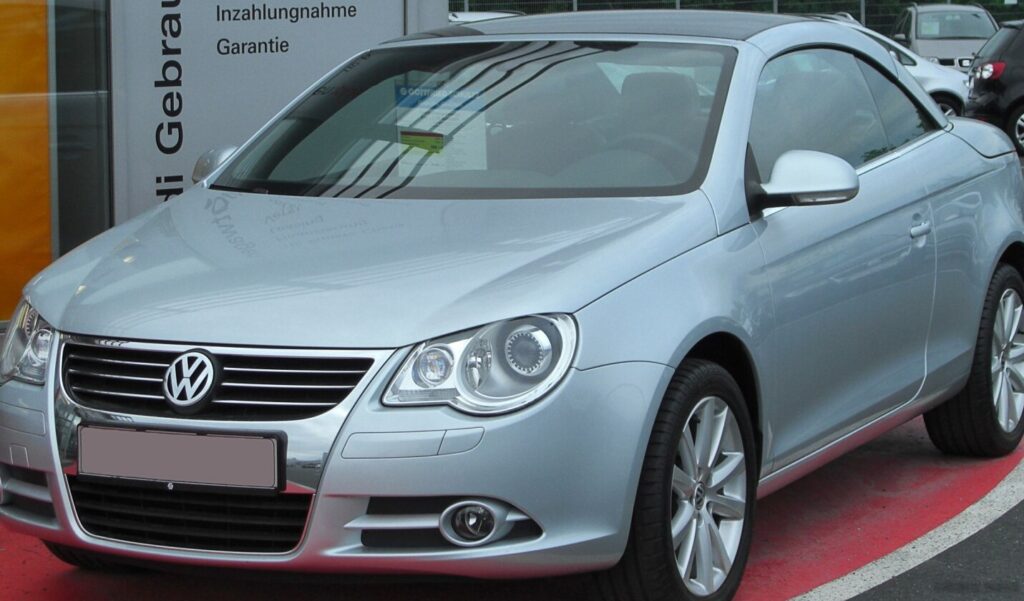
The Volkswagen Eos 1.4 TSI (160 hp) was a front-wheel-drive, two-door coupe-convertible produced between 2008 and 2009. Positioned as a mid-range offering within the Eos lineup, it aimed to provide a balance between performance, fuel efficiency, and affordability. The Eos itself was Volkswagen’s entry into the premium compact convertible market, sharing its platform – the A5 (or 1HX0 internally) – with the Golf Mk5 and Jetta Mk5. This variant, powered by the 1.4 TSI engine, represented a key step in Volkswagen’s adoption of turbocharged, direct-injection technology for improved efficiency and drivability.
| Brand | Volkswagen |
| Model | Eos |
| Generation | Eos |
| Type (Engine) | 1.4 TSI (160 Hp) |
| Start of production | 2008 |
| End of production | 2009 |
| Powertrain Architecture | Internal Combustion engine |
| Body type | Coupe – Cabriolet |
| Seats | 4 |
| Doors | 2 |
| Fuel consumption (economy) – urban (NEDC) | 8.5 l/100 km (27.7 US mpg, 33.2 UK mpg, 11.8 km/l) |
| Fuel consumption (economy) – extra urban (NEDC) | 5.6 l/100 km (42 US mpg, 50.4 UK mpg, 17.9 km/l) |
| Fuel consumption (economy) – combined (NEDC) | 6.7 l/100 km (35.1 US mpg, 42.2 UK mpg, 14.9 km/l) |
| CO2 emissions (NEDC) | 159 g/km |
| Fuel Type | Petrol (Gasoline) |
| Acceleration 0 – 100 km/h | 8.8 sec |
| Acceleration 0 – 62 mph | 8.8 sec |
| Acceleration 0 – 60 mph | 8.4 sec |
| Maximum speed | 215 km/h (133.59 mph) |
| Emission standard | Euro 4 |
| Weight-to-power ratio | 8.8 kg/Hp, 113.3 Hp/tonne |
| Weight-to-torque ratio | 5.9 kg/Nm, 170 Nm/tonne |
| Power | 160 Hp @ 5800 rpm |
| Power per litre | 115.1 Hp/l |
| Torque | 240 Nm @ 1500-4500 rpm (177.01 lb.-ft. @ 1500-4500 rpm) |
| Engine layout | Front, Transverse |
| Engine Model/Code | CAVD |
| Engine displacement | 1390 cm3 (84.82 cu. in.) |
| Number of cylinders | 4 |
| Engine configuration | Inline |
| Cylinder Bore | 76.5 mm (3.01 in.) |
| Piston Stroke | 75.6 mm (2.98 in.) |
| Compression ratio | 10:1 |
| Number of valves per cylinder | 4 |
| Fuel injection system | Direct injection |
| Engine aspiration | Turbocharging and Supercharger, Intercooler |
| Valvetrain | DOHC |
| Engine oil capacity | 3.6 l (3.8 US qt | 3.17 UK qt) |
| Coolant | 5.6 l (5.92 US qt | 4.93 UK qt) |
| Kerb Weight | 1412 kg (3112.93 lbs.) |
| Max. weight | 1980 kg (4365.15 lbs.) |
| Max load | 568 kg (1252.23 lbs.) |
| Trunk (boot) space – minimum | 205 l (7.24 cu. ft.) |
| Trunk (boot) space – maximum | 380 l (13.42 cu. ft.) |
| Fuel tank capacity | 55 l (14.53 US gal | 12.1 UK gal) |
| Permitted trailer load with brakes (8%) | 1600 kg (3527.4 lbs.) |
| Permitted trailer load with brakes (12%) | 1400 kg (3086.47 lbs.) |
| Permitted trailer load without brakes | 750 kg (1653.47 lbs.) |
| Permitted towbar download | 75 kg (165.35 lbs.) |
| Length | 4407 mm (173.5 in.) |
| Width | 1791 mm (70.51 in.) |
| Width including mirrors | 2009 mm (79.09 in.) |
| Height | 1443 mm (56.81 in.) |
| Wheelbase | 2578 mm (101.5 in.) |
| Front track | 1545 mm (60.83 in.) |
| Rear (Back) track | 1553 mm (61.14 in.) |
| Ride height (ground clearance) | 106 mm (4.17 in.) |
| Minimum turning circle (turning diameter) | 10.9 m (35.76 ft.) |
| Front suspension | Coil spring, Wishbone, Transverse stabilizer |
| Rear suspension | Independent multi-link suspension, Transverse stabilizer |
| Front brakes | Ventilated discs |
| Rear brakes | Disc |
| Assisting systems | ABS (Anti-lock braking system) |
| Steering type | Steering rack and pinion |
| Power steering | Electric Steering |
| Tires size | 215/55 R16 |
| Wheel rims size | 7J x 16 |
Powertrain & Engine Architecture
The heart of the Eos 1.4 TSI was the CAVD engine code, a 1.4-liter inline-four cylinder powerplant. What set this engine apart was its innovative combination of a turbocharger and a supercharger – a configuration Volkswagen termed “Twincharger.” At lower engine speeds, the mechanically driven supercharger provided instant boost, eliminating turbo lag. As engine speed increased, the exhaust gas-driven turbocharger took over, delivering sustained power. This dual-charging system, coupled with direct fuel injection, resulted in a surprisingly responsive engine for its size. The engine featured a double overhead camshaft (DOHC) valvetrain with four valves per cylinder, optimizing gas flow. The engine’s 10:1 compression ratio was a balance between efficiency and performance. The engine was transversely mounted, driving the front wheels.
Driving Characteristics
The 160 hp and 177 lb-ft of torque delivered by the 1.4 TSI engine, when paired with a six-speed automatic transmission, provided adequate, though not exhilarating, performance. Acceleration from 0-60 mph took around 8.4 seconds, and top speed was rated at 133.59 mph. The automatic transmission, while offering convenience, wasn’t known for its sportiness. Gear changes were generally smooth, but could feel somewhat hesitant during quick acceleration. Compared to the more powerful 2.0 TSI variants, the 1.4 TSI felt noticeably less potent, particularly when fully loaded or tackling steep inclines. However, the broad torque curve meant that the engine felt flexible and usable in everyday driving situations. The Twincharger system did a good job of masking the smaller displacement, providing a reasonably punchy feel.
Equipment & Trim Levels
The 1.4 TSI Eos typically came with a respectable level of standard equipment. This included air conditioning, power windows and locks, a CD stereo system, and alloy wheels. Safety features such as ABS, traction control, and multiple airbags were also standard. Higher trim levels offered options like leather upholstery, heated front seats, a sunroof (in addition to the convertible top), and a premium sound system. The interior design was generally clean and functional, reflecting Volkswagen’s typically understated aesthetic. The dashboard layout was straightforward, with logically placed controls. Upholstery was typically cloth, with leather available as an upgrade.
Chassis & Braking
The Eos 1.4 TSI utilized a MacPherson strut front suspension and a multi-link rear suspension, providing a comfortable and controlled ride. A transverse stabilizer bar was fitted to both the front and rear axles to reduce body roll during cornering. The braking system consisted of ventilated discs at the front and solid discs at the rear, providing adequate stopping power for the vehicle’s weight and performance. The electric power steering offered a light and precise feel, making it easy to maneuver in urban environments.
Market Reception & Comparison
The Eos 1.4 TSI was generally well-received by automotive critics as a sensible and fuel-efficient option within the convertible market. Its fuel economy – around 35.1 US mpg combined – was a significant selling point, particularly in Europe where fuel prices were higher. However, some reviewers found the performance to be somewhat underwhelming, especially compared to more powerful competitors. Compared to the 2.0 TSI Eos, the 1.4 TSI offered a lower price point and better fuel economy, but at the expense of performance. The 1.4 TSI appealed to buyers who prioritized efficiency and affordability over outright speed.
Legacy
The 1.4 TSI engine proved to be a relatively reliable unit, although the Twincharger system did require careful maintenance. The supercharger component, in particular, was known to be a potential point of failure if not properly serviced. Today, the Eos 1.4 TSI can be found on the used car market at relatively affordable prices. Its combination of convertible fun, decent fuel economy, and Volkswagen build quality makes it an attractive option for buyers seeking a stylish and practical open-top car. However, potential buyers should be aware of the potential maintenance costs associated with the Twincharger system and ensure that the vehicle has been properly maintained.
