
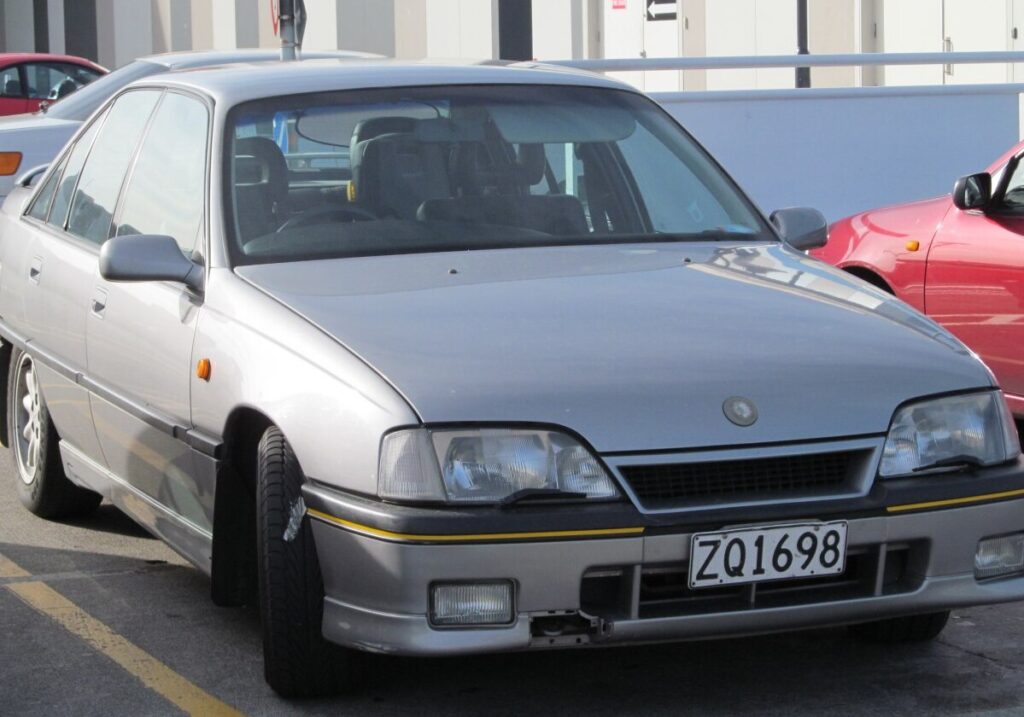
The Opel Omega A 2.0i CAT, produced from July 1990 to 1993, represented a key entry point into the Omega A range, Opel’s flagship sedan intended to replace the aging Commodore and Rekord models. Positioned as a comfortable and relatively affordable option within the lineup, the 2.0i CAT offered a balance between performance and fuel economy, appealing to buyers seeking a spacious, well-equipped family car. It served as a stepping stone to the more powerful and luxurious Omega variants, such as the 3.0i and the later 2.5 V6 models. The Omega A, built on Opel’s GM V platform, aimed to compete with rivals like the Ford Granada and BMW 5 Series, offering a distinctly German driving experience.
Technical Specifications
| Brand | Opel |
| Model | Omega |
| Generation | Omega A |
| Type (Engine) | 2.0i CAT (100 Hp) |
| Start of production | July, 1990 |
| End of production | 1993 |
| Powertrain Architecture | Internal Combustion engine |
| Body type | Sedan |
| Seats | 5 |
| Doors | 4 |
| Fuel Type | Petrol (Gasoline) |
| Power | 100 Hp |
| Power per litre | 50.1 Hp/l |
| Torque | 158 Nm @ 2600 rpm (116.53 lb.-ft. @ 2600 rpm) |
| Engine layout | Front, Longitudinal |
| Engine Model/Code | C20NEF |
| Engine displacement | 1998 cm3 (121.93 cu. in.) |
| Number of cylinders | 4 |
| Engine configuration | Inline |
| Number of valves per cylinder | 2 |
| Fuel injection system | Multi-port manifold injection |
| Engine aspiration | Naturally aspirated engine |
| Engine oil capacity | 4.5 l (4.76 US qt | 3.96 UK qt) |
| Coolant | 6 l (6.34 US qt | 5.28 UK qt) |
| Trunk (boot) space – minimum | 520 l (18.36 cu. ft.) |
| Trunk (boot) space – maximum | 870 l (30.72 cu. ft.) |
| Fuel tank capacity | 75 l (19.81 US gal | 16.5 UK gal) |
| Length | 4740 mm (186.61 in.) |
| Width | 1760 mm (69.29 in.) |
| Height | 1445 mm (56.89 in.) |
| Wheelbase | 2730 mm (107.48 in.) |
| Front track | 1445 mm (56.89 in.) |
| Rear (Back) track | 1460 mm (57.48 in.) |
| Drivetrain Architecture | The Internal combustion engine (ICE) drives the rear wheels of the vehicle. |
| Drive wheel | Rear wheel drive |
| Number of gears and type of gearbox | 5 gears, manual transmission |
| Front suspension | Spring Strut |
| Rear suspension | Wishbone |
| Front brakes | Ventilated discs |
| Rear brakes | Disc |
| Assisting systems | ABS (Anti-lock braking system) |
| Power steering | Hydraulic Steering |
Powertrain & Engine Architecture
The heart of the Omega A 2.0i CAT was the C20NEF engine, a 1998cc inline four-cylinder unit. This engine featured a cast iron block and an aluminum cylinder head, employing a two-valve-per-cylinder configuration. Fuel delivery was managed by Bosch Motronic multi-port fuel injection, contributing to improved efficiency and reduced emissions compared to earlier carbureted Opel engines. The ‘CAT’ designation indicates the presence of a catalytic converter, a crucial component for meeting increasingly stringent emissions regulations in Europe. The engine produced 100 horsepower and 158 Nm (116.53 lb-ft) of torque at 2600 rpm. The five-speed manual transmission was the standard offering, providing a relatively direct connection between the engine and the rear wheels.
Driving Characteristics
The 2.0i CAT Omega A offered a comfortable, if not particularly sporty, driving experience. With 100 horsepower propelling a relatively large sedan, acceleration was adequate for everyday driving but lacked the urgency of the larger-displacement engines available in the Omega range. The five-speed manual transmission allowed drivers to keep the engine in its optimal power band, but the car wasn’t designed for aggressive driving. The rear-wheel-drive configuration provided a balanced feel, although it wasn’t as dynamically engaging as some of its front-wheel-drive competitors. The gear ratios were tuned for fuel efficiency and cruising comfort, making it a suitable vehicle for long highway journeys.
Equipment & Trim Levels
The 2.0i CAT typically came with a reasonable level of standard equipment. This included central locking, power windows, and a basic stereo system. Interior upholstery was typically cloth, with a focus on durability and comfort. Optional extras included a sunroof, upgraded stereo systems, and air conditioning. The dashboard layout was functional and straightforward, typical of German automotive design of the era. While not as lavishly equipped as the higher-end Omega models, the 2.0i CAT provided a comfortable and practical interior for families.
Chassis & Braking
The Omega A featured a robust chassis with independent suspension at all four wheels. The front suspension utilized MacPherson struts, while the rear employed a semi-trailing arm setup. This configuration provided a good balance between ride comfort and handling. Braking duties were handled by ventilated discs at the front and solid discs at the rear. Anti-lock braking system (ABS) was standard, enhancing safety by preventing wheel lockup during hard braking. Hydraulic power steering was also standard, making the car easier to maneuver at low speeds.
Market Reception & Comparison
The Opel Omega A 2.0i CAT was generally well-received by automotive critics as a practical and comfortable family sedan. It was praised for its spacious interior, comfortable ride, and reasonable fuel economy. However, it was often criticized for its relatively modest performance compared to some of its rivals. Compared to the 3.0i and V6 Omega models, the 2.0i CAT offered a more affordable entry point into the range, but at the expense of performance and prestige. Against competitors like the Ford Granada, the Omega A offered a more modern design and a more refined driving experience.
Legacy
The Opel Omega A 2.0i CAT, while not the most sought-after variant of the Omega A, remains a reliable and affordable classic car. The C20NEF engine is known for its durability and relatively simple maintenance requirements. Today, these cars are increasingly appreciated by enthusiasts for their classic styling and comfortable driving experience. Finding well-maintained examples can be challenging, as many have succumbed to rust or have been driven into the ground. However, a well-preserved Omega A 2.0i CAT offers a glimpse into a bygone era of German automotive engineering, representing a solid and dependable family car from the early 1990s.
