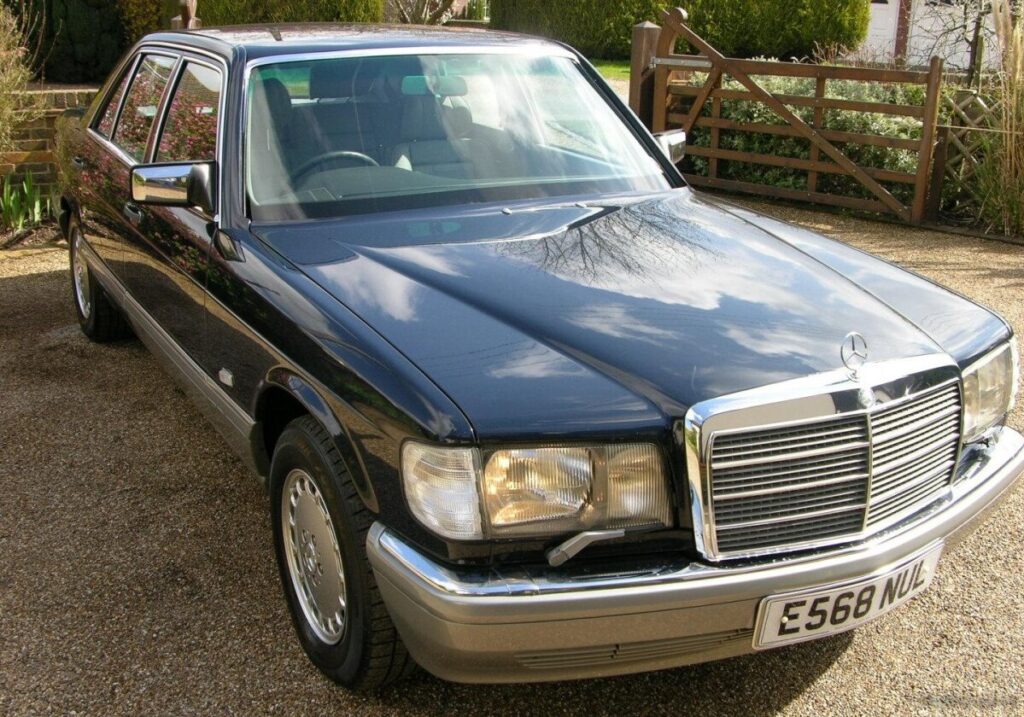
The Mercedes-Benz S-Class SEL (V126) 350 SDL CAT, produced from June 1985 to August 1991, represents a unique offering within the renowned W126 S-Class generation. This variant, distinguished by its diesel engine and catalytic converter (“CAT”), was primarily aimed at the European market, where diesel sedans were highly favored for their fuel efficiency and long-distance comfort. The 350 SDL occupied a middle ground in the S-Class lineup, offering a balance between luxury and economy, positioned below the more powerful and expensive 560 SEL but above the base 300 SDL. The facelifted V126, introduced in 1985, brought subtle but significant cosmetic and mechanical updates, solidifying the S-Class’s reputation for engineering excellence and understated elegance.
Technical Specifications
| Brand | Mercedes-Benz |
| Model | S-class |
| Generation | S-class SEL (V126, facelift 1985) |
| Type (Engine) | 350 SDL CAT (136 Hp) Automatic |
| Start of production | June, 1985 |
| End of production | August, 1991 |
| Powertrain Architecture | Internal Combustion engine |
| Body type | Sedan |
| Seats | 5 |
| Doors | 4 |
| Fuel Type | Diesel |
| Maximum speed | 175 km/h (108.74 mph) |
| Weight-to-power ratio | 13.2 kg/Hp, 76 Hp/tonne |
| Weight-to-torque ratio | 5.8 kg/Nm, 173.2 Nm/tonne |
| Power | 136 Hp @ 4000 rpm |
| Power per litre | 39.4 Hp/l |
| Torque | 310 Nm @ 2000 rpm (228.64 lb.-ft. @ 2000 rpm) |
| Engine layout | Front, Longitudinal |
| Engine Model/Code | OM 603 D 35 A / 603.970 |
| Engine displacement | 3449 cm3 (210.47 cu. in.) |
| Number of cylinders | 6 |
| Engine configuration | Inline |
| Cylinder Bore | 89 mm (3.5 in.) |
| Piston Stroke | 92.4 mm (3.64 in.) |
| Compression ratio | 22:1 |
| Number of valves per cylinder | 2 |
| Fuel injection system | Multi-port manifold injection |
| Engine aspiration | Turbocharger |
| Valvetrain | SOHC |
| Engine oil capacity | 7.5 l (7.93 US qt | 6.6 UK qt) |
| Coolant | 10 l (10.57 US qt | 8.8 UK qt) |
| Kerb Weight | 1790 kg (3946.27 lbs.) |
| Max. weight | 2270 kg (5004.49 lbs.) |
| Max load | 480 kg (1058.22 lbs.) |
| Fuel tank capacity | 90 l (23.78 US gal | 19.8 UK gal) |
| Length | 5285 mm (208.07 in.) |
| Width | 1820 mm (71.65 in.) |
| Height | 1441 mm (56.73 in.) |
| Wheelbase | 3070 mm (120.87 in.) |
| Front track | 1562 mm (61.5 in.) |
| Rear (Back) track | 1534 mm (60.39 in.) |
| Drivetrain Architecture | The Internal combustion engine (ICE) drives the rear wheels of the vehicle. |
| Drive wheel | Rear wheel drive |
| Number of gears and type of gearbox | 4 gears, automatic transmission |
| Front suspension | Double wishbone |
| Rear suspension | Trailing arm |
| Front brakes | Ventilated discs |
| Rear brakes | Disc |
| Assisting systems | ABS (Anti-lock braking system) |
| Steering type | Cone worm with recirculation balls |
| Power steering | Hydraulic Steering |
| Tires size | Front wheel tires: 205/65 R15Rear wheel tires: 205/65 R15 |
| Wheel rims size | Front wheel rims: 6.5J x 15Rear wheel rims: 6.5J x 15 |
Powertrain & Engine Architecture
The heart of the 350 SDL CAT is the OM 603 D 35 A inline-six cylinder diesel engine. This 3.5-liter engine, a hallmark of Mercedes-Benz diesel technology, featured a robust cast-iron block and aluminum cylinder head. The “A” designation signifies the inclusion of a catalytic converter, a relatively new technology at the time aimed at reducing harmful emissions. The engine employed multi-port manifold injection, a system that improved fuel atomization and combustion efficiency compared to earlier diesel injection methods. A single overhead camshaft (SOHC) controlled two valves per cylinder. The turbocharger, a key component, boosted power output to 136 horsepower and 229 lb-ft of torque. This engine was paired exclusively with a four-speed automatic transmission, designed for smooth and comfortable shifting. The transmission was geared towards maximizing fuel economy and providing relaxed cruising, rather than outright performance.
Driving Characteristics
The 350 SDL Automatic offered a distinctly different driving experience compared to its gasoline-powered siblings or even the manual diesel versions. The automatic transmission, while providing convenience, resulted in slightly slower acceleration. The focus was on effortless cruising and relaxed long-distance travel. The turbocharger helped mitigate some of the inherent lag associated with diesel engines, providing a usable surge of power at higher RPMs. However, the 136 hp output meant that spirited driving required careful planning. The gear ratios were optimized for fuel efficiency, meaning the engine often operated at lower RPMs during normal driving conditions. Compared to the 300 SDL, the 350 SDL offered noticeably more power and refinement, while the 560 SEL provided a significantly more powerful, but less fuel-efficient, alternative.
Equipment & Trim Levels
The 350 SDL CAT came standard with a generous array of features befitting its S-Class designation. These included power windows, power locks, central locking, a sunroof, and climate control. The interior was typically upholstered in high-quality leather, with wood trim adorning the dashboard and door panels. Optional extras included a premium sound system, heated seats, and a self-leveling suspension system. The exterior featured chrome trim and alloy wheels, contributing to the car’s luxurious appearance. The overall ambiance was one of understated elegance and refined comfort.
Chassis & Braking
The V126 S-Class featured a robust chassis with independent suspension all around. The front suspension utilized a double wishbone design, while the rear employed a trailing arm setup. This configuration provided a comfortable ride and good handling characteristics. The 350 SDL CAT was equipped with ventilated disc brakes at the front and solid discs at the rear. An Anti-lock Braking System (ABS) was standard, enhancing safety and control during emergency braking situations. The steering was a recirculating ball system with hydraulic power assistance, providing a comfortable and precise driving experience. Stabilizer bars were fitted front and rear to reduce body roll during cornering.
Market Reception & Comparison
The 350 SDL CAT was generally well-received by automotive critics, particularly in Europe. It was praised for its fuel efficiency, comfortable ride, and refined interior. However, some critics noted its relatively modest performance compared to the gasoline-powered S-Class models. Fuel economy was a significant advantage, especially in countries with high gasoline prices. Reliability was also a strong point, with the OM 603 engine being known for its durability. Compared to the 300 SDL, the 350 SDL offered a noticeable performance upgrade, justifying its higher price tag. Against the 560 SEL, the 350 SDL represented a more economical and practical choice, albeit with a significant trade-off in terms of power.
Legacy
The Mercedes-Benz 350 SDL CAT has proven to be a remarkably durable and reliable vehicle. The OM 603 engine is renowned for its longevity, with many examples exceeding 300,000 miles with proper maintenance. Today, the V126 S-Class, including the 350 SDL, enjoys a strong following among classic car enthusiasts. These cars are appreciated for their build quality, timeless design, and comfortable driving experience. While parts availability can be a challenge, a dedicated network of suppliers and enthusiasts ensures that these vehicles can be kept on the road for years to come. The 350 SDL CAT stands as a testament to Mercedes-Benz’s commitment to engineering excellence and its ability to create luxurious and durable automobiles.