
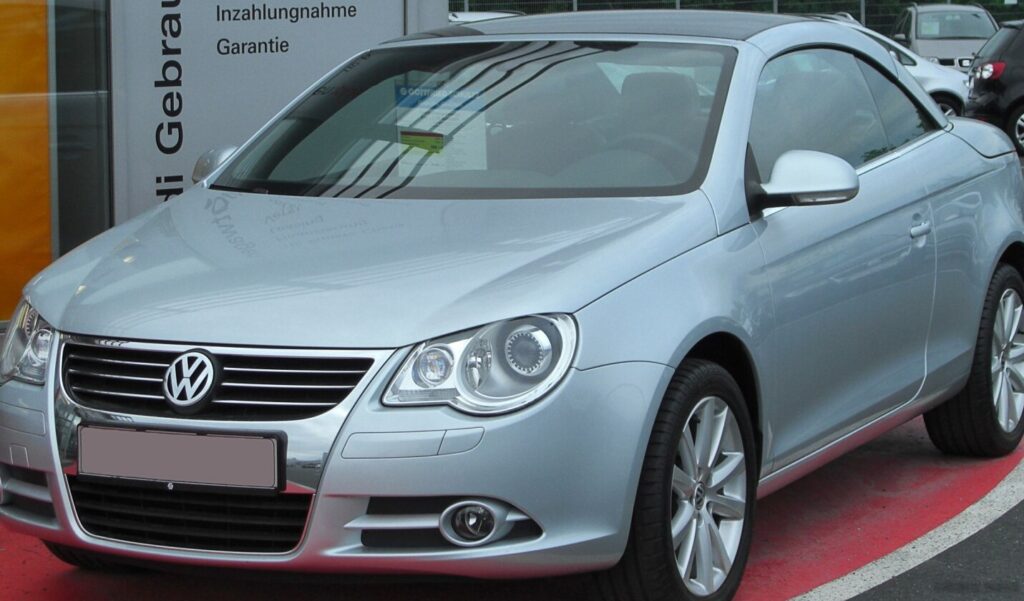
The Volkswagen Eos 2.0 16V FSI, produced from March 2006 to May 2008, represented a key offering within the first generation (2006-2009) of Volkswagen’s coupe-convertible model. Positioned as a mid-range trim, it aimed to bridge the gap between the more affordable base models and the higher-performance variants like the 2.0T FSI. The Eos, named after the Greek goddess of the dawn, was Volkswagen’s attempt to create a stylish, practical, and relatively affordable open-top car for the European and North American markets, competing with models like the Ford Focus Coupe-Convertible and the Renault Mégane Coupé-Cabriolet. This particular 2.0-liter FSI engine and six-speed manual transmission combination offered a balance of fuel efficiency and respectable performance, making it a popular choice for buyers seeking a versatile and enjoyable driving experience.
Technical Specifications
| Brand | Volkswagen |
| Model | Eos |
| Generation | Eos |
| Type (Engine) | 2.0 16V FSI (150 Hp) |
| Start of production | March, 2006 |
| End of production | May, 2008 |
| Powertrain Architecture | Internal Combustion engine |
| Body type | Coupe – Cabriolet |
| Seats | 4 |
| Doors | 2 |
| Fuel consumption (economy) – urban | 11.3 l/100 km (20.8 US mpg, 25 UK mpg, 8.8 km/l) |
| Fuel consumption (economy) – extra urban | 6.4 l/100 km (36.8 US mpg, 44.1 UK mpg, 15.6 km/l) |
| Fuel consumption (economy) – combined | 8.2 l/100 km (28.7 US mpg, 34.4 UK mpg, 12.2 km/l) |
| Fuel Type | Petrol (Gasoline) |
| Acceleration 0 – 100 km/h | 9.8 sec |
| Acceleration 0 – 62 mph | 9.8 sec |
| Acceleration 0 – 60 mph | 9.3 sec |
| Maximum speed | 210 km/h (130.49 mph) |
| Weight-to-power ratio | 9.9 kg/Hp, 101.3 Hp/tonne |
| Weight-to-torque ratio | 7.4 kg/Nm, 135 Nm/tonne |
| Power | 150 Hp @ 6000 rpm |
| Power per litre | 75.6 Hp/l |
| Torque | 200 Nm @ 3500 rpm (147.51 lb.-ft. @ 3500 rpm) |
| Engine layout | Front, Transverse |
| Engine Model/Code | BVY, BVZ |
| Engine displacement | 1984 cm3 (121.07 cu. in.) |
| Number of cylinders | 4 |
| Engine configuration | Inline |
| Cylinder Bore | 82.5 mm (3.25 in.) |
| Piston Stroke | 92.8 mm (3.65 in.) |
| Compression ratio | 11.5:1 |
| Number of valves per cylinder | 4 |
| Fuel injection system | Direct injection |
| Engine aspiration | Naturally aspirated engine |
| Valvetrain | DOHC |
| Engine oil capacity | 4.6 l (4.86 US qt | 4.05 UK qt) |
| Coolant | 8 l (8.45 US qt | 7.04 UK qt) |
| Kerb Weight | 1481 kg (3265.05 lbs.) |
| Max. weight | 1950 kg (4299.01 lbs.) |
| Max load | 469 kg (1033.97 lbs.) |
| Trunk (boot) space – minimum | 205 l (7.24 cu. ft.) |
| Trunk (boot) space – maximum | 380 l (13.42 cu. ft.) |
| Fuel tank capacity | 55 l (14.53 US gal | 12.1 UK gal) |
| Length | 4407 mm (173.5 in.) |
| Width | 1791 mm (70.51 in.) |
| Height | 1443 mm (56.81 in.) |
| Wheelbase | 2578 mm (101.5 in.) |
| Front track | 1545 mm (60.83 in.) |
| Rear (Back) track | 1553 mm (61.14 in.) |
| Minimum turning circle | 10.9 m (35.76 ft.) |
| Drivetrain Architecture | Front wheel drive |
| Drive wheel | Front wheel drive |
| Number of gears and type of gearbox | 6 gears, manual transmission |
| Front suspension | Spring Strut |
| Rear suspension | Coil spring |
| Front brakes | Ventilated discs |
| Rear brakes | Disc |
| Assisting systems | ABS (Anti-lock braking system) |
| Steering type | Steering rack and pinion |
| Tires size | 215/55 R16 |
| Wheel rims size | 7J x 16 |
Powertrain & Engine Architecture
The heart of the Eos 2.0 FSI was the BVY or BVZ engine code, a 1.984-liter (121.07 cubic inches) inline-four cylinder powerplant. This engine utilized Volkswagen’s FSI (Fuel Stratified Injection) direct injection technology. FSI allowed for precise fuel delivery directly into the combustion chamber, resulting in improved fuel efficiency and increased power output compared to traditional port fuel injection systems. The engine featured a double overhead camshaft (DOHC) valvetrain with four valves per cylinder, optimizing airflow for enhanced performance. The 11.5:1 compression ratio further contributed to the engine’s efficiency. Paired with this engine was a six-speed manual transmission, providing drivers with precise control over gear selection. The transmission’s gear ratios were tuned to balance acceleration and fuel economy, offering a reasonably engaging driving experience.
Driving Characteristics
The 150 horsepower and 147.51 lb-ft of torque produced by the 2.0 FSI engine provided adequate, though not exhilarating, performance. Acceleration from 0 to 60 mph took approximately 9.3 seconds, and the top speed was around 130.49 mph. Compared to the more powerful 2.0T FSI variant, the 2.0 FSI felt noticeably less responsive, particularly during overtaking maneuvers. However, the six-speed manual transmission allowed drivers to keep the engine in its optimal power band, mitigating some of the performance deficit. The gear ratios were well-spaced, providing smooth transitions and a decent level of control. The 2.0 FSI offered a more refined and fuel-efficient driving experience than the turbocharged 2.0T, making it a suitable choice for drivers prioritizing comfort and economy over outright speed.
Equipment & Trim Levels
The Eos 2.0 FSI typically came equipped with a respectable level of standard features. These included air conditioning, power windows and locks, a CD stereo system, and alloy wheels. Interior upholstery was typically cloth, though leather options were available. The dashboard layout was clean and functional, with a focus on ergonomics. Optional extras included a sunroof, upgraded audio systems, navigation, and heated front seats. The Eos aimed for a premium feel without the premium price tag of some competitors.
Chassis & Braking
The Eos utilized a front-wheel-drive layout with a MacPherson strut suspension in the front and a coil spring suspension in the rear. This setup provided a comfortable ride quality, absorbing bumps and imperfections in the road effectively. The front brakes were ventilated discs, offering good stopping power, while the rear brakes were solid discs. Anti-lock Braking System (ABS) was standard, enhancing safety and control during emergency braking situations. The chassis was reinforced to compensate for the loss of structural rigidity inherent in a convertible design.
Market Reception & Comparison
The Volkswagen Eos 2.0 FSI was generally well-received by automotive critics. It was praised for its stylish design, comfortable ride, and practical convertible top mechanism. However, some reviewers noted that the 2.0 FSI engine lacked the punch of its turbocharged counterpart. Fuel economy was considered good for its class, averaging around 28.7 US mpg in combined driving. Compared to the 2.0T FSI, the 2.0 FSI offered a lower purchase price and potentially lower maintenance costs, but at the expense of performance. The 2.0 FSI appealed to buyers who prioritized affordability and fuel efficiency over outright speed.
Legacy
The Volkswagen Eos, while not a massive sales success, established itself as a competent and stylish convertible. The 2.0 FSI engine, while not the most powerful option, proved to be relatively reliable. Today, well-maintained Eos 2.0 FSI models can be found on the used car market at reasonable prices. Common issues include wear and tear on convertible top mechanisms and potential oil leaks. However, with proper maintenance, these cars can provide years of enjoyable open-top motoring. The FSI engine, while advanced for its time, requires regular servicing to prevent carbon buildup, a common issue with direct injection engines.
