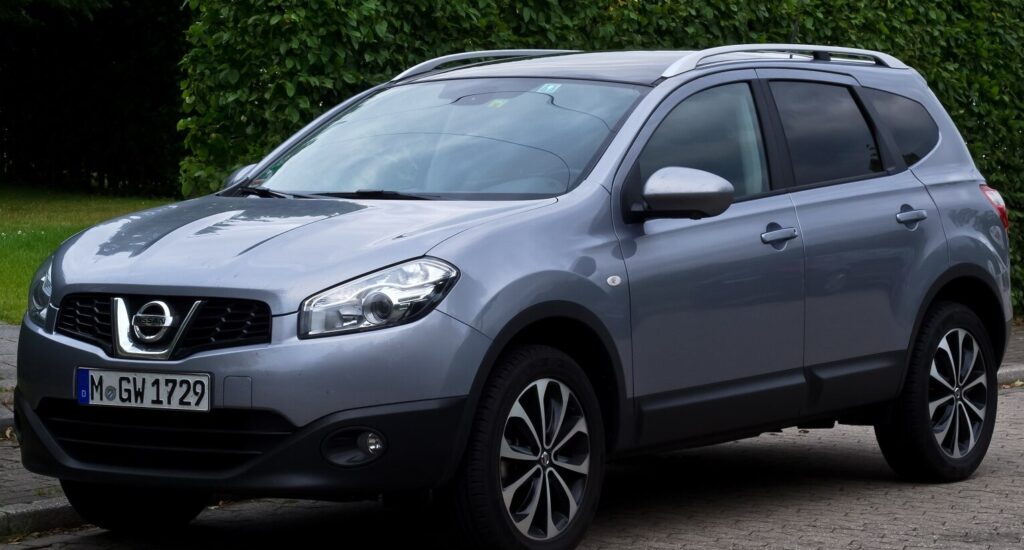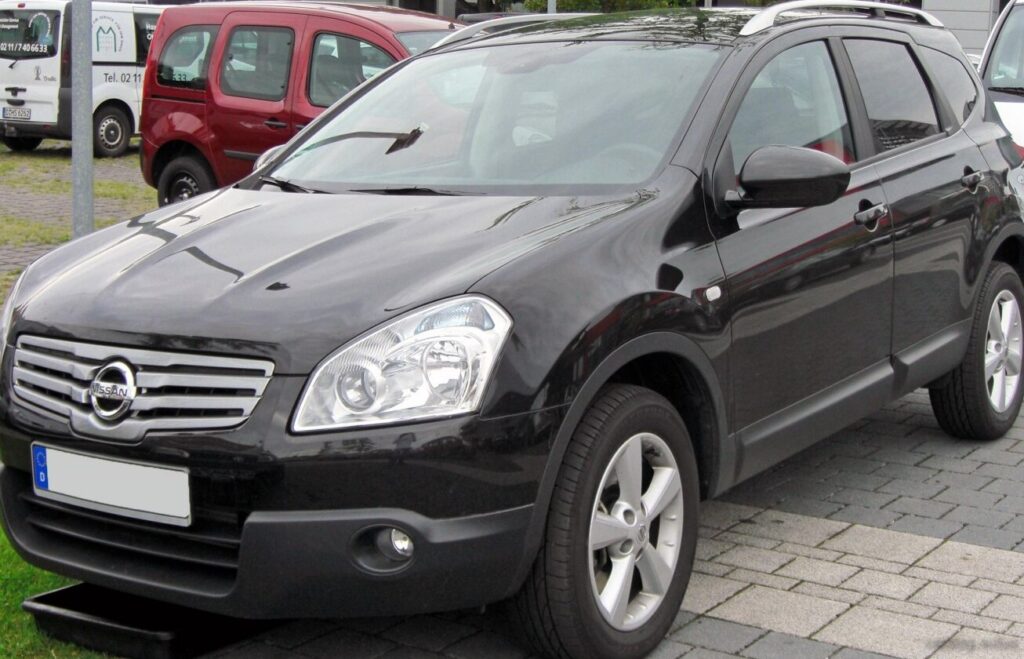
The Nissan Qashqai+2 I (NJ10) 1.6i, producing 114 horsepower, was a variant of Nissan’s popular compact crossover offered primarily in the European market from 2008 to 2010. This model represented an expansion of the original Qashqai line, adding a third row of seating to accommodate up to seven passengers. Positioned as a more affordable and practical option within the Qashqai+2 range, the 1.6i trim served as the entry point for buyers seeking the versatility of a seven-seater without the higher costs associated with the more powerful engine options. It was built on the Nissan B platform, shared with other compact Nissan and Renault vehicles.
Technical Specifications
| Brand | Nissan |
| Model | Qashqai |
| Generation | Qashqai+2 I (NJ10) |
| Type (Engine) | 1.6i (114 Hp) |
| Start of production | 2008 |
| End of production | 2010 |
| Powertrain Architecture | Internal Combustion engine |
| Body type | SUV, Crossover |
| Seats | 7 |
| Doors | 5 |
| Fuel consumption (urban) | 8.9 l/100 km (26.4 US mpg, 31.7 UK mpg, 11.2 km/l) |
| Fuel consumption (extra urban) | 5.9 l/100 km (39.9 US mpg, 47.9 UK mpg, 16.9 km/l) |
| Fuel consumption (combined) | 7 l/100 km (33.6 US mpg, 40.4 UK mpg, 14.3 km/l) |
| CO2 emissions | 165 g/km |
| Fuel Type | Petrol (Gasoline) |
| Acceleration 0 – 100 km/h | 12.9 sec |
| Acceleration 0 – 62 mph | 12.9 sec |
| Acceleration 0 – 60 mph | 12.3 sec |
| Maximum speed | 174 km/h (108.12 mph) |
| Emission standard | Euro 4 |
| Weight-to-power ratio | 12.3 kg/Hp, 81.2 Hp/tonne |
| Weight-to-torque ratio | 9 kg/Nm, 111.1 Nm/tonne |
| Power | 114 Hp @ 6000 rpm |
| Power per litre | 71.3 Hp/l |
| Torque | 156 Nm @ 4400 rpm (115.06 lb.-ft. @ 4400 rpm) |
| Engine layout | Front, Transverse |
| Engine Model/Code | HR16DE |
| Engine displacement | 1598 cm3 (97.52 cu. in.) |
| Number of cylinders | 4 |
| Engine configuration | Inline |
| Cylinder Bore | 78 mm (3.07 in.) |
| Piston Stroke | 83.6 mm (3.29 in.) |
| Number of valves per cylinder | 4 |
| Fuel injection system | Multi-port manifold injection |
| Engine aspiration | Naturally aspirated engine |
| Valvetrain | DOHC |
| Engine oil capacity | 4.3 l (4.54 US qt | 3.78 UK qt) |
| Coolant | 6.4 l (6.76 US qt | 5.63 UK qt) |
| Kerb Weight | 1404 kg (3095.29 lbs.) |
| Max. weight | 2072 kg (4567.98 lbs.) |
| Max load | 668 kg (1472.69 lbs.) |
| Trunk (boot) space – minimum | 130 l (4.59 cu. ft.) |
| Trunk (boot) space – maximum | 1520 l (53.68 cu. ft.) |
| Fuel tank capacity | 65 l (17.17 US gal | 14.3 UK gal) |
| Max. roof load | 75 kg (165.35 lbs.) |
| Permitted trailer load with brakes (12%) | 1200 kg (2645.55 lbs.) |
| Permitted trailer load without brakes | 735 kg (1620.4 lbs.) |
| Permitted towbar download | 75 kg (165.35 lbs.) |
| Length | 4530 mm (178.35 in.) |
| Width | 1780 mm (70.08 in.) |
| Height | 1645 mm (64.76 in.) |
| Wheelbase | 2765 mm (108.86 in.) |
| Front track | 1540 mm (60.63 in.) |
| Rear (Back) track | 1550 mm (61.02 in.) |
| Minimum turning circle | 11 m (36.09 ft.) |
| Drivetrain | Front wheel drive |
| Number of gears and type of gearbox | 5 gears, manual transmission |
| Front suspension | Independent, type McPherson with coil spring and anti-roll bar |
| Rear suspension | Independent multi-link spring suspension with stabilizer |
| Front brakes | Disc |
| Rear brakes | Disc |
| Assisting systems | ABS (Anti-lock braking system) |
| Steering type | Steering rack and pinion |
| Power steering | Electric Steering |
| Tires size | 215/65R16 |
| Wheel rims size | 6.5J x 16 |
INTRODUCTION
The Nissan Qashqai+2 I (NJ10) 1.6i, launched in 2008, was a significant addition to Nissan’s European lineup. Building upon the success of the standard Qashqai, the +2 variant offered the practicality of seven-passenger seating in a relatively compact crossover package. The 1.6i engine, while not the most powerful option available, was designed to provide a balance of affordability, fuel efficiency, and adequate performance for everyday driving. This trim level aimed to attract families and individuals who prioritized space and economy over outright speed. The NJ10 generation Qashqai+2 was a key player in establishing Nissan as a major force in the European crossover market.
Powertrain & Engine Architecture
The heart of the Qashqai+2 1.6i is the HR16DE engine, a 1.6-liter inline-four cylinder gasoline engine. This engine utilizes multi-point fuel injection and a double overhead camshaft (DOHC) valvetrain. The HR16DE is a naturally aspirated engine, meaning it doesn’t employ turbocharging or supercharging. It produces 114 horsepower at 6000 rpm and 156 Nm (115 lb-ft) of torque at 4400 rpm. The engine is transversely mounted in the front of the vehicle. The 1.6i was typically paired with a five-speed manual transmission, although a continuously variable transmission (CVT) was also offered as an option in some markets. The CVT aimed to improve fuel economy and provide smoother acceleration, but the manual transmission remained popular due to its lower cost and more direct driving feel.
Driving Characteristics
The Qashqai+2 1.6i, with its 114 horsepower and relatively modest torque output, wasn’t designed for exhilarating performance. Acceleration from 0 to 62 mph (0-100 km/h) took around 12.9 seconds. The engine felt adequate for everyday driving situations, such as commuting and running errands, but could feel strained when fully loaded with passengers and luggage, especially on inclines. The five-speed manual transmission offered reasonable control, but the gear ratios were spaced to prioritize fuel economy rather than rapid acceleration. Compared to the 1.6 dCi diesel or the 2.0-liter gasoline variants, the 1.6i felt noticeably less powerful. However, it offered a smoother and quieter driving experience than the diesel, and was generally more affordable to purchase and maintain.
Equipment & Trim Levels
The 1.6i trim of the Qashqai+2 typically came with a respectable level of standard equipment. This included air conditioning, electric front windows, a CD player with auxiliary input, and ABS brakes. Higher trim levels, such as the Tekna, added features like alloy wheels, climate control, rear parking sensors, and a more sophisticated audio system. Interior upholstery was typically cloth, with a dark color scheme. Optional extras included a panoramic sunroof, leather seats, and a navigation system. The third-row seats in the +2 were best suited for children or occasional use, as they offered limited legroom and headroom.
Chassis & Braking
The Qashqai+2 1.6i utilized an independent McPherson strut suspension at the front and an independent multi-link suspension at the rear. This setup provided a comfortable ride quality, absorbing bumps and imperfections in the road surface effectively. The front and rear brakes were both ventilated discs, providing adequate stopping power for the vehicle’s weight. Anti-lock Braking System (ABS) was standard. The steering was electrically assisted, offering light and precise control. The suspension was tuned to prioritize comfort over sporty handling, making it well-suited for everyday driving.
Market Reception & Comparison
The Qashqai+2 1.6i received mixed reviews from automotive critics. While praised for its practicality and affordability, the engine was often criticized for being underpowered, especially when the vehicle was fully loaded. Fuel economy was generally considered good for a seven-seater, averaging around 33.6 US mpg (40.4 UK mpg) in combined driving. Compared to the diesel variants, the 1.6i offered lower running costs in terms of fuel, but the diesel engines provided significantly better fuel economy and torque. The 1.6i appealed to buyers who prioritized a lower purchase price and a smoother, quieter driving experience over outright performance.
Legacy
The Nissan Qashqai+2 1.6i has proven to be a relatively reliable vehicle, with the HR16DE engine generally considered durable and long-lasting. Common issues include occasional problems with the electronic parking brake and the CVT transmission (if equipped). On the used car market, the Qashqai+2 1.6i represents a good value proposition for buyers seeking an affordable and practical seven-seater. Its relatively simple mechanical design and readily available parts contribute to its low cost of ownership. While not a performance standout, the Qashqai+2 1.6i remains a popular choice for families and individuals who need a versatile and economical vehicle.