
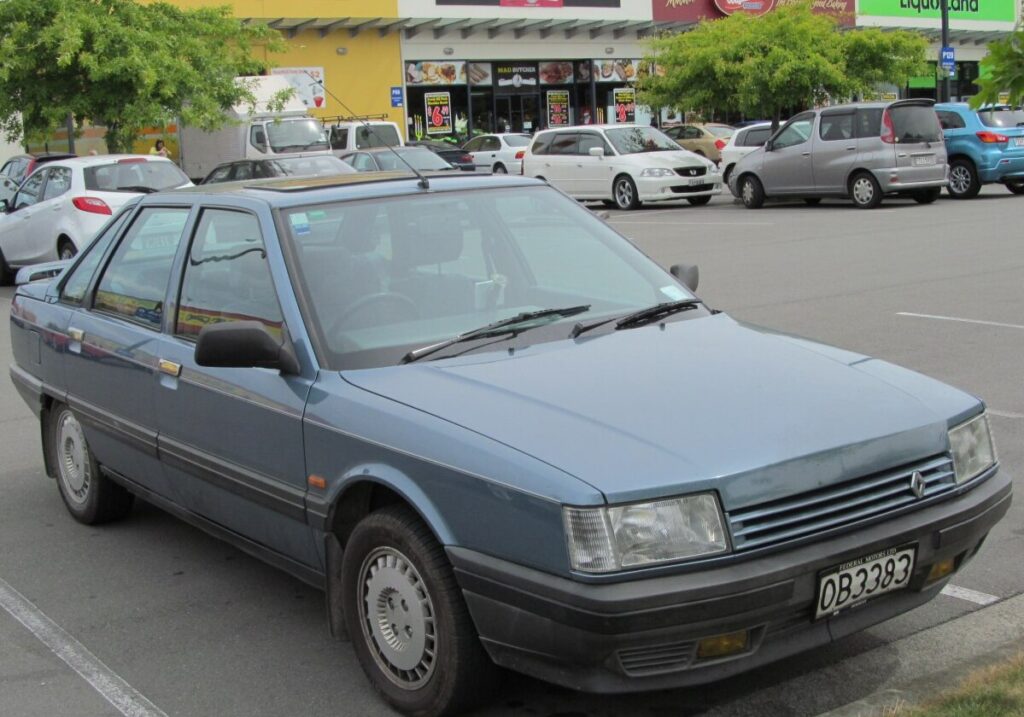
The Renault 21 (B48) 1.9 D, produced between 1989 and 1993, represented an economical and practical offering within the broader Renault 21 range. Positioned as the diesel variant, it catered to drivers prioritizing fuel efficiency and durability over outright performance. The B48 generation of the Renault 21, launched in 1986, was a significant update to the original R21, offering improved styling, interior refinement, and mechanical enhancements. The 1.9 D model specifically targeted buyers in Europe, where diesel engines were increasingly popular due to favorable taxation and fuel costs. It served as a workhorse for families and individuals needing a reliable and economical sedan.
Technical Specifications
| Brand | Renault |
| Model | 21 |
| Generation | 21 (B48) |
| Type (Engine) | 1.9 D (65 Hp) |
| Start of production | 1989 |
| End of production | 1993 |
| Powertrain Architecture | Internal Combustion engine |
| Body type | Sedan |
| Seats | 5 |
| Doors | 4 |
| Fuel consumption (urban) | 7.3 l/100 km (32.2 US mpg, 38.7 UK mpg, 13.7 km/l) |
| Fuel consumption (extra urban) | 4.6 l/100 km (51.1 US mpg, 61.4 UK mpg, 21.7 km/l) |
| Fuel consumption (combined) | 6.1 l/100 km (38.6 US mpg, 46.3 UK mpg, 16.4 km/l) |
| Fuel Type | Diesel |
| Acceleration 0 – 100 km/h | 16 sec |
| Acceleration 0 – 62 mph | 16 sec |
| Acceleration 0 – 60 mph | 15.2 sec |
| Maximum speed | 155 km/h (96.31 mph) |
| Weight-to-power ratio | 16 kg/Hp, 62.5 Hp/tonne |
| Weight-to-torque ratio | 8.6 kg/Nm, 116.3 Nm/tonne |
| Power | 65 Hp @ 4500 rpm |
| Power per litre | 34.8 Hp/l |
| Torque | 121 Nm @ 2250 rpm (89.25 lb.-ft. @ 2250 rpm) |
| Engine layout | Front, Transverse |
| Engine Model/Code | F8Q |
| Engine displacement | 1870 cm3 (114.11 cu. in.) |
| Number of cylinders | 4 |
| Engine configuration | Inline |
| Cylinder Bore | 80 mm (3.15 in.) |
| Piston Stroke | 93 mm (3.66 in.) |
| Compression ratio | 21.5:1 |
| Number of valves per cylinder | 2 |
| Fuel injection system | Precombustion chamber injection |
| Engine aspiration | Naturally aspirated engine |
| Valvetrain | OHC |
| Engine oil capacity | 6.5 l (6.87 US qt | 5.72 UK qt) |
| Coolant capacity | 7 l (7.4 US qt | 6.16 UK qt) |
| Kerb Weight | 1040 kg (2292.81 lbs.) |
| Max. weight | 1495 kg (3295.91 lbs.) |
| Max load | 455 kg (1003.1 lbs.) |
| Trunk (boot) space – minimum | 490 l (17.3 cu. ft.) |
| Fuel tank capacity | 66 l (17.44 US gal | 14.52 UK gal) |
| Length | 4530 mm (178.35 in.) |
| Width | 1730 mm (68.11 in.) |
| Height | 1415 mm (55.71 in.) |
| Wheelbase | 2660 mm (104.72 in.) |
| Front track | 1430 mm (56.3 in.) |
| Rear (Back) track | 1400 mm (55.12 in.) |
| Drivetrain Architecture | The Internal combustion engine (ICE) drives the front wheels of the vehicle. |
| Drive wheel | Front wheel drive |
| Number of gears and type of gearbox | 5 gears, manual transmission |
| Front suspension | Spring Strut |
| Rear suspension | Torsion |
| Front brakes | Ventilated discs |
| Rear brakes | Drum |
| Assisting systems | ABS (Anti-lock braking system) |
| Steering type | Steering rack and pinion |
| Power steering | Hydraulic Steering |
| Tires size | 195/55 R15 |
| Wheel rims size | 15 |
Powertrain & Engine Architecture
The Renault 21 1.9 D was powered by the F8Q engine, a 1.9-liter inline-four diesel engine. This engine was a mainstay in Renault’s lineup during the late 1980s and early 1990s, known for its robustness and relatively simple design. The F8Q utilized precombustion chamber injection, a system common in diesel engines of that era. This system involved injecting fuel into a small precombustion chamber connected to the main cylinder, where it was partially ignited before entering the main combustion chamber. This aided in smoother combustion and reduced engine noise compared to direct injection systems. The engine featured an overhead camshaft (OHC) valvetrain operating two valves per cylinder. The 65 horsepower output was achieved at 4500 rpm, while peak torque of 121 Nm (89.25 lb-ft) was delivered at 2250 rpm. The engine was transversely mounted in the front of the vehicle, driving the front wheels. The 5-speed manual transmission was the standard offering, providing a balance between fuel economy and usability.
Driving Characteristics
The 1.9 D variant of the Renault 21 offered a decidedly unhurried driving experience. With only 65 horsepower, acceleration was modest, taking approximately 16 seconds to reach 100 km/h (62 mph). The engine’s strength lay in its torque delivery, making it reasonably capable for everyday driving and hauling loads. The 5-speed manual transmission allowed drivers to keep the engine in its optimal torque band, but frequent downshifts were often necessary for overtaking or climbing hills. Compared to the gasoline-powered Renault 21 variants, the 1.9 D lacked the responsiveness and higher top speed. However, it significantly surpassed them in fuel economy, making it a popular choice for high-mileage drivers. The gear ratios were geared towards maximizing fuel efficiency rather than performance.
Equipment & Trim Levels
The Renault 21 1.9 D typically came with a fairly basic level of equipment, reflecting its position as an economical model. Standard features generally included cloth upholstery, a basic instrument cluster, and manual windows and door locks. Air conditioning and central locking were often available as optional extras. Trim levels varied depending on the market, but generally, the 1.9 D was positioned as the entry-level diesel offering. Higher trim levels might have included upgraded interior materials, alloy wheels, and additional comfort features. The dashboard layout was functional and straightforward, prioritizing usability over aesthetics.
Chassis & Braking
The Renault 21 1.9 D utilized a relatively simple chassis design. The front suspension featured MacPherson strut springs, while the rear suspension employed a torsion beam setup. This configuration provided a comfortable ride, although it wasn’t particularly sporty. The braking system consisted of ventilated discs on the front wheels and drum brakes on the rear. Anti-lock braking system (ABS) was available as an option, enhancing safety. The steering was a rack-and-pinion system with hydraulic power assistance, providing reasonable steering feel and ease of maneuverability. The 195/55 R15 tires were a common fitment, offering a balance between grip and rolling resistance.
Market Reception & Comparison
The Renault 21 1.9 D was generally well-received in European markets as a practical and economical family car. Critics praised its fuel efficiency and durability, but noted its lack of performance. Compared to other diesel-powered sedans of the time, such as the Peugeot 405 and Citroën BX, the Renault 21 1.9 D offered a competitive combination of price, fuel economy, and reliability. The gasoline-powered Renault 21 variants offered more performance but at the cost of significantly higher fuel consumption. The 1.9 D was often seen as a sensible choice for drivers prioritizing practicality and running costs.
Legacy
The Renault 21 1.9 D, while not a performance icon, has proven to be a remarkably durable and reliable vehicle. Many examples are still on the road today, testament to the robustness of the F8Q engine and the overall build quality of the B48 generation Renault 21. In the used car market, these models are often sought after by those looking for a simple, affordable, and economical vehicle. The F8Q engine is known for its longevity and relatively straightforward maintenance requirements. However, potential buyers should be aware of the age-related issues common to older vehicles, such as corrosion and wear and tear on suspension components. The Renault 21 1.9 D remains a popular choice for those seeking a classic European diesel sedan.
