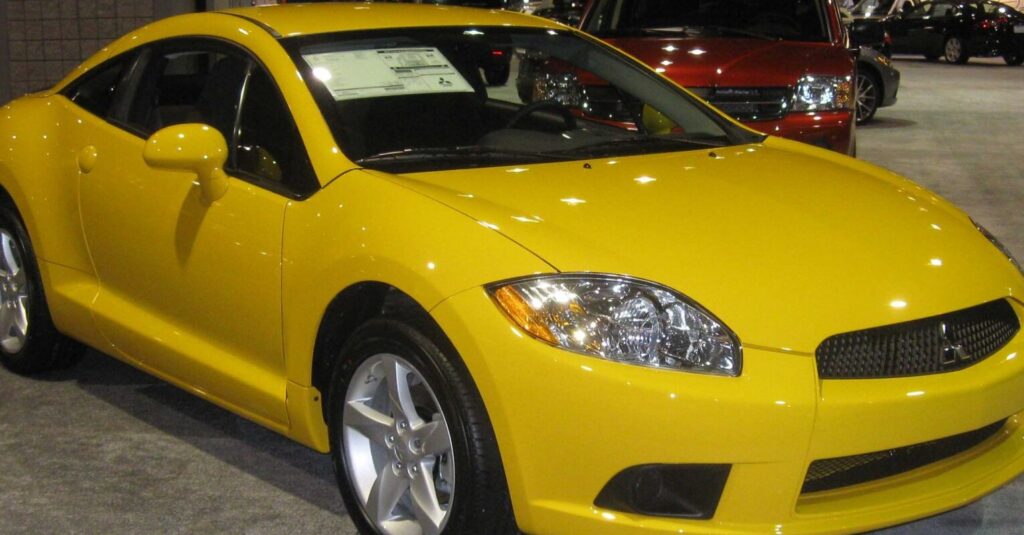
The Mitsubishi Eclipse IV (4G), specifically the facelifted version produced from 2009 to 2011, represented a significant departure from its earlier, more performance-focused iterations. While the Eclipse name had a history rooted in sporty coupes, the fourth generation, and particularly the GT 3.8L V6 MIVEC variant, aimed for a broader market appeal, blending style, technology, and a respectable level of performance. This model occupied a space between the base models and the more aggressively tuned Ralliart trim, offering a balance of features and power for the American consumer. It was built upon the GS platform, sharing components with the Galant and other Mitsubishi offerings of the era.
Technical Specifications
| Brand | Mitsubishi |
| Model | Eclipse |
| Generation | Eclipse IV (4G, facelift 2009) |
| Type (Engine) | GT 3.8L V6 MIVEC (265 Hp) |
| Start of production | 2009 |
| End of production | 2011 |
| Powertrain Architecture | Internal Combustion engine |
| Body type | Coupe, Liftback |
| Seats | 4 |
| Doors | 2 |
| Fuel consumption (urban) | 14.7 l/100 km (16 US mpg, 19.2 UK mpg) |
| Fuel consumption (extra urban) | 9.4 l/100 km (25 US mpg, 30.1 UK mpg) |
| Fuel Type | Petrol (Gasoline) |
| Weight-to-power ratio | 6 kg/Hp, 167.9 Hp/tonne |
| Weight-to-torque ratio | 4.4 kg/Nm, 225 Nm/tonne |
| Power | 265 Hp @ 5750 rpm |
| Power per litre | 69.2 Hp/l |
| Torque | 355 Nm @ 4500 rpm (261.83 lb.-ft. @ 4500 rpm) |
| Engine layout | Front, Longitudinal |
| Engine Model/Code | 6G75 |
| Engine displacement | 3828 cm3 (233.6 cu. in.) |
| Number of cylinders | 6 |
| Engine configuration | V-engine |
| Cylinder Bore | 95 mm (3.74 in.) |
| Piston Stroke | 90 mm (3.54 in.) |
| Compression ratio | 10.5:1 |
| Number of valves per cylinder | 4 |
| Fuel injection system | Multi-port manifold injection |
| Engine aspiration | Naturally aspirated engine |
| Valvetrain | SOHC |
| Engine oil capacity | 4.3 l (4.54 US qt | 3.78 UK qt) |
| Coolant capacity | 8.1 l (8.56 US qt | 7.13 UK qt) |
| Kerb Weight | 1578 kg (3478.89 lbs.) |
| Max. weight | 1945 kg (4287.99 lbs.) |
| Max load | 367 kg (809.1 lbs.) |
| Trunk (boot) space – maximum | 445 l (15.72 cu. ft.) |
| Fuel tank capacity | 67 l (17.7 US gal | 14.74 UK gal) |
| Length | 4582 mm (180.39 in.) |
| Width | 1835 mm (72.24 in.) |
| Height | 1359 mm (53.5 in.) |
| Wheelbase | 2575 mm (101.38 in.) |
| Front track | 1570 mm (61.81 in.) |
| Rear track | 1570 mm (61.81 in.) |
| Ride height (ground clearance) | 148 mm (5.83 in.) |
| Minimum turning circle | 12.2 m (40.03 ft.) |
| Drivetrain Architecture | Front wheel drive |
| Number of gears and type of gearbox | 6 gears, manual transmission |
| Front suspension | Independent type McPherson |
| Rear suspension | Independent multi-link suspension |
| Front brakes | Ventilated discs, 295 mm |
| Rear brakes | Disc, 285 mm |
| Assisting systems | ABS (Anti-lock braking system) |
| Steering type | Steering rack and pinion |
| Power steering | Hydraulic Steering |
| Tires size | 235/45 R18 |
| Wheel rims size | 18 |
Powertrain & Engine Architecture
The heart of the Eclipse GT 3.8L was the 6G75 engine, a 3.8-liter naturally aspirated V6. This engine utilized Mitsubishi’s MIVEC (Mitsubishi Innovative Valve timing and lift Electronic Control) technology, allowing for variable valve timing on both the intake and exhaust camshafts. This system optimized engine performance across the rev range, improving both power and fuel efficiency. The 6G75 featured a single overhead camshaft (SOHC) design, and a multi-port fuel injection system. The engine produced 265 horsepower at 5750 rpm and 261.83 lb-ft of torque at 4500 rpm. The engine was mounted longitudinally in the front of the vehicle, driving the front wheels. The six-speed manual transmission was the only transmission option for this trim.
Driving Characteristics
The 6G75-powered Eclipse GT offered a noticeable step up in performance compared to the base 2.4-liter four-cylinder models. While not a dedicated sports car, the V6 provided ample power for everyday driving and confident highway passing. The six-speed manual transmission allowed drivers to fully exploit the engine’s powerband. The gear ratios were tuned for a balance of acceleration and fuel economy. Compared to the Ralliart trim, which featured a turbocharged engine, the GT felt less aggressive but more predictable and easier to drive. The front-wheel-drive configuration, while adequate, could exhibit some torque steer under hard acceleration.
Equipment & Trim Levels
The GT trim level positioned itself as a mid-range offering within the Eclipse lineup. Standard features included air conditioning, power windows and locks, a CD/MP3 stereo system, and alloy wheels. Optional extras included a premium sound system, leather upholstery, a sunroof, and a navigation system. The interior featured a relatively straightforward dashboard layout with easy-to-use controls. The GT trim generally offered a more refined interior compared to the base models, with upgraded materials and finishes.
Chassis & Braking
The Eclipse GT utilized an independent McPherson strut suspension in the front and an independent multi-link suspension in the rear. This setup provided a comfortable ride while maintaining reasonable handling characteristics. The front brakes were ventilated discs measuring 295mm, while the rear brakes were solid discs measuring 285mm. Anti-lock brakes (ABS) were standard. The suspension was tuned for a balance of comfort and handling, leaning more towards the comfort side compared to the stiffer suspension found in the Ralliart model. The steering was hydraulic power-assisted rack and pinion, providing a responsive feel.
Market Reception & Comparison
The 2009-2011 Mitsubishi Eclipse GT 3.8L V6 MIVEC was generally well-received by automotive critics as a stylish and capable coupe. Reviewers praised the engine’s power and smoothness, as well as the comfortable ride. However, some criticized the front-wheel-drive configuration and the somewhat dated interior design. Compared to competitors like the Honda Accord Coupe and the Toyota Solara, the Eclipse offered a more distinctive styling and a more powerful engine, but lacked the same level of refinement and brand reputation. Fuel economy was average for its class, with EPA estimates of 16 mpg city and 25 mpg highway.
Legacy
The Mitsubishi Eclipse IV, including the GT 3.8L V6 MIVEC variant, represents a transitional period for the Eclipse nameplate. While it didn’t achieve the same level of performance-focused acclaim as earlier generations, it offered a compelling package of style, power, and features for a reasonable price. The 6G75 engine is known for its reliability, although regular maintenance is crucial. On the used car market, these Eclipses are generally affordable and can provide a good value for buyers seeking a stylish and relatively powerful coupe. However, potential buyers should be aware of potential issues with the electrical system and the suspension components.