
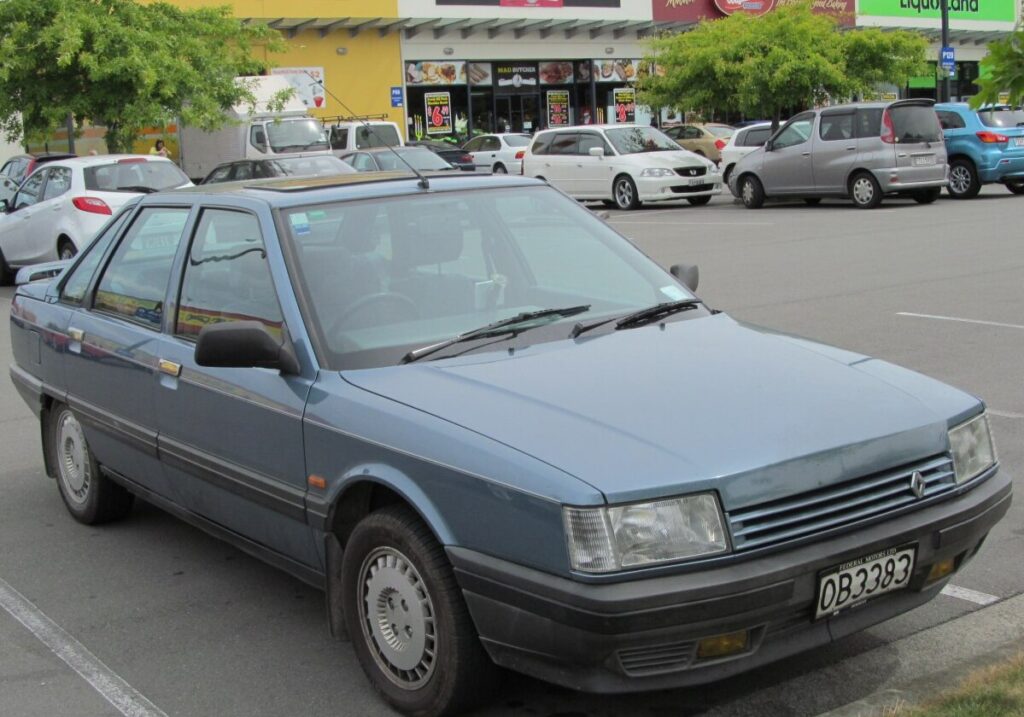
The Renault 21 2.0i, produced between 1989 and 1993, represented a significant step up in the Renault 21 (B48) lineup. Positioned as a mid-range offering, it bridged the gap between the more economical base models and the higher-performance turbocharged variants. This model was primarily aimed at buyers seeking a comfortable, well-equipped family sedan with respectable performance for its time. The 21 was Renault’s large family car, replacing the Renault 18, and was itself superseded by the Renault Laguna. It was a popular choice in Europe, particularly in France, where it competed with vehicles like the Peugeot 405 and Citroën BX.
Technical Specifications
| Brand | Renault |
| Model | 21 |
| Generation | 21 (B48) |
| Type (Engine) | 2.0 i (120 Hp) |
| Start of production | 1989 |
| End of production | 1993 |
| Powertrain Architecture | Internal Combustion engine |
| Body type | Sedan |
| Seats | 5 |
| Doors | 4 |
| Fuel consumption (urban) | 11.8 l/100 km (19.9 US mpg, 23.9 UK mpg) |
| Fuel consumption (extra urban) | 6.5 l/100 km (36.2 US mpg, 43.5 UK mpg) |
| Fuel consumption (combined) | 7.9 l/100 km (29.8 US mpg, 35.8 UK mpg) |
| Fuel Type | Petrol (Gasoline) |
| Acceleration 0 – 100 km/h | 9.9 sec |
| Acceleration 0 – 62 mph | 9.9 sec |
| Acceleration 0 – 60 mph | 9.4 sec |
| Maximum speed | 192 km/h (119.3 mph) |
| Weight-to-power ratio | 9 kg/Hp, 111.1 Hp/tonne |
| Weight-to-torque ratio | 6.4 kg/Nm, 155.6 Nm/tonne |
| Power | 120 Hp @ 5500 rpm |
| Power per litre | 60.2 Hp/l |
| Torque | 168 Nm @ 4500 rpm (123.91 lb.-ft. @ 4500 rpm) |
| Engine layout | Front, Transverse |
| Engine Model/Code | J7R 746, J7R 747 |
| Engine displacement | 1995 cm3 (121.74 cu. in.) |
| Number of cylinders | 4 |
| Engine configuration | Inline |
| Cylinder Bore | 88 mm (3.46 in.) |
| Piston Stroke | 82 mm (3.23 in.) |
| Compression ratio | 10:1 |
| Number of valves per cylinder | 2 |
| Fuel injection system | Multi-port manifold injection |
| Engine aspiration | Naturally aspirated engine |
| Valvetrain | OHC |
| Engine oil capacity | 5.5 l (5.81 US qt | 4.84 UK qt) |
| Coolant capacity | 6.8 l (7.19 US qt | 5.98 UK qt) |
| Kerb Weight | 1080 kg (2380.99 lbs.) |
| Max. weight | 1570 kg (3461.26 lbs.) |
| Max load | 490 kg (1080.27 lbs.) |
| Trunk (boot) space – minimum | 490 l (17.3 cu. ft.) |
| Fuel tank capacity | 66 l (17.44 US gal | 14.52 UK gal) |
| Length | 4530 mm (178.35 in.) |
| Width | 1730 mm (68.11 in.) |
| Height | 1415 mm (55.71 in.) |
| Wheelbase | 2660 mm (104.72 in.) |
| Front track | 1430 mm (56.3 in.) |
| Rear track | 1400 mm (55.12 in.) |
| Drivetrain Architecture | Front wheel drive |
| Number of gears | 5 |
| Gearbox type | Manual transmission |
| Front suspension | Spring Strut |
| Rear suspension | Torsion |
| Front brakes | Ventilated discs |
| Rear brakes | Drum |
| Assisting systems | ABS (Anti-lock braking system) |
| Steering type | Steering rack and pinion |
| Power steering | Hydraulic Steering |
| Tires size | 185/65 R14 |
| Wheel rims size | 14 |
Powertrain & Engine Architecture
The heart of the Renault 21 2.0i is the J7R engine, specifically the J7R 746 or J7R 747 variant. This is a 1995cc, inline-four cylinder engine featuring a single overhead camshaft (OHC) and two valves per cylinder. The engine utilizes multi-port fuel injection, a significant advancement over earlier carburetor-equipped models, contributing to improved fuel efficiency and smoother power delivery. The J7R engine is known for its relative simplicity and durability. The 2.0L engine produced 120 horsepower at 5500 rpm and 168 Nm (124 lb-ft) of torque at 4500 rpm. This power was delivered to the front wheels through a five-speed manual transmission, although a three-speed automatic transmission was also available, albeit less common. The automatic transmission, while offering convenience, did impact acceleration and fuel economy. The engine’s design prioritized reliability and ease of maintenance over outright performance.
Driving Characteristics
The Renault 21 2.0i with the manual transmission offered a reasonably engaging driving experience. Acceleration to 60 mph took around 9.4 seconds, and it had a top speed of approximately 119 mph. The engine provided adequate power for everyday driving and overtaking maneuvers. The five-speed gearbox allowed for efficient cruising on the highway. The automatic transmission version, while smoother, noticeably dulled performance, extending the 0-60 mph time to around 10.5 seconds. The suspension, featuring a spring strut front and torsion beam rear, provided a comfortable ride, absorbing bumps and imperfections in the road well. However, it wasn’t particularly sporty, with noticeable body roll during cornering. Steering feel was adequate, but lacked the precision found in some contemporary rivals. Overall, the driving experience was geared towards comfort and practicality rather than outright performance.
Equipment & Trim Levels
The 2.0i trim level of the Renault 21 typically included features such as central locking, electric front windows, and a basic stereo system. Higher-spec versions could be equipped with options like air conditioning, a sunroof, and upgraded upholstery. Interior materials were generally durable, though not luxurious. The dashboard layout was functional and straightforward, with clearly labeled controls. The seats offered reasonable comfort for long journeys. The 2.0i sat above the base 1.7L models in terms of equipment and performance, but below the more powerful and expensive 2.0 Turbo and V6 variants. The 2.0i represented a good balance of features for the price, appealing to families and drivers seeking a well-equipped vehicle.
Chassis & Braking
The Renault 21 2.0i utilized a front-wheel-drive layout with a relatively simple chassis design. The front suspension employed MacPherson struts, while the rear featured a torsion beam. Braking was handled by ventilated discs at the front and drum brakes at the rear. Anti-lock braking system (ABS) was available as an option, enhancing safety. The steering was rack and pinion, providing reasonable precision, and was assisted by hydraulic power steering for ease of use. The tires were typically 185/65 R14, offering a good balance of comfort and grip. The chassis was designed to prioritize ride comfort and stability over sporty handling.
Market Reception & Comparison
The Renault 21 2.0i was generally well-received by automotive critics as a practical and comfortable family car. It was praised for its spacious interior, comfortable ride, and relatively fuel-efficient engine. However, some critics noted that the styling was somewhat conservative and that the handling wasn’t particularly engaging. Compared to the 1.7L models, the 2.0i offered a noticeable performance boost. Compared to the 2.0 Turbo and V6 versions, it was less powerful but more affordable and fuel-efficient. The 2.0i offered a good compromise between performance, economy, and price. It was seen as a sensible choice for buyers who prioritized practicality and comfort over outright performance.
Legacy
The Renault 21 2.0i, while not a particularly rare or collectible car today, remains a reasonably reliable and affordable classic. The J7R engine is known for its durability, and parts availability is generally good. However, like any older car, it’s important to check for rust and ensure that regular maintenance has been performed. The automatic transmission versions are less sought after due to their reduced performance. Today, the Renault 21 2.0i represents a solid and dependable choice for those seeking a classic French family sedan, offering a glimpse into a bygone era of automotive design and engineering. It’s a testament to Renault’s commitment to building practical and reliable vehicles for the everyday driver.
