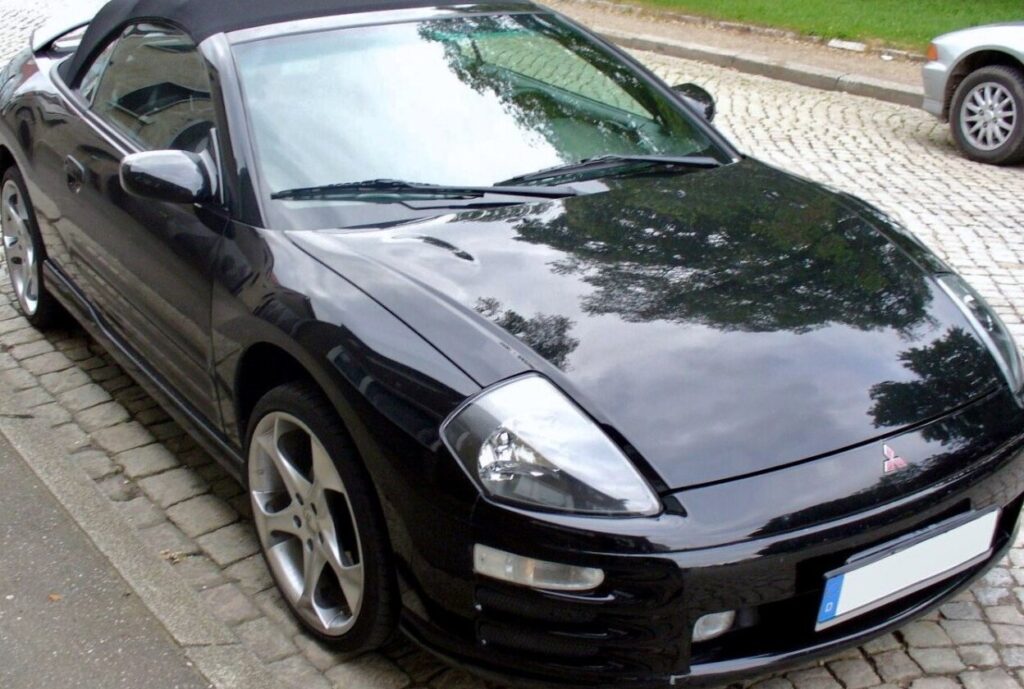
The Mitsubishi Eclipse Spyder III (3G) GS 2.4 i 16V, produced from 1999 to 2002, represented a significant iteration of Mitsubishi’s popular sports compact convertible. Positioned as a mid-range offering within the third-generation Eclipse Spyder lineup (internally designated the 3G), this variant aimed to balance performance with affordability and everyday usability. It occupied a space between the base model and the more powerful turbocharged versions, appealing to buyers seeking a stylish open-air experience without the higher price tag or increased running costs of the GT models. The 3G Eclipse Spyder, built on the shared Diamond Star Motors (DSM) platform, was a key model for Mitsubishi in the North American market, capitalizing on the growing demand for sporty convertibles.
Technical Specifications
| Brand | Mitsubishi |
| Model | Eclipse |
| Generation | Eclipse Spyder III (3G) |
| Type (Engine) | GS 2.4 i 16V (147 Hp) |
| Start of production | 1999 |
| End of production | 2002 |
| Powertrain Architecture | Internal Combustion engine |
| Body type | Cabriolet |
| Seats | 4 |
| Doors | 2 |
| Fuel consumption (urban) | 10.2 l/100 km (23.1 US mpg) |
| Fuel consumption (extra urban) | 7.9 l/100 km (29.8 US mpg) |
| Fuel Type | Petrol (Gasoline) |
| Weight-to-power ratio | 9.5 kg/Hp |
| Weight-to-torque ratio | 6.5 kg/Nm |
| Power | 147 Hp @ 5500 rpm |
| Power per litre | 62.6 Hp/l |
| Torque | 214 Nm @ 4000 rpm (157.84 lb.-ft. @ 4000 rpm) |
| Engine layout | Front, Transverse |
| Engine displacement | 2350 cm3 (143.41 cu. in.) |
| Number of cylinders | 4 |
| Engine configuration | Inline |
| Cylinder Bore | 86.5 mm (3.41 in.) |
| Piston Stroke | 100 mm (3.94 in.) |
| Compression ratio | 9.5:1 |
| Number of valves per cylinder | 4 |
| Fuel injection system | Multi-port manifold injection |
| Engine aspiration | Naturally aspirated engine |
| Valvetrain | SOHC |
| Kerb Weight | 1395 kg (3075.45 lbs.) |
| Max. weight | 1770 kg (3902.18 lbs.) |
| Max load | 375 kg (826.73 lbs.) |
| Trunk (boot) space – minimum | 170 l (6 cu. ft.) |
| Fuel tank capacity | 62 l (16.38 US gal) |
| Length | 4455 mm (175.39 in.) |
| Width | 1750 mm (68.9 in.) |
| Height | 1340 mm (52.76 in.) |
| Wheelbase | 2560 mm (100.79 in.) |
| Front track | 1510 mm (59.45 in.) |
| Rear (Back) track | 1510 mm (59.45 in.) |
| Front overhang | 975 mm (38.39 in.) |
| Rear overhang | 920 mm (36.22 in.) |
| Ride height (ground clearance) | 163 mm (6.42 in.) |
| Drivetrain Architecture | Front wheel drive |
| Number of gears and type of gearbox | 5 gears, manual transmission |
| Front suspension | Independent type McPherson |
| Rear suspension | Independent multi-link suspension |
| Front brakes | Ventilated discs |
| Rear brakes | Disc |
| Assisting systems | ABS (Anti-lock braking system) |
| Steering type | Steering rack and pinion |
| Power steering | Hydraulic Steering |
| Tires size | 205/55 R16 |
| Wheel rims size | 16 |
Powertrain & Engine Architecture
The GS 2.4 i 16V variant was powered by Mitsubishi’s 4G63 inline-four cylinder engine, displacing 2.4 liters (2350 cc). This engine, a staple in many Mitsubishi vehicles of the era, featured a single overhead camshaft (SOHC) valvetrain with four valves per cylinder. The engine utilized a multi-port fuel injection system for precise fuel delivery. While not as technologically advanced as the later MIVEC variable valve timing systems found in higher-spec Eclipses, the 4G63 was known for its durability and relatively easy maintenance. The 147 horsepower output was achieved at 5500 rpm, with peak torque of 214 Nm (157.84 lb-ft) arriving at 4000 rpm. The engine was transversely mounted in the front of the vehicle, driving the front wheels. The standard transmission for this model was a five-speed manual, offering a direct and engaging driving experience.
Driving Characteristics
The 2.4-liter engine, paired with the five-speed manual transmission, provided adequate performance for everyday driving. Acceleration was respectable, though not particularly brisk, with a 0-60 mph time estimated around 8-9 seconds. The engine felt relatively smooth and responsive in the mid-range, making it suitable for both city commuting and highway cruising. Compared to the turbocharged Eclipse GS-T, the naturally aspirated GS lacked the immediate punch and overall speed, but it offered a more linear power delivery and reduced turbo lag. The manual transmission featured well-chosen gear ratios, allowing the driver to keep the engine in its optimal power band. The front-wheel-drive configuration provided decent traction in most conditions, but could exhibit some torque steer under hard acceleration.
Equipment & Trim Levels
The Eclipse Spyder GS 2.4 i 16V typically came equipped with a range of standard features designed to enhance comfort and convenience. These included power windows, power locks, air conditioning, and a basic audio system. The interior featured cloth upholstery and a relatively simple dashboard layout. Optional extras included a premium sound system, leather upholstery, and a power-operated convertible top. The GS trim level generally offered a step up in features compared to the base model, but lacked the more luxurious appointments found in the GT trim.
Chassis & Braking
The Eclipse Spyder’s chassis featured an independent McPherson strut suspension in the front and an independent multi-link suspension in the rear. This setup provided a good balance of ride comfort and handling. The GS model typically featured ventilated disc brakes in the front and solid disc brakes in the rear. Anti-lock braking system (ABS) was standard, enhancing safety and control during emergency braking situations. The steering was rack-and-pinion with hydraulic power assistance, providing precise and responsive steering feel. The standard tire size was 205/55 R16, mounted on 16-inch alloy wheels.
Market Reception & Comparison
The Eclipse Spyder GS 2.4 i 16V was generally well-received by automotive critics as a stylish and affordable convertible. It was praised for its comfortable ride, responsive handling, and relatively fuel-efficient engine. However, some reviewers noted that the engine lacked the power and excitement of the turbocharged GS-T model. Compared to other convertibles in its class, such as the Mazda Miata and Honda Civic Sol, the Eclipse Spyder offered a more spacious interior and a more powerful engine, but it was also heavier and less nimble. Fuel economy was reasonable for a vehicle of its type, averaging around 23 mpg in the city and 30 mpg on the highway.
Legacy
The Mitsubishi Eclipse Spyder III (3G) GS 2.4 i 16V has maintained a modest following among enthusiasts. The 4G63 engine is known for its durability and potential for modification, making it a popular choice for those seeking a reliable and tunable powerplant. While not as sought-after as the turbocharged GS-T models, the GS 2.4 i 16V offers a more affordable entry point into the Eclipse Spyder ownership experience. Today, well-maintained examples can be found on the used car market, often appealing to buyers looking for a classic sports compact convertible with a reasonable price tag. Common issues to look for include convertible top wear, rust in areas prone to corrosion, and general wear and tear associated with age and mileage.