
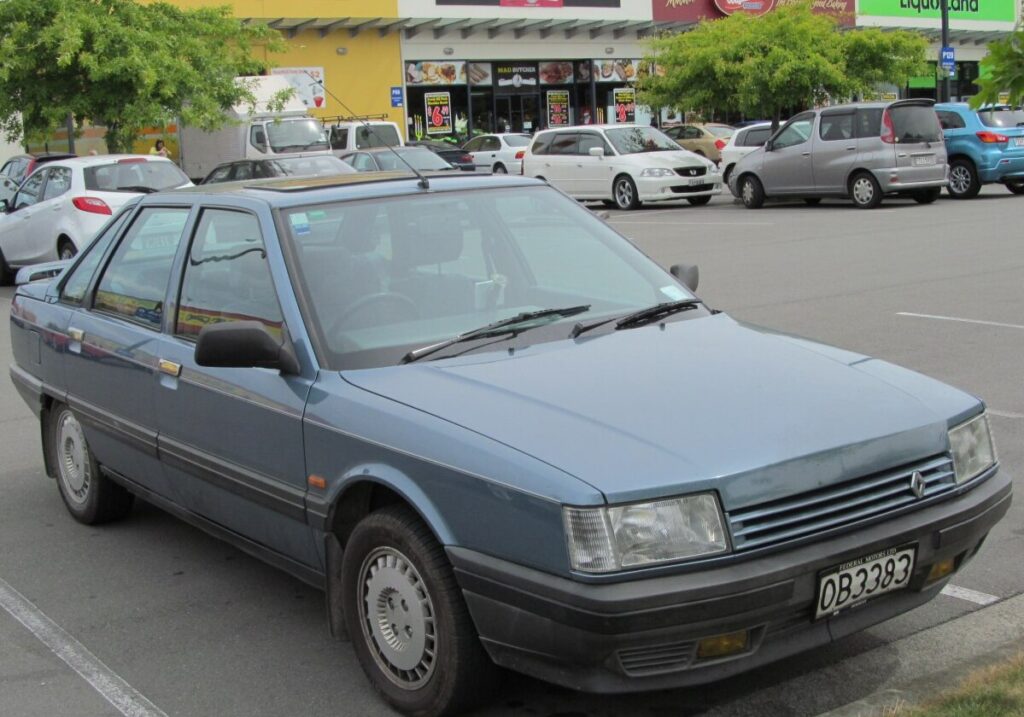
The Renault 21 2.0i Turbo 4×4, produced between 1989 and 1994, represented the performance pinnacle of the B48 Renault 21 range. Positioned as the flagship model, it combined a potent turbocharged engine with all-wheel drive, offering a unique driving experience within the typically front-wheel-drive European mid-size sedan segment. This variant was aimed at drivers seeking a blend of practicality, comfort, and spirited performance, differentiating itself from the more economical base models and the generally less powerful naturally aspirated versions.
Technical Specifications
| Brand | Renault |
| Model | 21 |
| Generation | 21 (B48) |
| Type (Engine) | 2.0 i Turbo (175 Hp) 4×4 |
| Start of production | 1989 |
| End of production | 1994 |
| Powertrain Architecture | Internal Combustion engine |
| Body type | Sedan |
| Seats | 5 |
| Doors | 4 |
| Fuel consumption (urban) | 12 l/100 km (19.6 US mpg, 23.5 UK mpg, 8.3 km/l) |
| Fuel consumption (extra urban) | 7.4 l/100 km (31.8 US mpg, 38.2 UK mpg, 13.5 km/l) |
| Fuel consumption (combined) | 8.9 l/100 km (26.4 US mpg, 31.7 UK mpg, 11.2 km/l) |
| Fuel Type | Petrol (Gasoline) |
| Acceleration 0 – 100 km/h | 8.6 sec |
| Acceleration 0 – 62 mph | 8.6 sec |
| Acceleration 0 – 60 mph | 8.2 sec |
| Maximum speed | 217 km/h (134.84 mph) |
| Weight-to-power ratio | 7.7 kg/Hp, 130.1 Hp/tonne |
| Weight-to-torque ratio | 5 kg/Nm, 200.7 Nm/tonne |
| Power | 175 Hp @ 5200 rpm |
| Power per litre | 87.7 Hp/l |
| Torque | 270 Nm @ 3000 rpm (199.14 lb.-ft. @ 3000 rpm) |
| Engine layout | Front, Transverse |
| Engine Model/Code | J7R 752 |
| Engine displacement | 1995 cm3 (121.74 cu. in.) |
| Number of cylinders | 4 |
| Engine configuration | Inline |
| Cylinder Bore | 88 mm (3.46 in.) |
| Piston Stroke | 82 mm (3.23 in.) |
| Compression ratio | 8.1:1 |
| Number of valves per cylinder | 2 |
| Fuel injection system | Multi-port manifold injection |
| Engine aspiration | Turbocharger |
| Valvetrain | OHC |
| Engine oil capacity | 6.5 l (6.87 US qt | 5.72 UK qt) |
| Coolant | 6.2 l (6.55 US qt | 5.46 UK qt) |
| Kerb Weight | 1345 kg (2965.22 lbs.) |
| Max. weight | 1800 kg (3968.32 lbs.) |
| Max load | 455 kg (1003.1 lbs.) |
| Trunk (boot) space – minimum | 490 l (17.3 cu. ft.) |
| Fuel tank capacity | 62 l (16.38 US gal | 13.64 UK gal) |
| Length | 4530 mm (178.35 in.) |
| Width | 1730 mm (68.11 in.) |
| Height | 1415 mm (55.71 in.) |
| Wheelbase | 2660 mm (104.72 in.) |
| Front track | 1430 mm (56.3 in.) |
| Rear (Back) track | 1400 mm (55.12 in.) |
| Drive wheel | All wheel drive (4×4) |
| Number of gears and type of gearbox | 5 gears, manual transmission |
| Front suspension | Spring Strut |
| Rear suspension | Torsion |
| Front brakes | Ventilated discs |
| Rear brakes | Disc |
| Assisting systems | ABS (Anti-lock braking system) |
| Steering type | Steering rack and pinion |
| Power steering | Hydraulic Steering |
| Tires size | 195/55 R15 |
| Wheel rims size | 15 |
INTRODUCTION
The Renault 21 (B48) 2.0i Turbo 4×4 was introduced in 1989 as a higher-performance variant of the popular Renault 21 sedan. The B48 generation, launched in 1986, was a significant update to the original Renault 21, offering improved styling, interior refinement, and mechanical upgrades. The 2.0i Turbo 4×4 sat at the top of the range, offering a compelling alternative to front-wheel-drive competitors and appealing to buyers who desired all-weather capability and enhanced performance. Production continued until 1994, coinciding with the introduction of the Renault Laguna, which eventually replaced the 21 in Renault’s lineup.
Powertrain & Engine Architecture
The heart of the 21 2.0i Turbo 4×4 is the J7R 752 engine, a 1995cc inline-four cylinder powerplant. This engine utilizes a Garrett turbocharger and multi-port fuel injection to produce 175 horsepower at 5200 rpm and 270 Nm (199 lb-ft) of torque at 3000 rpm. The engine features a single overhead camshaft (OHC) valvetrain with two valves per cylinder. The 8.1:1 compression ratio was a compromise between performance and reliability when using the turbocharger. The engine’s transverse mounting and front-wheel-bias all-wheel-drive system contribute to its handling characteristics. The 4×4 system itself is a viscous coupling system, providing automatic engagement of the rear wheels when traction is lost. The car was exclusively offered with a five-speed manual transmission, chosen to handle the engine’s torque output and provide a more engaging driving experience.
Driving Characteristics
The 2.0i Turbo 4×4 delivers a noticeably more spirited driving experience than the lower-powered Renault 21 variants. Acceleration to 60 mph takes approximately 8.2 seconds, and it achieves a top speed of 134.84 mph. The turbocharger provides a surge of power in the mid-range, making overtaking maneuvers effortless. The all-wheel-drive system enhances traction, particularly on slippery surfaces, providing increased stability and confidence. While the suspension is tuned for comfort, it offers reasonable body control. The five-speed manual transmission allows for precise gear selection, maximizing the engine’s performance. Compared to the naturally aspirated 2.0-liter models, the turbo variant offers significantly more power and torque, but at the expense of slightly increased fuel consumption.
Equipment & Trim Levels
The 2.0i Turbo 4×4 was typically well-equipped, reflecting its position as the range-topping model. Standard features included central locking, electric windows, power steering, and an anti-lock braking system (ABS). Interior appointments typically featured comfortable cloth upholstery, although leather options were sometimes available. The dashboard layout was functional and ergonomically designed, with clear instrumentation. Optional extras could include a sunroof, upgraded audio system, and metallic paint finishes. The interior trim was generally more refined than the base models, with higher-quality materials used throughout.
Chassis & Braking
The Renault 21 2.0i Turbo 4×4 utilizes a MacPherson strut front suspension and a torsion beam rear suspension. The front brakes are ventilated discs, providing ample stopping power, while the rear brakes are solid discs. The all-wheel-drive system adds weight compared to front-wheel-drive models, but the improved traction compensates for this. The steering is a rack-and-pinion system with hydraulic power assistance, offering precise and responsive handling. Tire size is typically 195/55 R15, providing a good balance between grip and ride comfort.
Market Reception & Comparison
The Renault 21 2.0i Turbo 4×4 was generally well-received by automotive critics, who praised its performance, handling, and all-weather capability. However, some reviewers noted that the turbocharger could exhibit some lag, and the fuel economy was not as competitive as some of its rivals. Compared to other models in the Renault 21 range, the Turbo 4×4 offered a significant performance upgrade, but it also came at a higher price point. It competed with other performance sedans of the era, such as the Ford Sierra RS Cosworth and the Peugeot 405 T16, although it was generally positioned as a more practical and affordable alternative.
Legacy
The Renault 21 2.0i Turbo 4×4 remains a relatively rare and sought-after classic car today. The J7R engine, while not without its quirks, is generally considered to be robust and reliable when properly maintained. The all-wheel-drive system adds to its appeal, making it a capable and enjoyable car to drive in a variety of conditions. Finding well-maintained examples can be challenging, as many have succumbed to rust or neglect. However, for enthusiasts seeking a unique and rewarding classic French sedan, the Renault 21 2.0i Turbo 4×4 represents a compelling option. Parts availability can be limited, but a dedicated community of owners and specialists exists to support the preservation of these vehicles.
