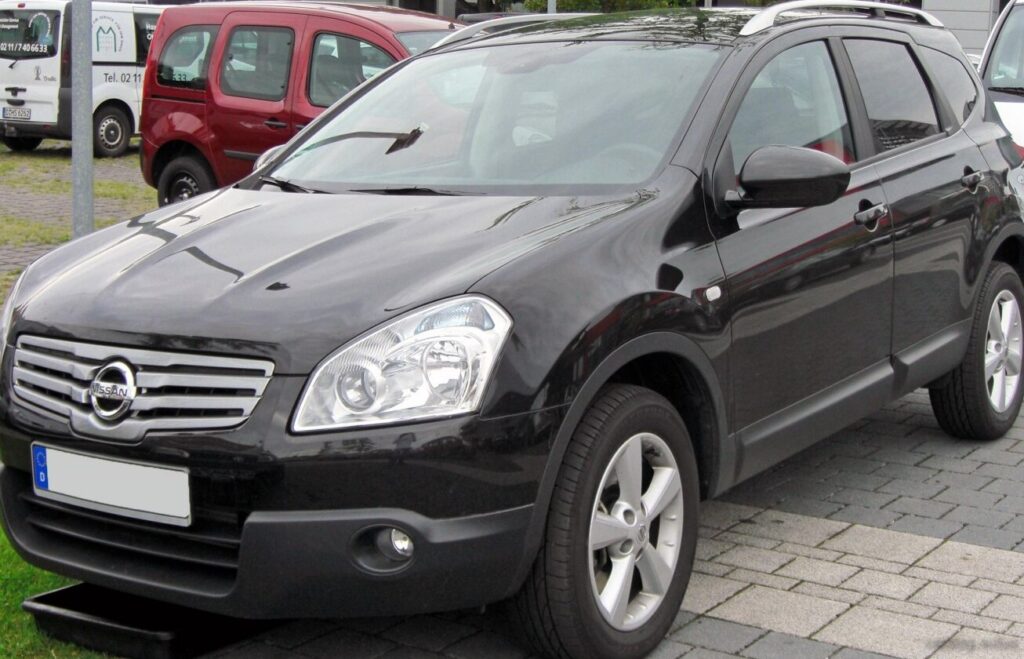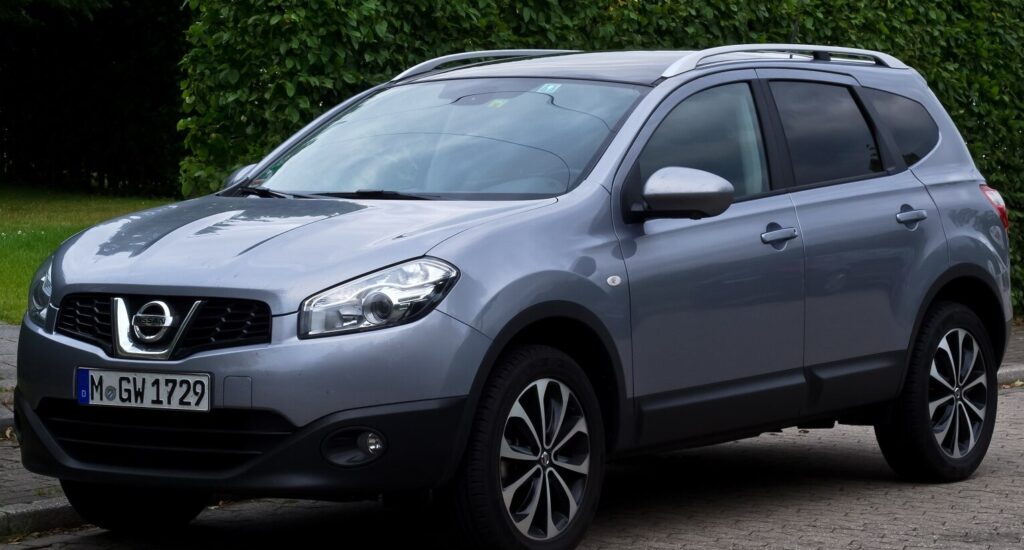
The Nissan Qashqai+2 I (NJ10), specifically the facelifted version produced from 2010 to 2014, represented Nissan’s entry into the compact crossover segment with optional seven-passenger seating. This variant, equipped with the 1.6-liter HR16DE engine producing 117 horsepower and featuring a Stop/Start system, was positioned as a fuel-efficient and practical option within the Qashqai+2 lineup. It aimed to appeal to families seeking a versatile vehicle for everyday use, offering a balance between space, economy, and affordability. The Qashqai+2, built on the Nissan B platform (shared with the Renault Mégane), was primarily marketed in Europe, offering a more spacious alternative to traditional hatchbacks and smaller SUVs.
Technical Specifications
| Brand | Nissan |
| Model | Qashqai |
| Generation | Qashqai+2 I (NJ10, facelift 2010) |
| Type (Engine) | 1.6 (117 Hp) Stop/Start |
| Start of production | 2010 |
| End of production | 2014 |
| Powertrain Architecture | Internal Combustion engine |
| Body type | SUV, Crossover |
| Seats | 7 |
| Doors | 5 |
| Fuel consumption (urban) | 7.9 l/100 km (29.8 US mpg, 35.8 UK mpg, 12.7 km/l) |
| Fuel consumption (extra urban) | 5.6 l/100 km (42 US mpg, 50.4 UK mpg, 17.9 km/l) |
| Fuel consumption (combined) | 6.4 l/100 km (36.8 US mpg, 44.1 UK mpg, 15.6 km/l) |
| CO2 emissions | 149 g/km |
| Fuel Type | Petrol (Gasoline) |
| Acceleration 0 – 100 km/h | 12.9 sec |
| Acceleration 0 – 62 mph | 12.9 sec |
| Acceleration 0 – 60 mph | 12.3 sec |
| Maximum speed | 180 km/h (111.85 mph) |
| Emission standard | Euro 5 |
| Weight-to-power ratio | 12.1 kg/Hp, 82.5 Hp/tonne |
| Weight-to-torque ratio | 9 kg/Nm, 111.3 Nm/tonne |
| Power | 117 Hp @ 6000 rpm |
| Power per litre | 73.2 Hp/l |
| Torque | 158 Nm @ 4400 rpm (116.53 lb.-ft. @ 4400 rpm) |
| Engine layout | Front, Transverse |
| Engine Model/Code | HR16DE |
| Engine displacement | 1598 cm3 (97.52 cu. in.) |
| Number of cylinders | 4 |
| Engine configuration | Inline |
| Cylinder Bore | 78 mm (3.07 in.) |
| Piston Stroke | 83.6 mm (3.29 in.) |
| Compression ratio | 10.7:1 |
| Number of valves per cylinder | 4 |
| Fuel injection system | Multi-port manifold injection |
| Engine aspiration | Naturally aspirated engine |
| Engine oil capacity | 4.3 l (4.54 US qt | 3.78 UK qt) |
| Coolant | 6.4 l (6.76 US qt | 5.63 UK qt) |
| Kerb Weight | 1419-1523 kg (3128.36 – 3357.64 lbs.) |
| Max. weight | 2072 kg (4567.98 lbs.) |
| Max load | 549-653 kg (1210.34 – 1439.62 lbs.) |
| Trunk (boot) space – minimum | 130 l (4.59 cu. ft.) |
| Trunk (boot) space – maximum | 1520 l (53.68 cu. ft.) |
| Fuel tank capacity | 65 l (17.17 US gal | 14.3 UK gal) |
| Permitted trailer load with brakes (12%) | 1200 kg (2645.55 lbs.) |
| Permitted trailer load without brakes | 735 kg (1620.4 lbs.) |
| Permitted towbar download | 75 kg (165.35 lbs.) |
| Length | 4541 mm (178.78 in.) |
| Width | 1780 mm (70.08 in.) |
| Height | 1645 mm (64.76 in.) |
| Wheelbase | 2765 mm (108.86 in.) |
| Front track | 1540 mm (60.63 in.) |
| Rear (Back) track | 1550 mm (61.02 in.) |
| Minimum turning circle | 11 m (36.09 ft.) |
| Drivetrain | Front wheel drive |
| Number of gears and type of gearbox | 5 gears, manual transmission |
| Front suspension | Independent, type McPherson with coil spring and anti-roll bar |
| Rear suspension | Independent multi-link spring suspension with stabilizer |
| Front brakes | Ventilated discs |
| Rear brakes | Disc |
| Assisting systems | ABS (Anti-lock braking system) |
| Steering type | Steering rack and pinion |
| Power steering | Electric Steering |
| Tires size | 215/55 R18 |
| Wheel rims size | 6.5J x 18 |
Powertrain & Engine Architecture
The heart of this Qashqai+2 variant is the HR16DE 1.6-liter inline-four cylinder gasoline engine. This engine, a member of Nissan’s HR series, utilizes multi-point fuel injection and a dual overhead camshaft (DOHC) valvetrain with four valves per cylinder. The HR16DE is known for its relatively simple design and focus on fuel efficiency. The Stop/Start system, introduced to improve fuel economy, automatically shuts off the engine when the vehicle comes to a halt and restarts it upon releasing the brake pedal. This system relies on a robust starter motor and a reinforced dual-mass flywheel to handle the frequent start-stop cycles. The engine is transversely mounted, driving the front wheels through a five-speed manual transmission. While an automatic transmission was available on other Qashqai models, this specific 117 hp version was primarily offered with the manual gearbox in many European markets.
Driving Characteristics
The 1.6-liter engine, producing 117 horsepower, provides adequate but not exhilarating performance in the Qashqai+2. Acceleration from 0-60 mph takes around 12.3 seconds, and the top speed is approximately 112 mph. The five-speed manual transmission offers a reasonable spread of gears, but the engine feels strained when accelerating hard or climbing hills. Compared to the more powerful 1.5 dCi diesel or the 2.0-liter gasoline variants, this 1.6L engine prioritizes fuel economy over outright performance. The gear ratios are tuned for efficiency, resulting in a comfortable cruising experience but requiring frequent downshifts for overtaking maneuvers. The relatively light weight of the vehicle (around 3,100-3,350 lbs) helps to mitigate the engine’s modest power output.
Equipment & Trim Levels
The 1.6-liter Stop/Start Qashqai+2 typically came equipped with a base level of features, including air conditioning, electric front windows, a CD player with auxiliary input, and ABS brakes. Higher trim levels, such as Visia, Acenta, and Tekna, added features like alloy wheels, climate control, rear parking sensors, Bluetooth connectivity, and a navigation system. Interior upholstery was typically cloth, with options for upgraded materials on higher trims. The seven-passenger configuration featured folding rear seats to maximize cargo space when not in use. Optional extras included a panoramic sunroof, leather seats, and a premium audio system.
Chassis & Braking
The Qashqai+2 utilizes an independent McPherson strut suspension at the front and an independent multi-link suspension at the rear, providing a comfortable ride quality. Stabilizer bars are fitted to both axles to reduce body roll during cornering. The braking system consists of ventilated discs at the front and solid discs at the rear, providing adequate stopping power for the vehicle’s weight and performance. ABS (Anti-lock Braking System) is standard, enhancing safety during emergency braking situations. The steering is electrically assisted, offering light and precise control.
Market Reception & Comparison
The 1.6-liter Qashqai+2 was generally well-received as a practical and affordable family vehicle. Critics praised its fuel efficiency and spacious interior, but noted its lack of outright performance. Compared to the diesel variants, the 1.6L petrol engine offered lower torque and slightly higher running costs, but it was quieter and smoother to drive. The manual transmission, while efficient, was sometimes criticized for its slightly notchy shift quality. Fuel economy figures of around 37 mpg combined were competitive for its class. Reliability was generally good, with the HR16DE engine proving to be a durable unit.
Legacy
The Nissan Qashqai+2, particularly the 1.6-liter variant, established Nissan as a key player in the European compact crossover market. The HR16DE engine continued to be used in other Nissan and Renault models, demonstrating its versatility and reliability. On the used car market, these Qashqai+2 models are often sought after for their affordability and practicality. While not the most exciting vehicle to drive, the 1.6L Stop/Start version offers a compelling combination of space, economy, and dependability, making it a sensible choice for families seeking a versatile and budget-friendly vehicle.