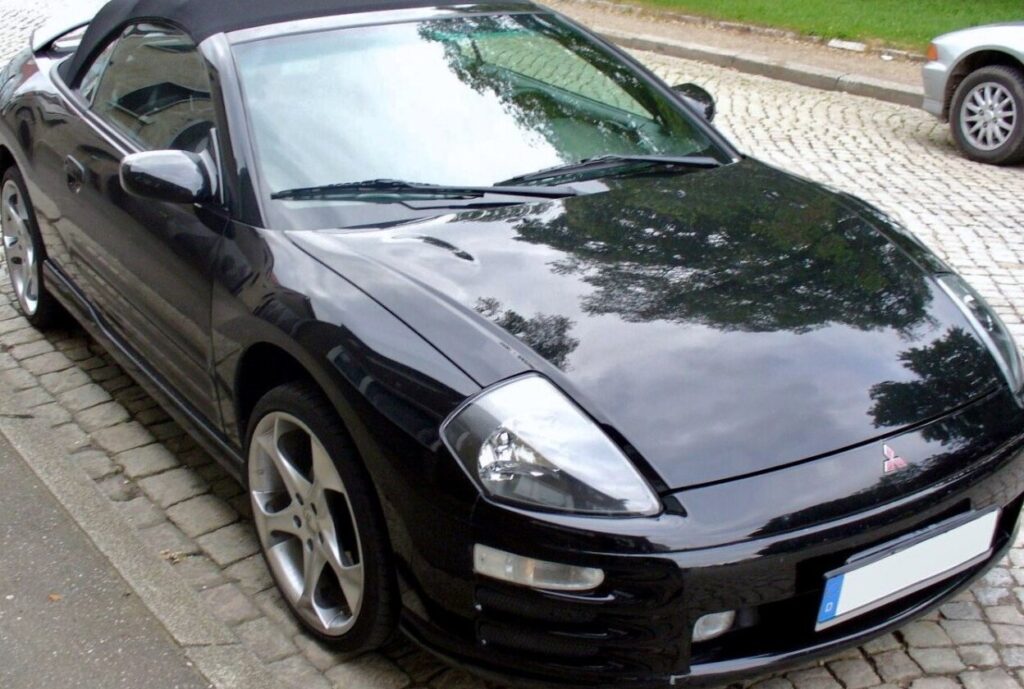
The Mitsubishi Eclipse Spyder III (3G) GT 3.0 i V6 24V, produced between 1999 and 2002, represented a significant evolution in Mitsubishi’s open-top sports car lineage. Part of the third generation (3G) Eclipse platform – internally designated as the 3G Spyder – this variant occupied the premium position within the convertible range, offering a substantial increase in performance over the base 2.0-liter models. It was primarily marketed towards enthusiasts seeking a blend of sporty handling, respectable power, and the open-air experience of a convertible, largely targeting the North American market where the Spyder found its greatest success. The 3G Eclipse, and particularly the Spyder, aimed to recapture some of the spirit of the original Eclipse while offering a more refined and mature driving experience.
Technical Specifications
| Brand | Mitsubishi |
| Model | Eclipse |
| Generation | Eclipse Spyder III (3G) |
| Type | GT 3.0 i V6 24V (200 Hp) |
| Start of production | 1999 |
| End of production | 2002 |
| Powertrain Architecture | Internal Combustion engine |
| Body type | Cabriolet |
| Seats | 4 |
| Doors | 2 |
| Fuel consumption (urban) | 11.8 l/100 km (19.9 US mpg) |
| Fuel consumption (extra urban) | 8.7 l/100 km (27 US mpg) |
| Fuel Type | Petrol (Gasoline) |
| Acceleration 0 – 100 km/h | 7.6 sec |
| Acceleration 0 – 62 mph | 7.6 sec |
| Acceleration 0 – 60 mph | 7.2 sec |
| Maximum speed | 215 km/h (133.59 mph) |
| Weight-to-power ratio | 7.4 kg/Hp |
| Weight-to-torque ratio | 5.3 kg/Nm |
| Power | 200 Hp @ 5500 rpm |
| Power per litre | 67.3 Hp/l |
| Torque | 278 Nm @ 4000 rpm (205.04 lb.-ft. @ 4000 rpm) |
| Engine layout | Front, Transverse |
| Engine displacement | 2972 cm3 (181.36 cu. in.) |
| Number of cylinders | 6 |
| Engine configuration | V-engine |
| Cylinder Bore | 91.1 mm (3.59 in.) |
| Piston Stroke | 76 mm (2.99 in.) |
| Compression ratio | 9:1 |
| Number of valves per cylinder | 4 |
| Fuel injection system | Multi-port manifold injection |
| Engine aspiration | Naturally aspirated engine |
| Valvetrain | SOHC |
| Kerb Weight | 1485 kg (3273.86 lbs.) |
| Trunk (boot) space (minimum) | 170 l (6 cu. ft.) |
| Fuel tank capacity | 62 l (16.38 US gal | 13.64 UK gal) |
| Length | 4455 mm (175.39 in.) |
| Width | 1750 mm (68.9 in.) |
| Height | 1340 mm (52.76 in.) |
| Wheelbase | 2560 mm (100.79 in.) |
| Front track | 1510 mm (59.45 in.) |
| Rear track | 1510 mm (59.45 in.) |
| Front overhang | 975 mm (38.39 in.) |
| Rear overhang | 920 mm (36.22 in.) |
| Ride height (ground clearance) | 165 mm (6.5 in.) |
| Drivetrain Architecture | Front wheel drive |
| Number of gears | 5 |
| Gearbox type | Manual transmission |
| Front suspension | Independent type McPherson |
| Rear suspension | Independent multi-link suspension |
| Front brakes | Ventilated discs |
| Rear brakes | Disc |
| Assisting systems | ABS (Anti-lock braking system) |
| Steering type | Steering rack and pinion |
| Power steering | Hydraulic Steering |
| Tires size | 215/50 R17 |
| Wheel rims size | 17 |
Powertrain & Engine Architecture
The heart of the Eclipse Spyder GT was the 6A13 3.0-liter V6 engine. This naturally aspirated powerplant featured a single overhead camshaft (SOHC) design and utilized multi-port fuel injection. The 6A13 was a robust engine, known for its relatively smooth power delivery. Its 9:1 compression ratio was a compromise between performance and reliability, allowing it to run on readily available 87 octane gasoline. The engine produced 200 horsepower at 5500 rpm and 278 Nm (205 lb-ft) of torque at 4000 rpm. The five-speed manual transmission was the standard offering, providing drivers with direct control over the engine’s power. The transmission was chosen for its durability and relatively short throw, enhancing the sporty driving experience.
Driving Characteristics
The 3.0-liter V6, coupled with the five-speed manual, provided a noticeable performance upgrade over the base 1.8-liter and 2.0-liter models. Acceleration to 60 mph was achieved in approximately 7.2 seconds, and the car felt responsive in everyday driving situations. While not a track weapon, the GT offered ample power for confident passing maneuvers and enjoyable cruising. The front-wheel-drive configuration, while contributing to lower production costs, did exhibit some torque steer under hard acceleration. The suspension, tuned for a balance between comfort and handling, provided a reasonably controlled ride, although it wasn’t as firm or precise as some rear-wheel-drive competitors. The manual transmission’s gear ratios were well-matched to the engine’s powerband, allowing for spirited driving without excessive shifting.
Equipment & Trim Levels
The GT trim level was the most well-equipped in the Spyder lineup. Standard features included air conditioning, power windows and locks, a premium sound system, and alloy wheels. Leather upholstery was often included, and options such as a sunroof, upgraded audio systems (including a Monsoon premium sound system), and automatic climate control were available. The interior design was generally considered functional and aesthetically pleasing for its time, although the materials used were not necessarily luxurious. The Spyder’s convertible top was a power-operated unit, offering convenient open-air motoring.
Chassis & Braking
The Eclipse Spyder III utilized a unibody construction for rigidity. The front suspension employed independent McPherson struts, while the rear featured an independent multi-link setup. This suspension configuration aimed to provide a comfortable ride while maintaining reasonable handling characteristics. Braking duties were handled by ventilated discs at the front and solid discs at the rear. Anti-lock brakes (ABS) were standard, enhancing safety and control during emergency braking situations. The steering system was a rack-and-pinion setup with hydraulic power assistance, providing responsive and precise steering feel.
Market Reception & Comparison
The Eclipse Spyder GT 3.0 was generally well-received by automotive critics. It was praised for its strong engine, comfortable ride, and attractive styling. However, some reviewers noted the presence of torque steer and the limitations of the front-wheel-drive platform. Compared to the base models, the GT offered a significant performance boost, justifying its higher price tag. Against competitors like the Mazda MX-5 Miata (which was rear-wheel drive and more focused on handling) and the Honda Prelude (which offered a more refined driving experience), the Eclipse Spyder GT occupied a middle ground, appealing to buyers who wanted a blend of performance, comfort, and practicality. Fuel economy was reasonable for a V6-powered convertible, averaging around 19 mpg in the city and 27 mpg on the highway.
Legacy
The Mitsubishi Eclipse Spyder III GT 3.0 i V6 24V has developed a modest following among enthusiasts. The 6A13 engine is known for its durability, and well-maintained examples can still provide reliable transportation today. However, like many cars of this era, age-related issues such as corrosion, worn suspension components, and electrical problems can arise. The Spyder’s convertible top mechanism can also require maintenance. On the used car market, prices for well-preserved examples have been steadily increasing, reflecting a growing appreciation for this generation of the Eclipse. While not a collector’s item in the same vein as some other sports cars, the Spyder GT represents a unique and enjoyable driving experience from the late 1990s and early 2000s.