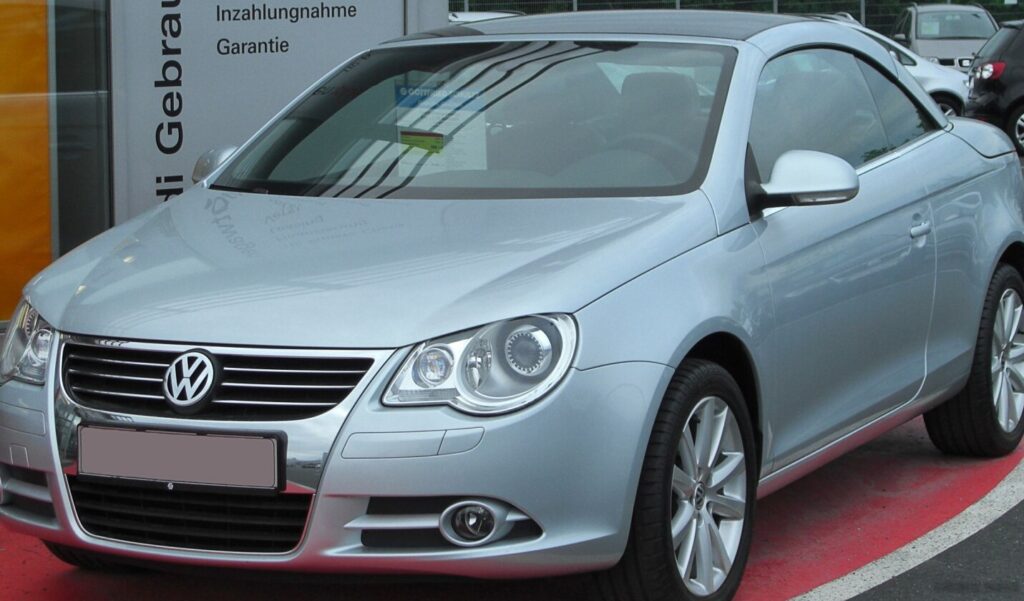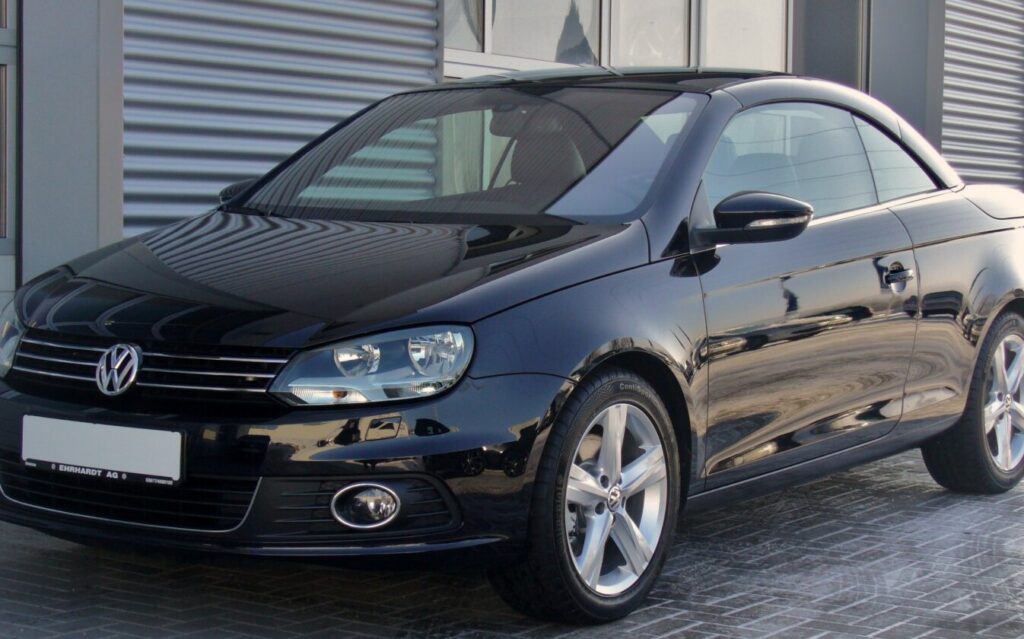
The Volkswagen Eos, particularly the facelifted version produced from October 2010 to May 2015, represented Volkswagen’s entry into the premium compact convertible market. The 1.4 TSI (160 hp) variant occupied a middle ground within the Eos lineup, offering a balance between performance, fuel efficiency, and affordability. Positioned above the base 1.6-liter engine and below the more powerful 2.0-liter TSI models, it aimed to attract buyers seeking a stylish and comfortable open-top experience without the higher price tag or running costs of the range-topping trims. The Eos itself was built on the Volkswagen Group’s A5 (or 1HX0) platform, shared with models like the Golf Mk5 and Mk6, and the Scirocco.
Technical Specifications
| Brand | Volkswagen |
| Model | Eos |
| Generation | Eos (facelift 2010) |
| Type (Engine) | 1.4 TSI (160 Hp) |
| Start of production | October, 2010 |
| End of production | May, 2015 |
| Powertrain Architecture | Internal Combustion engine |
| Body type | Coupe – Cabriolet |
| Seats | 4 |
| Doors | 2 |
| Fuel consumption (urban) | 8.9 l/100 km (26.4 US mpg, 31.7 UK mpg, 11.2 km/l) |
| Fuel consumption (extra urban) | 5.5 l/100 km (42.8 US mpg, 51.4 UK mpg, 18.2 km/l) |
| Fuel consumption (combined) | 6.8 l/100 km (34.6 US mpg, 41.5 UK mpg, 14.7 km/l) |
| CO2 emissions | 157 g/km |
| Fuel Type | Petrol (Gasoline) |
| Acceleration 0 – 100 km/h | 8.8 sec |
| Acceleration 0 – 62 mph | 8.8 sec |
| Acceleration 0 – 60 mph | 8.4 sec |
| Maximum speed | 217 km/h (134.84 mph) |
| Emission standard | Euro 5 |
| Weight-to-power ratio | 9.5 kg/Hp, 104.8 Hp/tonne |
| Weight-to-torque ratio | 6.4 kg/Nm, 157.3 Nm/tonne |
| Power | 160 Hp @ 5800 rpm |
| Power per litre | 115.1 Hp/l |
| Torque | 240 Nm @ 1500-4500 rpm (177.01 lb.-ft. @ 1500-4500 rpm) |
| Engine layout | Front, Transverse |
| Engine Model/Code | CAVD, CTHD |
| Engine displacement | 1390 cm3 (84.82 cu. in.) |
| Number of cylinders | 4 |
| Engine configuration | Inline |
| Number of valves per cylinder | 4 |
| Fuel injection system | Direct injection |
| Engine aspiration | Turbocharging and Supercharger, Intercooler |
| Engine oil capacity | 3.6 l (3.8 US qt | 3.17 UK qt) |
| Kerb Weight | 1526 kg (3364.25 lbs.) |
| Max. weight | 1950 kg (4299.01 lbs.) |
| Max load | 424 kg (934.76 lbs.) |
| Trunk (boot) space – minimum | 205 l (7.24 cu. ft.) |
| Fuel tank capacity | 55 l (14.53 US gal | 12.1 UK gal) |
| Length | 4423 mm (174.13 in.) |
| Width | 1791 mm (70.51 in.) |
| Height | 1444 mm (56.85 in.) |
| Wheelbase | 2578 mm (101.5 in.) |
| Front track | 1545 mm (60.83 in.) |
| Rear (Back) track | 1547 mm (60.91 in.) |
| Minimum turning circle | 10.9 m (35.76 ft.) |
| Drivetrain Architecture | The Internal combustion engine (ICE) drives the front wheels of the vehicle. |
| Drive wheel | Front wheel drive |
| Number of gears and type of gearbox | 6 gears, manual transmission |
| Front brakes | Ventilated discs |
| Assisting systems | ABS (Anti-lock braking system) |
| Steering type | Steering rack and pinion |
| Tires size | 215/55 R16; 235/40 R18 |
| Wheel rims size | 7J x 16; 8J x 18 |
Powertrain & Engine Architecture
The heart of the Eos 1.4 TSI was the EA111 engine family, specifically the CAVD or CTHD engine code depending on the exact production date and market. This 1.4-liter inline-four engine was notable for its combination of turbocharging and supercharging – a relatively uncommon setup. The supercharger provided immediate boost at low engine speeds, eliminating turbo lag and improving responsiveness during city driving. As the engine revved higher, the turbocharger took over, delivering sustained power. This dual-charging system, coupled with direct fuel injection, allowed the engine to produce 160 horsepower and 240 Nm (177 lb-ft) of torque. The engine featured four valves per cylinder and a timing chain for durability. The six-speed manual transmission was the standard offering, providing a good balance of fuel economy and driver engagement.
Driving Characteristics
The 1.4 TSI Eos offered a surprisingly sprightly driving experience for a convertible. While not a sports car, the engine’s torque delivery made it feel more powerful than its displacement suggested. Acceleration from 0 to 60 mph took around 8.4-8.8 seconds, which was competitive for its class. The manual transmission allowed for precise gear changes, and the relatively short ratios kept the engine in its power band. Compared to the 2.0 TSI models, the 1.4 TSI felt less urgent, particularly at higher speeds, but it offered a more relaxed and fuel-efficient driving experience. The Eos’s suspension was tuned for comfort, providing a smooth ride even on uneven surfaces. However, this did result in some body roll during cornering.
Equipment & Trim Levels
The Eos 1.4 TSI typically came well-equipped, even in base trim. Standard features included air conditioning, power windows and locks, a CD stereo system, and alloy wheels. Higher trim levels added features such as leather upholstery, heated front seats, a sunroof (in addition to the convertible top), and a premium sound system. Optional extras included navigation, parking sensors, and bi-xenon headlights. Interior upholstery was typically cloth on base models, with leather available as an upgrade. The dashboard layout was clean and functional, with a focus on ergonomics.
Chassis & Braking
The Eos utilized a MacPherson strut front suspension and a multi-link rear suspension, providing a good balance of ride comfort and handling. Front brakes were ventilated discs, while rear brakes were typically solid discs on most models, although some earlier versions may have featured drum brakes. Anti-lock braking system (ABS) was standard. The Eos’s chassis was reinforced to compensate for the lack of a fixed roof, ensuring adequate structural rigidity. Stabilizer bars were fitted front and rear to reduce body roll. The steering was a rack-and-pinion system, providing precise and responsive steering feel.
Market Reception & Comparison
The Volkswagen Eos 1.4 TSI was generally well-received by automotive critics. It was praised for its stylish design, comfortable interior, and refined driving experience. The 1.4 TSI engine was lauded for its fuel efficiency and responsiveness, although some reviewers noted that it lacked the outright power of the 2.0 TSI models. Compared to other compact convertibles, such as the Mazda MX-5 and BMW Z4, the Eos offered a more practical and comfortable experience, with a larger interior and a more forgiving suspension. However, it was also more expensive and less sporty. Fuel economy was a strong point, averaging around 34.6 US mpg in combined driving.
Legacy
The Volkswagen Eos, while not a massive sales success, established itself as a credible contender in the compact convertible segment. The 1.4 TSI engine proved to be relatively reliable, although regular maintenance is crucial. The dual-charging system can be more complex to repair than a traditional turbocharged engine, but it generally holds up well with proper care. On the used car market, the Eos 1.4 TSI represents a good value proposition for buyers seeking a stylish and comfortable convertible at an affordable price. However, potential buyers should be aware of the potential for convertible top issues and ensure that the car has been properly maintained.