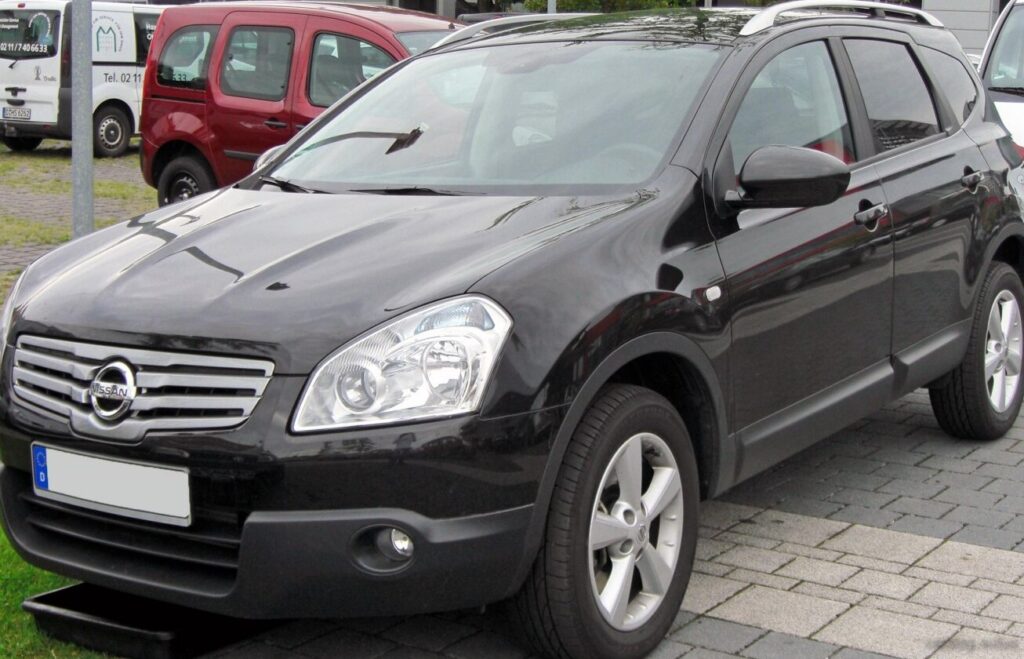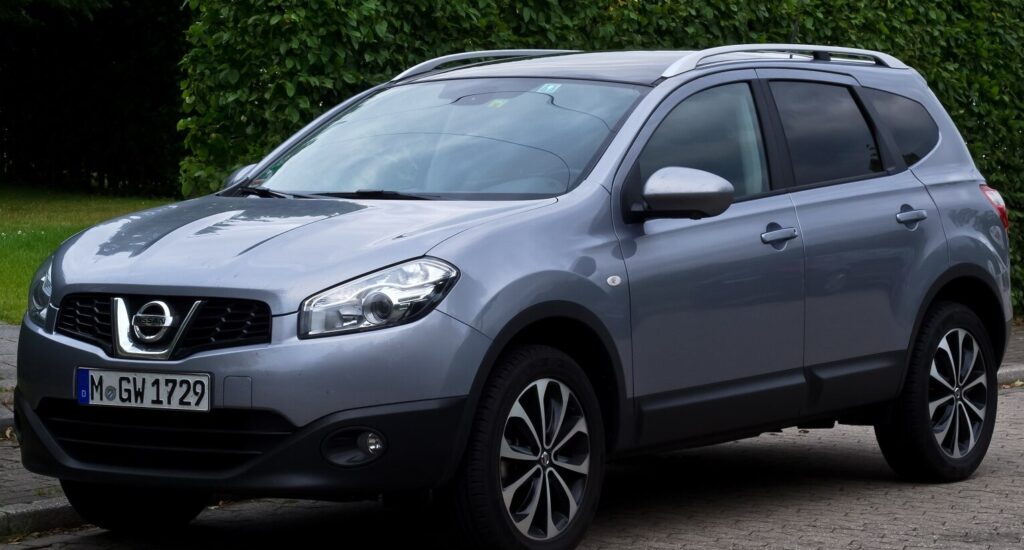
The Nissan Qashqai+2, specifically the first generation (NJ10) facelift model produced from 2011 to 2013, offered a unique proposition in the compact crossover segment: standard seven-passenger seating. This variant, equipped with the 1.6 dCi diesel engine producing 131 horsepower and paired with a six-speed manual transmission and all-wheel drive (4×4), represented a mid-range offering within the Qashqai+2 lineup. It aimed to balance fuel efficiency, practicality, and all-weather capability for families seeking a versatile vehicle. The Qashqai+2 was Nissan’s response to the growing demand for compact SUVs, particularly in the European market, where space and versatility were highly valued.
Technical Specifications
| Brand | Nissan |
| Model | Qashqai |
| Generation | Qashqai+2 I (NJ10, facelift 2010) |
| Type (Engine) | 1.6 dCi (131 Hp) 4×4 |
| Start of production | 2011 |
| End of production | 2013 |
| Powertrain Architecture | Internal Combustion engine |
| Body type | SUV, Crossover |
| Seats | 7 |
| Doors | 5 |
| Fuel consumption (urban) | 6.2 l/100 km (37.9 US mpg, 45.6 UK mpg, 16.1 km/l) |
| Fuel consumption (extra urban) | 4.7 l/100 km (50 US mpg, 60.1 UK mpg, 21.3 km/l) |
| Fuel consumption (combined) | 5.3 l/100 km (44.4 US mpg, 53.3 UK mpg, 18.9 km/l) |
| CO2 emissions | 139 g/km |
| Fuel Type | Diesel |
| Acceleration 0 – 100 km/h | 11.6 sec |
| Acceleration 0 – 62 mph | 11.6 sec |
| Acceleration 0 – 60 mph | 11 sec |
| Maximum speed | 189 km/h (117.44 mph) |
| Emission standard | Euro 5 |
| Weight-to-power ratio | 12.9 kg/Hp, 77.5 Hp/tonne |
| Weight-to-torque ratio | 5.3 kg/Nm, 189.3 Nm/tonne |
| Power | 131 Hp @ 4000 rpm |
| Power per litre | 82 Hp/l |
| Torque | 320 Nm @ 1750 rpm (236.02 lb.-ft. @ 1750 rpm) |
| Engine layout | Front, Transverse |
| Engine Model/Code | R9M |
| Engine displacement | 1598 cm3 (97.52 cu. in.) |
| Number of cylinders | 4 |
| Engine configuration | Inline |
| Cylinder Bore | 80 mm (3.15 in.) |
| Piston Stroke | 79.5 mm (3.13 in.) |
| Compression ratio | 15.4:1 |
| Number of valves per cylinder | 4 |
| Fuel injection system | Diesel Commonrail |
| Engine aspiration | Turbocharger, Intercooler |
| Engine oil capacity | 5.5 l (5.81 US qt | 4.84 UK qt) |
| Coolant | 8 l (8.45 US qt | 7.04 UK qt) |
| Kerb Weight | 1690-1749 kg (3725.81 – 3855.88 lbs.) |
| Max. weight | 2320 kg (5114.72 lbs.) |
| Max load | 571-630 kg (1258.84 – 1388.91 lbs.) |
| Trunk (boot) space – minimum | 130 l (4.59 cu. ft.) |
| Trunk (boot) space – maximum | 1520 l (53.68 cu. ft.) |
| Fuel tank capacity | 65 l (17.17 US gal | 14.3 UK gal) |
| Permitted trailer load with brakes (12%) | 1400 kg (3086.47 lbs.) |
| Permitted trailer load without brakes | 750 kg (1653.47 lbs.) |
| Permitted towbar download | 75 kg (165.35 lbs.) |
| Length | 4541 mm (178.78 in.) |
| Width | 1780 mm (70.08 in.) |
| Height | 1645 mm (64.76 in.) |
| Wheelbase | 2765 mm (108.86 in.) |
| Front track | 1540 mm (60.63 in.) |
| Rear (Back) track | 1550 mm (61.02 in.) |
| Minimum turning circle | 11 m (36.09 ft.) |
| Drive wheel | All wheel drive (4×4) |
| Number of gears and type of gearbox | 6 gears, manual transmission |
| Front suspension | Independent, type McPherson with coil spring and anti-roll bar |
| Rear suspension | Independent multi-link spring suspension with stabilizer |
| Front brakes | Ventilated discs |
| Rear brakes | Ventilated discs |
| Assisting systems | ABS (Anti-lock braking system) |
| Steering type | Steering rack and pinion |
| Power steering | Electric Steering |
| Tires size | 215/55R18 |
| Wheel rims size | 6.5J x 18 |
Powertrain & Engine Architecture
The heart of this Qashqai+2 variant is the Renault-Nissan Alliance’s R9M 1.6-liter four-cylinder diesel engine. This engine, a member of the M9R family, utilizes a common-rail direct injection system, delivering fuel at extremely high pressure for optimized combustion. The engine features a single overhead camshaft (SOHC) operating four valves per cylinder. A turbocharger with an intercooler is employed to boost power and torque, providing 131 horsepower at 4000 rpm and a substantial 320 Nm (236 lb-ft) of torque at a low 1750 rpm. The six-speed manual transmission was the standard offering, providing a good balance between fuel economy and drivability. The 4×4 system is an electronically controlled all-wheel drive, primarily front-wheel drive but capable of engaging the rear wheels when traction is lost.
Driving Characteristics
The 1.6 dCi engine, while not exceptionally powerful, provided adequate performance for everyday driving, even with a fully loaded vehicle. Acceleration from 0-60 mph took around 11 seconds, and the top speed was approximately 117 mph. The strong low-end torque made it particularly well-suited for overtaking and navigating hilly terrain. The six-speed manual transmission allowed drivers to keep the engine in its optimal power band. Compared to the higher-output 1.6 dCi variants or the petrol engines, this version prioritized fuel economy over outright performance. The all-wheel-drive system enhanced stability and traction, especially in adverse weather conditions, making it a practical choice for those living in regions with inclement weather.
Equipment & Trim Levels
The 1.6 dCi 4×4 trim typically included air conditioning, electric front and rear windows, a CD player with auxiliary input, and alloy wheels as standard equipment. Safety features such as ABS, electronic brakeforce distribution (EBD), and multiple airbags were also standard. Higher trim levels offered options like climate control, a touchscreen infotainment system with navigation, parking sensors, and leather upholstery. The Qashqai+2 aimed for a comfortable and practical interior, with a focus on durability and ease of use.
Chassis & Braking
The Qashqai+2 utilized an independent McPherson strut suspension at the front and an independent multi-link suspension at the rear, providing a comfortable ride and good handling characteristics. Ventilated disc brakes were fitted on all four wheels, offering adequate stopping power. The steering was electrically assisted, providing a light and responsive feel. The suspension was tuned to prioritize comfort over sporty handling, making it suitable for long journeys and everyday driving. Stabilizer bars were included on both axles to reduce body roll during cornering.
Market Reception & Comparison
The Qashqai+2 1.6 dCi 4×4 was generally well-received by critics for its practicality, fuel efficiency, and all-weather capability. It offered a compelling alternative to traditional MPVs, providing seven-passenger seating in a more stylish and compact package. Compared to the petrol-powered Qashqai models, the 1.6 dCi offered significantly better fuel economy. However, some reviewers noted that the engine could be somewhat noisy under heavy acceleration. Against competitors like the Citroën Grand C4 Picasso and the Renault Grand Scenic, the Qashqai+2 stood out with its more rugged SUV styling and available all-wheel drive.
Legacy
The R9M engine, while generally reliable, has been known to exhibit issues with the diesel particulate filter (DPF) and turbocharger in some cases, particularly if not properly maintained. Regular servicing and the use of high-quality diesel fuel are crucial for ensuring longevity. Today, the Qashqai+2 1.6 dCi 4×4 represents a relatively affordable and practical option in the used car market. Its seven-passenger seating and all-wheel-drive capability continue to appeal to families seeking a versatile and capable vehicle. However, potential buyers should be aware of the potential DPF and turbocharger issues and ensure a thorough inspection before purchase.