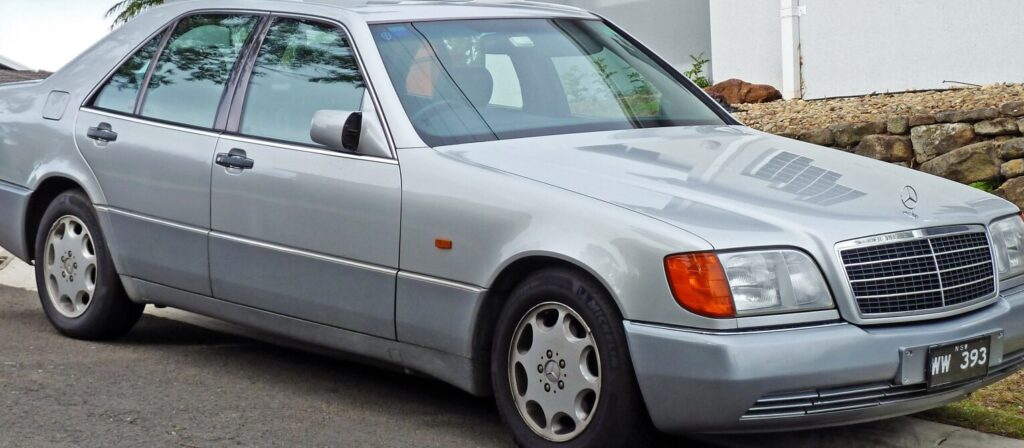
The Mercedes-Benz S-Class (W140) 300 SE, produced from 1991 to 1993, represented a significant step forward in luxury and technology for the German automaker. Positioned as a mid-range offering within the expansive W140 lineup – which included models like the 500SE and the later 320SE – the 300 SE aimed to deliver a refined driving experience with a balance of performance and fuel efficiency. It served as a popular choice for buyers seeking the prestige of the S-Class without the higher price tag of the flagship models. The W140 generation, known for its robust build quality and advanced features, quickly became a benchmark for full-size luxury sedans.
Technical Specifications
| Brand | Mercedes-Benz |
| Model | S-class |
| Generation | S-class (W140) |
| Type | 300 SE (231 Hp) Automatic 5-speed |
| Start of production | 1991 |
| End of production | 1993 |
| Powertrain Architecture | Internal Combustion engine |
| Body type | Sedan |
| Seats | 5 |
| Doors | 4 |
| Fuel consumption (urban) | 16.3 l/100 km (14.4 US mpg, 17.3 UK mpg, 6.1 km/l) |
| Fuel consumption (extra urban) | 9.3 l/100 km (25.3 US mpg, 30.4 UK mpg, 10.8 km/l) |
| Fuel consumption (combined) | 11.1 l/100 km (21.2 US mpg, 25.4 UK mpg, 9 km/l) |
| Fuel Type | Petrol (Gasoline) |
| Acceleration 0 – 100 km/h | 8.6 sec |
| Acceleration 0 – 62 mph | 8.6 sec |
| Acceleration 0 – 60 mph | 8.2 sec |
| Maximum speed | 225 km/h (139.81 mph) |
| Weight-to-power ratio | 8.2 kg/Hp, 122.2 Hp/tonne |
| Weight-to-torque ratio | 6.1 kg/Nm, 164 Nm/tonne |
| Power | 231 Hp @ 5800 rpm |
| Power per litre | 72.2 Hp/l |
| Torque | 310 Nm @ 4100 rpm (228.64 lb.-ft. @ 4100 rpm) |
| Engine layout | Front, Longitudinal |
| Engine Model/Code | M 104 E 32/104.990 |
| Engine displacement | 3199 cm3 (195.21 cu. in.) |
| Number of cylinders | 6 |
| Engine configuration | Inline |
| Cylinder Bore | 89.9 mm (3.54 in.) |
| Piston Stroke | 84 mm (3.31 in.) |
| Compression ratio | 10:1 |
| Number of valves per cylinder | 4 |
| Fuel injection system | Multi-port manifold injection |
| Engine aspiration | Naturally aspirated engine |
| Valvetrain | DOHC |
| Engine oil capacity | 7.5 l (7.93 US qt | 6.6 UK qt) |
| Coolant | 14.5 l (15.32 US qt | 12.76 UK qt) |
| Kerb Weight | 1890 kg (4166.74 lbs.) |
| Max. weight | 2410 kg (5313.14 lbs.) |
| Max load | 520 kg (1146.4 lbs.) |
| Trunk (boot) space – minimum | 525 l (18.54 cu. ft.) |
| Fuel tank capacity | 100 l (26.42 US gal | 22 UK gal) |
| Length | 5113 mm (201.3 in.) |
| Width | 1886 mm (74.25 in.) |
| Height | 1492 mm (58.74 in.) |
| Wheelbase | 3040 mm (119.69 in.) |
| Front track | 1602 mm (63.07 in.) |
| Rear (Back) track | 1574 mm (61.97 in.) |
| Minimum turning circle | 12.18 m (39.96 ft.) |
| Drivetrain Architecture | Rear wheel drive |
| Number of gears | 5 |
| Gearbox type | automatic transmission |
| Front suspension | Double wishbone |
| Rear suspension | Independent multi-link spring suspension with stabilizer |
| Front brakes | Ventilated discs |
| Rear brakes | Disc |
| Assisting systems | ABS (Anti-lock braking system) |
| Steering type | Worm-reduction unit |
| Power steering | Hydraulic Steering |
| Tires size | 235/60 R16 |
| Wheel rims size | 7.5J x 16 |
Powertrain & Engine Architecture
The 300 SE was powered by the M104 E 32 engine, a 3.2-liter inline-six cylinder powerplant. This engine was a significant departure from the earlier Mercedes-Benz inline-six designs, featuring a short-stroke configuration and a double overhead camshaft (DOHC) valvetrain. The M104 utilized Bosch Motronic fuel injection and management system, ensuring precise fuel delivery and optimized engine performance. The engine produced 231 horsepower at 5800 rpm and 310 Nm (228.64 lb-ft) of torque at 4100 rpm. Paired with a 5-speed automatic transmission, the powertrain delivered smooth and refined shifts, prioritizing comfort over outright acceleration. This transmission was a robust unit designed for the torque output of the M104, offering a balance between responsiveness and fuel economy.
Driving Characteristics
The 300 SE Automatic offered a comfortable and composed driving experience. While not as sporty as the manual transmission variants or the higher-output 400E/500E models, the automatic transmission provided effortless cruising and smooth acceleration. The 5-speed automatic was geared for relaxed highway driving, with taller gear ratios contributing to fuel efficiency. Acceleration from 0 to 60 mph took approximately 8.2 seconds, respectable for a large luxury sedan of its era. The automatic transmission did slightly diminish the engine’s responsiveness compared to the manual, but the trade-off was a more refined and user-friendly driving experience, particularly in urban environments.
Equipment & Trim Levels
The 300 SE came standard with a comprehensive list of luxury features, befitting its S-Class designation. These included leather upholstery, power-adjustable front seats with memory function, automatic climate control, a high-quality sound system, and power windows and locks. Wood trim adorned the interior, adding to the sense of luxury. Optional extras included a sunroof, upgraded sound systems, rear seat climate control, and various exterior enhancements. The 300 SE typically featured a more restrained exterior appearance compared to the sportier 400E/500E, focusing on understated elegance.
Chassis & Braking
The W140 S-Class featured a robust chassis with double wishbone suspension at the front and an independent multi-link spring suspension with a stabilizer bar at the rear. This suspension setup provided a comfortable ride while maintaining good handling characteristics. The 300 SE was equipped with ventilated disc brakes at the front and solid discs at the rear. Anti-lock braking system (ABS) was standard, enhancing safety and control during emergency braking situations. The steering was a hydraulic power-assisted worm-reduction unit, offering a smooth and precise steering feel.
Market Reception & Comparison
The 300 SE was generally well-received by automotive critics, who praised its comfortable ride, refined interior, and advanced features. However, some reviewers noted that the automatic transmission dulled the engine’s performance compared to the manual versions. Compared to the 400E and 500E, the 300 SE offered a more affordable entry point into the S-Class range, albeit with less power. Fuel economy was reasonable for a vehicle of its size and class, averaging around 21.2 US mpg in combined driving. Reliability was generally good, although the W140 S-Class was known for its complex systems, which could be expensive to repair.
Legacy
The W140 S-Class 300 SE remains a sought-after classic car today, appreciated for its build quality, luxurious features, and timeless design. The M104 engine is known for its durability and relatively straightforward maintenance. While finding well-maintained examples can be challenging, the 300 SE offers a compelling combination of luxury, performance, and reliability for enthusiasts. Parts availability is generally good, although some specific components may be difficult to source. The W140 generation, and the 300 SE in particular, cemented Mercedes-Benz’s reputation for building some of the finest luxury automobiles in the world.