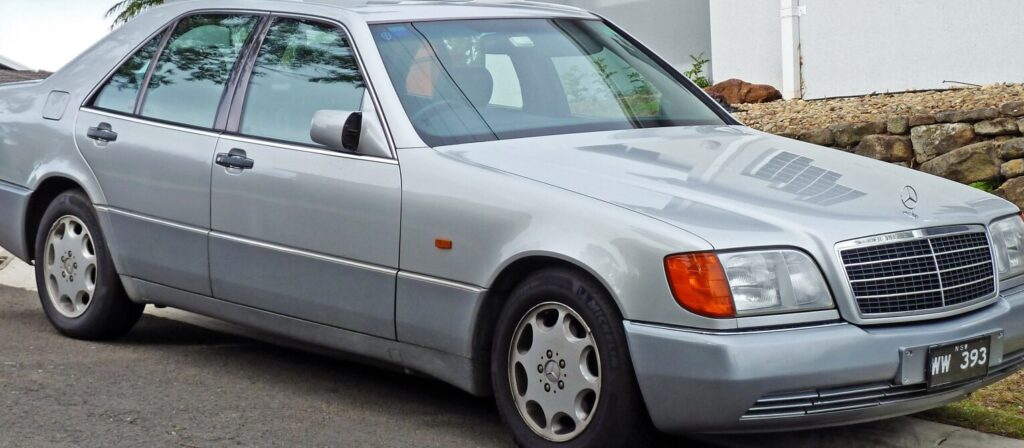
The Mercedes-Benz S-Class W140 500 SE, produced from 1991 to 1993, represented a significant leap forward in luxury and technology for the German automaker. Positioned as a high-performance variant within the W140 series – the third generation of the S-Class – the 500 SE offered a compelling blend of power, refinement, and advanced features. It served as a flagship model, showcasing Mercedes-Benz’s engineering prowess and setting a new benchmark for full-size luxury sedans. The W140 platform itself was a substantial departure from its predecessor, emphasizing increased size, enhanced safety, and a more sophisticated driving experience.
Technical Specifications
| Brand | Mercedes-Benz |
| Model | S-class |
| Generation | S-class (W140) |
| Type (Engine) | 500 SE (326 Hp) Automatic |
| Start of production | 1991 year |
| End of production | 1993 year |
| Powertrain Architecture | Internal Combustion engine |
| Body type | Sedan |
| Seats | 5 |
| Doors | 4 |
| Fuel consumption (economy) – combined | 13 l/100 km |
| Fuel consumption (economy) – combined | 18.1 US mpg |
| Fuel consumption (economy) – combined | 21.7 UK mpg |
| Fuel consumption (economy) – combined | 7.7 km/l |
| Fuel Type | Petrol (Gasoline) |
| Acceleration 0 – 100 km/h | 6.7 sec |
| Acceleration 0 – 62 mph | 6.7 sec |
| Acceleration 0 – 60 mph | 6.4 sec |
| Maximum speed | 250 km/h |
| Maximum speed | 155.34 mph |
| Weight-to-power ratio | 6.1 kg/Hp |
| Weight-to-power ratio | 163 Hp/tonne |
| Weight-to-torque ratio | 4.2 kg/Nm |
| Weight-to-torque ratio | 240 Nm/tonne |
| Power | 326 Hp @ 5700 rpm |
| Power per litre | 65.6 Hp/l |
| Torque | 480 Nm @ 3900 rpm |
| Torque | 354.03 lb.-ft. @ 3900 rpm |
| Engine layout | Front, Longitudinal |
| Engine Model/Code | M 119 E 50 |
| Engine displacement | 4973 cm3 |
| Engine displacement | 303.47 cu. in. |
| Number of cylinders | 8 |
| Engine configuration | V-engine |
| Cylinder Bore | 96.5 mm |
| Cylinder Bore | 3.8 in. |
| Piston Stroke | 85 mm |
| Piston Stroke | 3.35 in. |
| Compression ratio | 10:1 |
| Number of valves per cylinder | 4 |
| Fuel injection system | Multi-port manifold injection |
| Engine aspiration | Naturally aspirated engine |
| Valvetrain | DOHC |
| Engine oil capacity | 8 l |
| Engine oil capacity | 8.45 US qt | 7.04 UK qt |
| Coolant | 16.5 l |
| Coolant | 17.44 US qt | 14.52 UK qt |
| Kerb Weight | 2000 kg |
| Kerb Weight | 4409.25 lbs. |
| Max. weight | 2520 kg |
| Max. weight | 5555.65 lbs. |
| Max load | 520 kg |
| Max load | 1146.4 lbs. |
| Trunk (boot) space – minimum | 525 l |
| Trunk (boot) space – minimum | 18.54 cu. ft. |
| Fuel tank capacity | 100 l |
| Fuel tank capacity | 26.42 US gal | 22 UK gal |
| Permitted trailer load with brakes (12%) | 1900 kg |
| Permitted trailer load with brakes (12%) | 4188.78 lbs. |
| Permitted trailer load without brakes | 750 kg |
| Permitted trailer load without brakes | 1653.47 lbs. |
| Length | 5113 mm |
| Length | 201.3 in. |
| Width | 1886 mm |
| Width | 74.25 in. |
| Height | 1495 mm |
| Height | 58.86 in. |
| Wheelbase | 3040 mm |
| Wheelbase | 119.69 in. |
| Front track | 1602 mm |
| Front track | 63.07 in. |
| Rear (Back) track | 1574 mm |
| Rear (Back) track | 61.97 in. |
| Minimum turning circle (turning diameter) | 12.18 m |
| Minimum turning circle (turning diameter) | 39.96 ft. |
| Drivetrain Architecture | The Internal combustion engine (ICE) drives the rear wheels of the vehicle. |
| Drive wheel | Rear wheel drive |
| Number of gears and type of gearbox | 4 gears, automatic transmission |
| Front suspension | Double wishbone |
| Rear suspension | Independent multi-link spring suspension with stabilizer |
| Front brakes | Ventilated discs |
| Rear brakes | Ventilated discs |
| Assisting systems | ABS (Anti-lock braking system) |
| Steering type | Worm-reduction unit |
| Power steering | Hydraulic Steering |
| Tires size | 235/60 R16 |
| Wheel rims size | 7.5J x 16 |
Powertrain & Engine Architecture
The heart of the 500 SE was the M119 E 50 engine, a 4.973-liter (303.47 cubic inches) naturally aspirated V8. This engine was a significant advancement over previous Mercedes-Benz V8s, featuring all-aluminum construction, a dual overhead camshaft (DOHC) valvetrain with four valves per cylinder, and Bosch Motronic fuel injection. The M119 produced 326 horsepower at 5700 rpm and 480 Nm (354 lb-ft) of torque at 3900 rpm. The engine’s design prioritized smooth power delivery and refinement over outright peak performance. Paired with the engine was a four-speed automatic transmission, specifically designed to handle the V8’s substantial torque. This transmission, while not as sophisticated as some later automatic gearboxes, provided smooth and reliable shifting, contributing to the car’s overall luxurious driving experience.
Driving Characteristics
The 500 SE offered a distinctly grand touring experience. While the 6.7-second 0-60 mph acceleration was respectable for the early 1990s, the focus was on effortless cruising and comfortable long-distance travel. The automatic transmission, while smooth, did result in some power loss compared to the available five-speed manual transmission found in other W140 variants. The gear ratios were tuned for relaxed acceleration and highway efficiency. Compared to the more fuel-conscious 300 SE or the performance-oriented 500E, the 500 SE struck a balance between power and luxury, appealing to drivers who prioritized a refined driving experience over sporty handling.
Equipment & Trim Levels
The 500 SE came standard with a comprehensive list of luxury features, including leather upholstery, wood trim, power-adjustable front seats with memory function, automatic climate control, a premium sound system, and power windows and locks. Optional extras included a sunroof, rear seat entertainment system, and upgraded leather options. The interior design emphasized spaciousness and comfort, with a focus on high-quality materials and meticulous craftsmanship. The dashboard layout was typical of Mercedes-Benz at the time, featuring a clean and functional design with easily accessible controls.
Chassis & Braking
The W140 S-Class featured a robust chassis with double wishbone front suspension and an independent multi-link rear suspension with a stabilizer bar. This suspension setup provided a comfortable ride while maintaining good handling characteristics. The 500 SE was equipped with ventilated disc brakes on all four wheels and an Anti-lock Braking System (ABS), ensuring confident stopping power. The steering was a hydraulic power-assisted worm-reduction unit, offering precise control and a comfortable feel.
Market Reception & Comparison
The W140 S-Class, including the 500 SE, was widely praised by automotive critics for its luxurious interior, advanced technology, and refined driving experience. However, its high price tag and substantial size were also noted. Compared to the 300 SE, the 500 SE offered significantly more power and performance, but at a higher cost. The 500 SE also differed from the 500E, a performance-oriented version of the W140 developed in collaboration with AMG, which featured a more aggressive suspension and styling. Fuel economy, while not a primary concern for buyers in this segment, was lower for the 500 SE compared to the smaller-engined models.
Legacy
The Mercedes-Benz W140 S-Class 500 SE remains a highly sought-after classic car today. The M119 engine is known for its durability and reliability, although maintenance can be expensive due to its complexity. Well-maintained examples command premium prices in the used car market. The W140 S-Class is often regarded as the last of the “over-engineered” Mercedes-Benz models, representing a commitment to quality and craftsmanship that is increasingly rare in modern automobiles. Its advanced features and luxurious appointments continue to impress, solidifying its place as a landmark vehicle in automotive history.