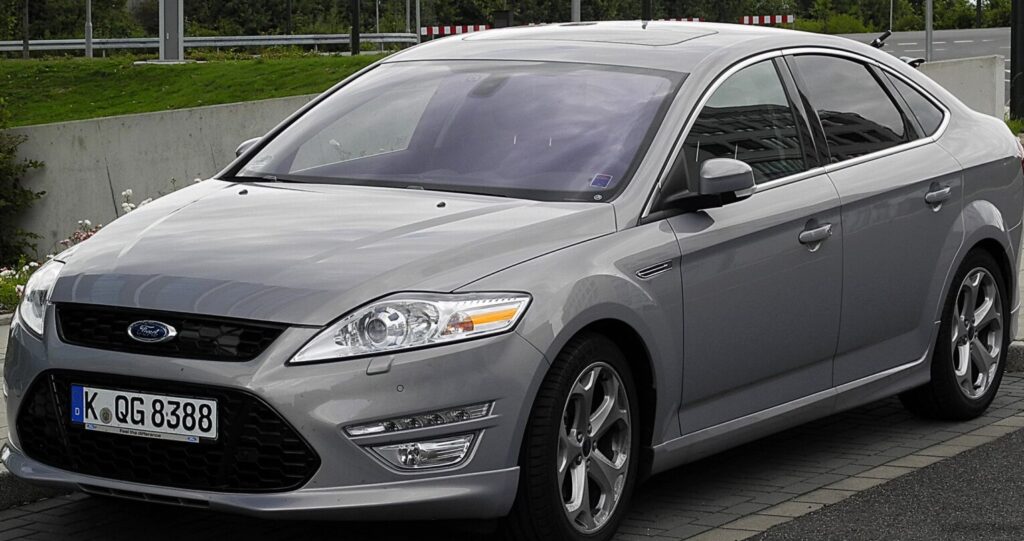
The Ford Mondeo III facelift, produced from 2010 to 2014, represented a significant refresh of Ford’s mid-size offering, aimed primarily at the European market. Within the Mondeo range, the 2.0 EcoBoost 240 horsepower variant paired with the PowerShift dual-clutch transmission (DCT) occupied a performance-oriented, mid-to-upper trim level. This model aimed to bridge the gap between the more economical engine options and the flagship trims, offering a blend of spirited driving and reasonable fuel efficiency. It was positioned as a competitor to vehicles like the Volkswagen Passat and Opel/Vauxhall Insignia, offering a more dynamic driving experience than some of its rivals.
Technical Specifications
| Brand | Ford |
| Model | Mondeo |
| Generation | Mondeo III Hatchback (facelift 2010) |
| Type (Engine) | 2.0 EcoBoost (240 Hp) PowerShift |
| Start of production | 2010 |
| End of production | 2014 |
| Powertrain Architecture | Internal Combustion engine |
| Body type | Hatchback |
| Seats | 5 |
| Doors | 5 |
| Fuel consumption (urban) | 10.9 l/100 km (21.6 US mpg, 25.9 UK mpg, 9.2 km/l) |
| Fuel consumption (extra urban) | 6 l/100 km (39.2 US mpg, 47.1 UK mpg, 16.7 km/l) |
| Fuel consumption (combined) | 7.7 l/100 km (30.5 US mpg, 36.7 UK mpg, 13 km/l) |
| CO2 emissions | 179 g/km |
| Fuel Type | Petrol (Gasoline) |
| Acceleration 0 – 100 km/h | 7.5 sec |
| Acceleration 0 – 62 mph | 7.5 sec |
| Acceleration 0 – 60 mph | 7.1 sec |
| Maximum speed | 246 km/h (152.86 mph) |
| Emission standard | Euro 5 |
| Weight-to-power ratio | 6.5 kg/Hp, 153 Hp/tonne |
| Weight-to-torque ratio | 4.6 kg/Nm, 216.7 Nm/tonne |
| Power | 240 Hp @ 6000 rpm |
| Power per litre | 120.1 Hp/l |
| Torque | 340 Nm @ 1900-3500 rpm (250.77 lb.-ft. @ 1900-3500 rpm) |
| Engine layout | Front, Transverse |
| Engine Model/Code | TPBA |
| Engine displacement | 1999 cm3 (121.99 cu. in.) |
| Number of cylinders | 4 |
| Engine configuration | Inline |
| Cylinder Bore | 87.5 mm (3.44 in.) |
| Piston Stroke | 83.1 mm (3.27 in.) |
| Compression ratio | 10:1 |
| Number of valves per cylinder | 4 |
| Fuel injection system | Direct injection |
| Engine aspiration | Turbocharger, Intercooler |
| Valvetrain | DOHC |
| Engine oil capacity | 5.4 l (5.71 US qt | 4.75 UK qt) |
| Coolant | 6.2 l (6.55 US qt | 5.46 UK qt) |
| Kerb Weight | 1569 kg (3459.05 lbs.) |
| Max. weight | 2200 kg (4850.17 lbs.) |
| Max load | 631 kg (1391.12 lbs.) |
| Trunk (boot) space – minimum | 486 l (17.16 cu. ft.) |
| Trunk (boot) space – maximum | 1390 l (49.09 cu. ft.) |
| Length | 4784 mm (188.35 in.) |
| Width | 1886 mm (74.25 in.) |
| Height | 1500 mm (59.06 in.) |
| Wheelbase | 2850 mm (112.2 in.) |
| Front track | 1588 mm (62.52 in.) |
| Rear (Back) track | 1605 mm (63.19 in.) |
| Minimum turning circle | 11.6 m (38.06 ft.) |
| Drivetrain Architecture | Front wheel drive |
| Number of gears and type of gearbox | 6 gears, automatic transmission PowerShift |
| Front suspension | Independent, type McPherson with coil spring and anti-roll bar |
| Rear suspension | Independent multi-link spring suspension with stabilizer |
| Front brakes | Ventilated discs |
| Rear brakes | Disc |
| Assisting systems | ABS (Anti-lock braking system) |
| Steering type | Steering rack and pinion |
| Tires size | 205/55 R16 |
| Wheel rims size | 6.5J x 16 |
INTRODUCTION
The 2.0 EcoBoost 240 PS PowerShift Mondeo, introduced during the facelift of the Mk3 generation, represented a significant step up in performance for the Mondeo line. Built between 2010 and 2014, this variant leveraged Ford’s advancements in direct injection and turbocharging technology. The “EcoBoost” designation signified a focus on balancing power with fuel efficiency, a key marketing point for Ford at the time. The PowerShift transmission, a six-speed dual-clutch unit, was intended to provide quicker shifts and a more engaging driving experience than a traditional automatic. This model aimed to appeal to drivers seeking a sporty and practical family car.
Powertrain & Engine Architecture
At the heart of this Mondeo variant lies the TPBA engine, a 1.999-liter inline-four cylinder powerplant. This engine utilizes direct fuel injection, a technology that precisely meters fuel directly into the combustion chamber, improving efficiency and power output. The engine also features a single turbocharger with an intercooler, boosting horsepower and torque. The DOHC (Double Overhead Camshaft) valvetrain, with four valves per cylinder, further enhances breathing and performance. The PowerShift 6F35 transmission is a key component, utilizing two separate clutches for odd and even gears, allowing for seamless and rapid gear changes. Unlike a traditional torque converter automatic, the PowerShift operates more like a manual transmission, contributing to improved fuel economy and a more connected feel. The engine’s control unit (ECU) manages fuel delivery, ignition timing, and turbocharger boost pressure to optimize performance and emissions.
Driving Characteristics
The 240 horsepower and 340 Nm (250 lb-ft) of torque delivered by the 2.0 EcoBoost engine, coupled with the PowerShift transmission, provided a noticeable performance upgrade over lower-powered Mondeo variants. Acceleration from 0-60 mph was achieved in approximately 7.1 seconds, and the car offered a respectable top speed of 152.86 mph. The PowerShift transmission, when functioning correctly, offered quick and smooth gear changes, enhancing the driving experience. However, early iterations of the PowerShift transmission were known to exhibit issues with shuddering and reliability, which could detract from the overall driving experience. The gear ratios were tuned to provide a balance between acceleration and fuel economy, with a relatively short final drive to maximize responsiveness. Compared to the 1.6 EcoBoost or diesel variants, the 2.0 EcoBoost offered significantly more power and a more engaging driving experience, but at the cost of slightly higher fuel consumption.
Equipment & Trim Levels
The 2.0 EcoBoost 240 PS PowerShift typically came equipped with a generous level of standard features. These often included alloy wheels (typically 17 or 18 inch), air conditioning, a CD/radio system with auxiliary input, power windows and mirrors, and ABS brakes. Higher trim levels, such as Titanium, added features like leather upholstery, heated front seats, a premium sound system, and parking sensors. Optional extras included a sunroof, navigation system, and advanced safety features like adaptive cruise control and lane departure warning. Interior upholstery was typically cloth on lower trims and leather on higher trims. The dashboard layout was generally consistent across the Mondeo range, with a focus on functionality and ergonomics.
Chassis & Braking
The Mondeo III facelift utilized an independent front suspension with McPherson struts and a multi-link independent rear suspension. This setup provided a good balance between ride comfort and handling. Stabilizer bars were fitted to both the front and rear axles to reduce body roll during cornering. Braking duties were handled by ventilated discs on the front wheels and solid discs on the rear. ABS (Anti-lock Braking System) was standard, providing enhanced braking performance and stability. The chassis was designed to provide a stable and predictable driving experience, with a focus on minimizing understeer. The suspension tuning was generally softer than some of its more performance-oriented rivals, prioritizing ride comfort for everyday use.
Market Reception & Comparison
The 2.0 EcoBoost 240 PS PowerShift Mondeo was generally well-received by automotive critics. It was praised for its strong performance, comfortable ride, and spacious interior. However, the PowerShift transmission was a recurring point of criticism, with reports of reliability issues and shuddering. Fuel economy was considered reasonable for a car of its performance, averaging around 30.5 US mpg in combined driving. Compared to the 1.6 EcoBoost, the 2.0 EcoBoost offered a significant performance boost, but at a higher price point. Compared to the diesel variants, the 2.0 EcoBoost offered a more refined driving experience, but with slightly higher fuel consumption. The Mondeo consistently offered good value for money compared to its rivals, such as the Volkswagen Passat and Opel/Vauxhall Insignia.
Legacy
The 2.0 EcoBoost engine became a mainstay in Ford’s lineup, appearing in a wide range of vehicles. However, the PowerShift transmission’s reputation for unreliability has somewhat tarnished the legacy of this particular Mondeo variant. On the used car market, these models can be found at relatively affordable prices, but potential buyers should be aware of the potential transmission issues and factor in the cost of potential repairs. Despite the transmission concerns, the 2.0 EcoBoost engine itself is generally considered to be a reliable unit, provided it has been properly maintained. The Mondeo III facelift, and particularly this 240 PS variant, remains a popular choice for those seeking a spacious, comfortable, and reasonably sporty family car.