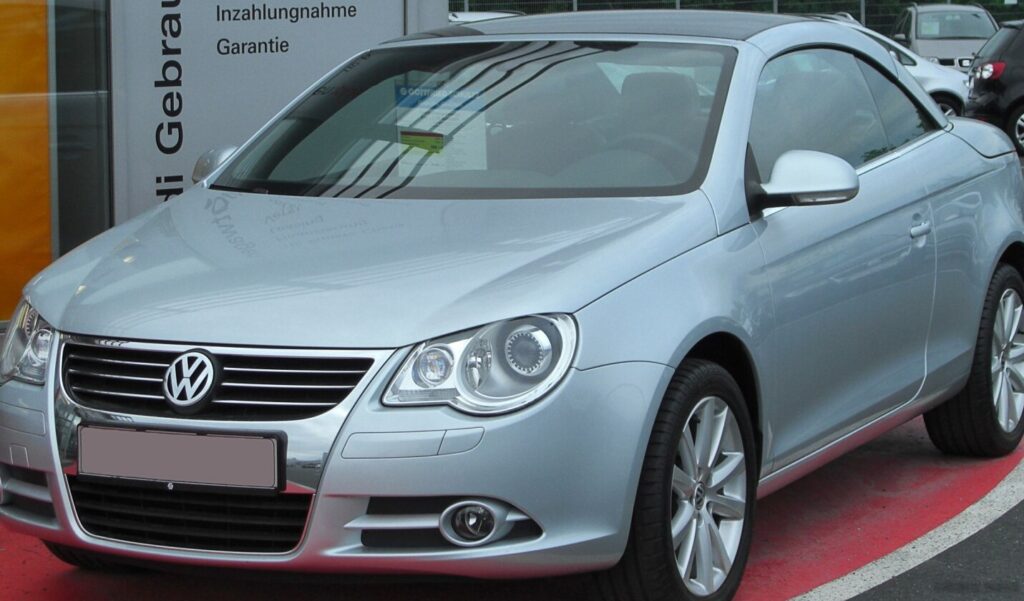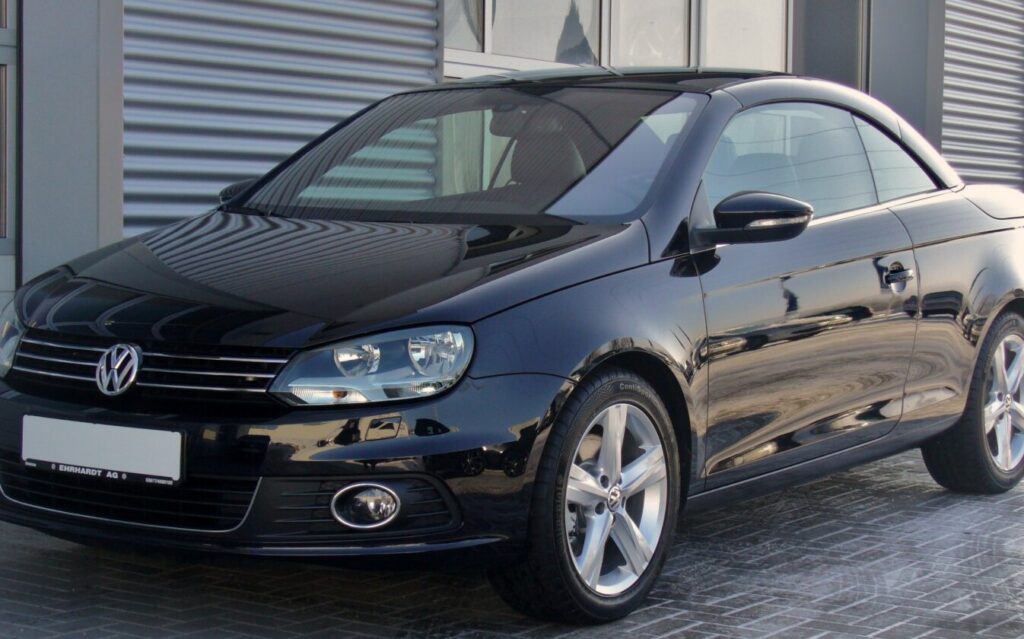
The Volkswagen Eos, particularly the facelifted version produced from 2010 to 2015, represented Volkswagen’s entry into the premium compact convertible market. The 2.0 TSI model, equipped with a 210 horsepower turbocharged engine and a dual-clutch DSG transmission, was positioned as the performance-oriented trim within the Eos lineup. It sat above the base 1.6 and 2.0 TDI models, offering a significant power upgrade and a more engaging driving experience, while remaining below the range-topping trims in terms of outright luxury. Production spanned from October 2010 to May 2015, building upon the initial Eos platform (1F7) introduced in 2006, with the 2010 facelift bringing styling updates and refined engine options.
Technical Specifications
| Brand | Volkswagen |
| Model | Eos |
| Generation | Eos (facelift 2010) |
| Type (Engine) | 2.0 TSI (210 Hp) DSG |
| Start of production | October, 2010 |
| End of production | May, 2015 |
| Powertrain Architecture | Internal Combustion engine |
| Body type | Coupe – Cabriolet |
| Seats | 4 |
| Doors | 2 |
| Fuel consumption (urban) | 10.2 l/100 km (23.1 US mpg) |
| Fuel consumption (extra urban) | 5.9 l/100 km (39.9 US mpg) |
| Fuel consumption (combined) | 7.5 l/100 km (31.4 US mpg) |
| CO2 emissions | 174 g/km |
| Fuel Type | Petrol (Gasoline) |
| Acceleration 0 – 100 km/h | 7.8 sec |
| Acceleration 0 – 62 mph | 7.8 sec |
| Acceleration 0 – 60 mph | 7.4 sec |
| Maximum speed | 236 km/h (146.64 mph) |
| Emission standard | Euro 5 |
| Weight-to-power ratio | 7.6 kg/Hp |
| Weight-to-torque ratio | 5.7 kg/Nm |
| Power | 210 Hp @ 5300-6200 rpm |
| Torque | 280 Nm @ 1700-5200 rpm (206.52 lb.-ft.) |
| Engine layout | Front, Transverse |
| Engine Model/Code | CCZB |
| Engine displacement | 1984 cm3 (121.07 cu. in.) |
| Number of cylinders | 4 |
| Engine configuration | Inline |
| Number of valves per cylinder | 4 |
| Fuel injection system | Direct injection |
| Engine aspiration | Turbocharger, Intercooler |
| Engine oil capacity | 4.7 l (4.97 US qt | 4.14 UK qt) |
| Kerb Weight | 1586 kg (3496.53 lbs.) |
| Max. weight | 2020 kg (4453.34 lbs.) |
| Max load | 434 kg (956.81 lbs.) |
| Trunk (boot) space – minimum | 205 l (7.24 cu. ft.) |
| Fuel tank capacity | 55 l (14.53 US gal | 12.1 UK gal) |
| Length | 4423 mm (174.13 in.) |
| Width | 1791 mm (70.51 in.) |
| Height | 1444 mm (56.85 in.) |
| Wheelbase | 2578 mm (101.5 in.) |
| Front track | 1545 mm (60.83 in.) |
| Rear (Back) track | 1547 mm (60.91 in.) |
| Minimum turning circle | 10.9 m (35.76 ft.) |
| Number of gears | 6 |
| Gearbox type | automatic transmission DSG |
| Front brakes | Ventilated discs |
| Tires size | 215/55 R16; 235/40 R18 |
| Wheel rims size | 7J x 16; 8J x 18 |
Powertrain & Engine Architecture
The heart of the 2010-2015 Volkswagen Eos 2.0 TSI was the CCZB engine code, a 1.984-liter (121.07 cubic inches) inline-four cylinder gasoline engine. This engine featured direct fuel injection (FSI) and a turbocharger with an intercooler, allowing for a high power output from a relatively small displacement. The direct injection system precisely meters fuel into the combustion chamber, improving efficiency and reducing emissions. The turbocharger boosts power by forcing more air into the engine, while the intercooler cools the compressed air, further enhancing performance. The engine produced 210 horsepower at 5300-6200 rpm and 280 Nm (206.52 lb-ft) of torque between 1700 and 5200 rpm. This engine was part of the EA888 family, known for its robust design and tuning potential.
The engine was paired exclusively with a six-speed dual-clutch transmission (DSG). This transmission offers both fully automatic operation and the ability for the driver to manually shift gears via paddle shifters or the gear selector. The DSG provides quick and smooth gear changes, contributing to the car’s sporty driving feel. The transmission’s programming was tuned to balance performance and fuel efficiency.
Driving Characteristics
The 2.0 TSI/DSG combination in the Eos delivered a noticeably more spirited driving experience compared to the lower-powered engine options. Acceleration from 0 to 60 mph took approximately 7.4 seconds, and the car felt responsive in everyday driving situations. The DSG transmission allowed for quick downshifts when needed, providing ample power for overtaking maneuvers. While not a dedicated sports car, the Eos 2.0 TSI offered a good balance of performance and comfort. The gear ratios were optimized for both acceleration and highway cruising. Compared to a manual transmission equipped Eos, the DSG offered convenience and slightly quicker acceleration, but some enthusiasts preferred the more direct feel of a manual gearbox.
Equipment & Trim Levels
The 2.0 TSI Eos typically came well-equipped, reflecting its position as a mid-range to upper-mid-range trim. Standard features often included automatic climate control, power windows and locks, a premium audio system, and alloy wheels. Leather upholstery was frequently standard or available as an option. The 2010 facelift brought updated interior trim options and improved infotainment systems. Optional extras included navigation, heated seats, and a panoramic sunroof, which was a particularly popular option for the Eos due to its convertible nature. The interior design was generally conservative and functional, prioritizing usability over outright luxury.
Chassis & Braking
The Eos featured a MacPherson strut front suspension and a multi-link rear suspension, providing a comfortable ride and good handling characteristics. The suspension was tuned to balance comfort and stability, making it suitable for both city driving and longer journeys. Braking duties were handled by ventilated disc brakes at the front and either disc or drum brakes at the rear, depending on the specific configuration and optional equipment. Anti-lock brakes (ABS) were standard. Stabilizer bars were fitted to both the front and rear axles to reduce body roll during cornering.
Market Reception & Comparison
The Volkswagen Eos 2.0 TSI was generally well-received by automotive critics. It was praised for its stylish design, comfortable interior, and enjoyable driving experience. The 2.0 TSI engine was considered a strong performer, and the DSG transmission was lauded for its smoothness and responsiveness. Fuel economy was respectable for a convertible, averaging around 31.4 US mpg in combined driving. Compared to other compact convertibles of the time, such as the Mazda MX-5 Miata and BMW 1 Series Convertible, the Eos offered a more practical and comfortable interior, with more space for passengers and luggage. However, it wasn’t as focused on outright sporty handling as some of its rivals.
Legacy
The Volkswagen Eos, while not a high-volume seller, established itself as a solid and reliable convertible option. The 2.0 TSI engine and DSG transmission have proven to be durable and relatively trouble-free, provided they are properly maintained. On the used car market, the Eos 2.0 TSI remains a popular choice for buyers seeking a stylish and well-equipped convertible at a reasonable price. Regular maintenance, including oil changes and DSG transmission servicing, is crucial to ensure the long-term reliability of this powertrain. The Eos was discontinued in 2015, but its blend of practicality, comfort, and performance continues to appeal to a dedicated following.