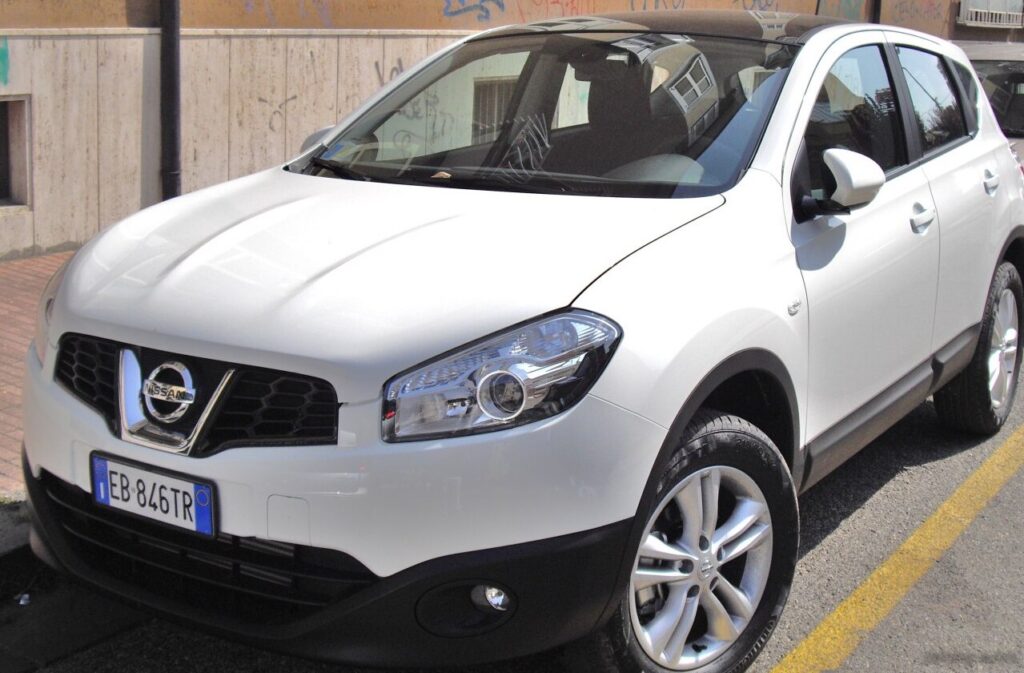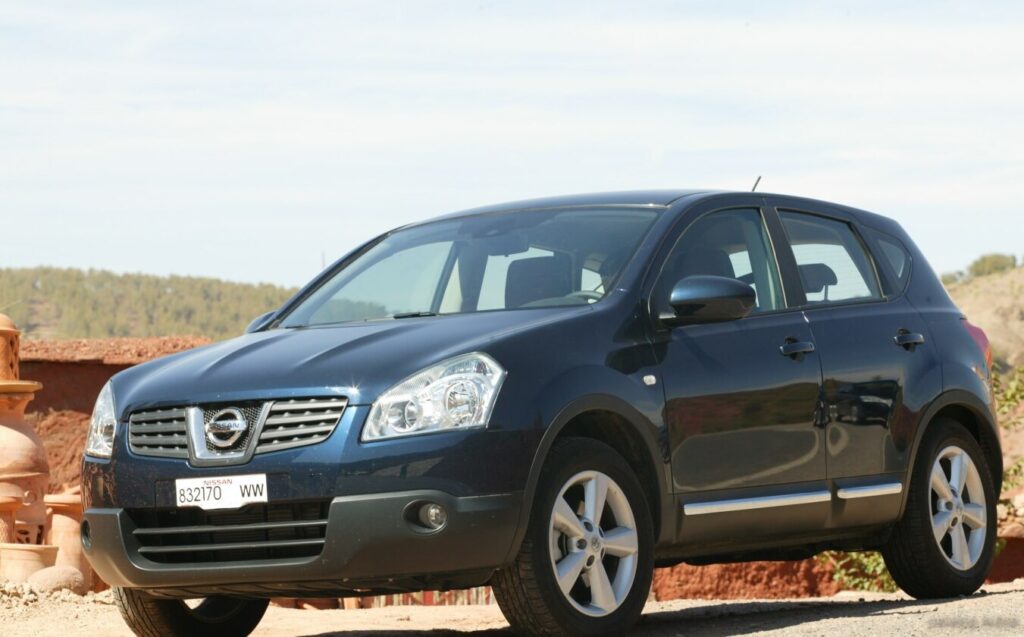
The Nissan Qashqai (known as the Dualis in some markets) represented Nissan’s entry into the burgeoning compact crossover segment in Europe. Introduced in 2007, the first generation Qashqai, internally designated the J10, aimed to blend the practicality of a hatchback with the elevated driving position and styling of an SUV. The 1.5 dCi variant, producing 106 horsepower, was a key model in the lineup, particularly in European markets where diesel engines were highly favored. Production of this specific configuration ran from 2007 to 2010, serving as an accessible and fuel-efficient option within the Qashqai range.
Technical Specifications
| Brand | Nissan |
| Model | Qashqai |
| Generation | Qashqai I (J10) |
| Type (Engine) | 1.5 dCi (106 Hp) |
| Start of production | 2007 |
| End of production | 2010 |
| Powertrain Architecture | Internal Combustion engine |
| Body type | SUV, Crossover |
| Seats | 5 |
| Doors | 5 |
| Fuel consumption (urban) | 6 l/100 km (39.2 US mpg, 47.1 UK mpg, 16.7 km/l) |
| Fuel consumption (extra urban) | 4.8 l/100 km (49 US mpg, 58.9 UK mpg, 20.8 km/l) |
| Fuel consumption (combined) | 5.2 l/100 km (45.2 US mpg, 54.3 UK mpg, 19.2 km/l) |
| CO2 emissions | 139 g/km |
| Fuel Type | Diesel |
| Acceleration 0 – 100 km/h | 12.2 sec |
| Acceleration 0 – 62 mph | 12.2 sec |
| Acceleration 0 – 60 mph | 11.6 sec |
| Maximum speed | 174 km/h (108.12 mph) |
| Emission standard | Euro 4 |
| Weight-to-power ratio | 13.3 kg/Hp, 75.3 Hp/tonne |
| Weight-to-torque ratio | 5.9 kg/Nm, 170.6 Nm/tonne |
| Power | 106 Hp @ 4000 rpm |
| Power per litre | 72.6 Hp/l |
| Torque | 240 Nm @ 2000 rpm (177.01 lb.-ft. @ 2000 rpm) |
| Engine layout | Front, Transverse |
| Engine Model/Code | K9K |
| Engine displacement | 1461 cm3 (89.16 cu. in.) |
| Number of cylinders | 4 |
| Engine configuration | Inline |
| Cylinder Bore | 76 mm (2.99 in.) |
| Piston Stroke | 80.5 mm (3.17 in.) |
| Number of valves per cylinder | 4 |
| Fuel injection system | Diesel Commonrail |
| Engine aspiration | Turbocharger, Intercooler |
| Valvetrain | OHC |
| Engine oil capacity | 4.6 l (4.86 US qt | 4.05 UK qt) |
| Coolant | 9.1 l (9.62 US qt | 8.01 UK qt) |
| Kerb Weight | 1407 kg (3101.9 lbs.) |
| Max. weight | 1930 kg (4254.92 lbs.) |
| Max load | 523 kg (1153.02 lbs.) |
| Trunk (boot) space – minimum | 410 l (14.48 cu. ft.) |
| Trunk (boot) space – maximum | 1513 l (53.43 cu. ft.) |
| Fuel tank capacity | 65 l (17.17 US gal | 14.3 UK gal) |
| Max. roof load | 75 kg (165.35 lbs.) |
| Permitted trailer load with brakes (12%) | 1200 kg (2645.55 lbs.) |
| Permitted trailer load without brakes | 740 kg (1631.42 lbs.) |
| Permitted towbar download | 75 kg (165.35 lbs.) |
| Length | 4315 mm (169.88 in.) |
| Width | 1780 mm (70.08 in.) |
| Height | 1605 mm (63.19 in.) |
| Wheelbase | 2630 mm (103.54 in.) |
| Front track | 1540 mm (60.63 in.) |
| Rear (Back) track | 1545 mm (60.83 in.) |
| Ride height (ground clearance) | 200 mm (7.87 in.) |
| Minimum turning circle | 10.6 m (34.78 ft.) |
| Approach angle | 19.2° |
| Departure angle | 30.2° |
| Ramp-over angle | 17.0° |
| Wading depth | 350 mm (13.78 in.) |
| Drivetrain Architecture | The Internal combustion engine (ICE) drives the front wheels of the vehicle. |
| Drive wheel | Front wheel drive |
| Number of gears and type of gearbox | 6 gears, manual transmission |
| Front suspension | Independent, type McPherson with coil spring and anti-roll bar |
| Rear suspension | Independent multi-link spring suspension with stabilizer |
| Front brakes | Ventilated discs |
| Rear brakes | Disc |
| Assisting systems | ABS (Anti-lock braking system) |
| Steering type | Steering rack and pinion |
| Power steering | Electric Steering |
| Tires size | 215/65 R16; 215/60 R17 |
| Wheel rims size | 5.5J x 16; 6.5J x 17 |
INTRODUCTION
The Nissan Qashqai J10 1.5 dCi (106 Hp) was a crucial variant in establishing the Qashqai’s success, particularly in Europe. Launched in 2007, it slotted into the mid-range of the Qashqai lineup, offering a balance between affordability and efficiency. Built on the Nissan/Renault CMF (Common Module Family) platform, the J10 Qashqai aimed to provide a more comfortable and refined experience than traditional small hatchbacks, while remaining more compact and manageable than larger SUVs. This 106 hp diesel version was specifically targeted at buyers prioritizing fuel economy and lower running costs.
Powertrain & Engine Architecture
The heart of this Qashqai variant is the Renault-Nissan Alliance’s K9K 1.5-liter four-cylinder diesel engine. This engine, known for its robustness and efficiency, utilizes a common-rail direct injection system, delivering fuel at extremely high pressure for optimized combustion. The K9K engine in this application produces 106 horsepower at 4000 rpm and 240 Nm (177 lb-ft) of torque at 2000 rpm. A turbocharger with an intercooler further enhances performance. The engine features an overhead camshaft (OHC) valvetrain with four valves per cylinder. The 1.5 dCi was typically paired with a six-speed manual transmission, although a six-speed automatic transmission was also available, albeit less common. The automatic transmission was designed to provide smooth shifts and contribute to the vehicle’s overall refinement.
Driving Characteristics
The 1.5 dCi 106 hp Qashqai offered a comfortable, if not particularly sporty, driving experience. Acceleration from 0-60 mph took around 11.6 seconds, and top speed was approximately 108 mph. The engine’s torque peak at 2000 rpm provided adequate pulling power for everyday driving and overtaking maneuvers. Compared to the higher-output 1.6 dCi or 2.0-liter petrol variants, the 1.5 dCi felt less responsive, especially at higher speeds. However, the six-speed manual transmission allowed drivers to keep the engine in its optimal power band. The automatic transmission, while convenient, could sometimes feel sluggish, particularly when attempting quick downshifts. The Qashqai’s suspension was tuned for comfort, absorbing bumps and imperfections in the road well.
Equipment & Trim Levels
The 1.5 dCi 106 hp Qashqai was typically offered in Visia, Acenta, and Tekna trim levels. The base Visia trim included features such as air conditioning, electric front windows, and a CD player. The Acenta trim added alloy wheels, cruise control, and a trip computer. The top-of-the-line Tekna trim offered features like automatic climate control, rain-sensing wipers, and a panoramic sunroof. Interior upholstery was typically cloth, with options for upgraded materials on higher trims. Optional extras included satellite navigation, leather seats, and parking sensors.
Chassis & Braking
The Qashqai J10 utilized an independent McPherson strut suspension setup at the front and an independent multi-link suspension at the rear, providing a good balance between ride comfort and handling. Front brakes were ventilated discs, while rear brakes were solid discs. Anti-lock Braking System (ABS) was standard across all trim levels. The Qashqai’s steering was electrically assisted, providing light and precise control. Stabilizer bars were fitted to both the front and rear axles to reduce body roll during cornering.
Market Reception & Comparison
The Qashqai 1.5 dCi was well-received by critics and consumers alike. It was praised for its fuel efficiency, comfortable ride, and spacious interior. Compared to other compact crossovers of the time, such as the Suzuki SX4 and the Chevrolet Captiva Sport, the Qashqai offered a more refined driving experience and a more stylish design. The 1.5 dCi engine provided excellent fuel economy, averaging around 45.2 US mpg in combined driving, making it an attractive option for cost-conscious buyers. However, some critics noted that the engine could feel underpowered, especially when fully loaded or driving uphill. Compared to the 2.0-liter petrol version, the 1.5 dCi offered significantly better fuel economy but less outright performance.
Legacy
The Nissan Qashqai J10 1.5 dCi established a strong reputation for reliability and durability. The K9K engine, in particular, proved to be a robust and long-lasting unit. On the used car market, these Qashqais continue to be popular choices, offering a good balance of practicality, affordability, and fuel efficiency. While some components, such as the turbocharger and fuel injectors, may require attention after high mileage, the overall running costs are generally reasonable. The Qashqai J10 1.5 dCi played a significant role in popularizing the compact crossover segment and remains a well-regarded vehicle among those seeking a versatile and economical family car.