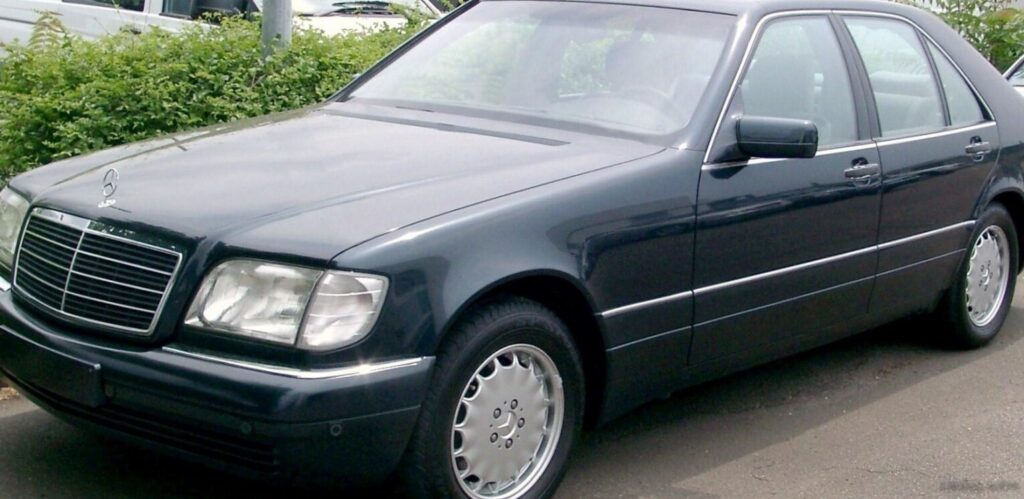
The Mercedes-Benz S 300 Turbodiesel, produced between June 1996 and August 1998, was a variant of the W140 S-Class following the 1994 facelift. Positioned as a fuel-efficient, long-distance cruiser within the S-Class range, it offered a blend of luxury and diesel economy. This model represented a significant offering for European markets, where diesel engines were – and continue to be – highly favored for their efficiency. In the US market, the W140 S-Class was primarily available with gasoline engines, making the S 300 Turbodiesel a relatively rare import or a later-life enthusiast vehicle.
Technical Specifications
| Brand | Mercedes-Benz |
| Model | S-class |
| Generation | S-class (W140, facelift 1994) |
| Type (Engine) | S 300 Turbodiesel (177 Hp) 5G-TRONIC |
| Start of production | June, 1996 |
| End of production | August, 1998 |
| Powertrain Architecture | Internal Combustion engine |
| Body type | Sedan |
| Seats | 5 |
| Doors | 4 |
| Fuel consumption (economy) – urban (NEDC) | 13.8 l/100 km (17 US mpg, 20.5 UK mpg, 7.2 km/l) |
| Fuel consumption (economy) – extra urban (NEDC) | 8.1 l/100 km (29 US mpg, 34.9 UK mpg, 12.3 km/l) |
| Fuel consumption (economy) – combined (NEDC) | 10.3 l/100 km (22.8 US mpg, 27.4 UK mpg, 9.7 km/l) |
| CO2 emissions (NEDC) | 273 g/km |
| Fuel Type | Diesel |
| Acceleration 0 – 100 km/h | 11.2 sec |
| Acceleration 0 – 62 mph | 11.2 sec |
| Acceleration 0 – 60 mph | 10.6 sec |
| Maximum speed | 206 km/h (128 mph) |
| Weight-to-power ratio | 11.1 kg/Hp, 90.3 Hp/tonne |
| Weight-to-torque ratio | 5.9 kg/Nm, 168.4 Nm/tonne |
| Power | 177 Hp @ 4400 rpm |
| Power per litre | 59.1 Hp/l |
| Torque | 330 Nm @ 1600-3600 rpm (243.4 lb.-ft. @ 1600-3600 rpm) |
| Engine layout | Front, Longitudinal |
| Engine Model/Code | OM 606.960 |
| Engine displacement | 2996 cm3 (182.83 cu. in.) |
| Number of cylinders | 6 |
| Engine configuration | Inline |
| Cylinder Bore | 87 mm (3.43 in.) |
| Piston Stroke | 84 mm (3.31 in.) |
| Compression ratio | 22:1 |
| Number of valves per cylinder | 4 |
| Fuel injection system | Precombustion chamber injection |
| Engine aspiration | Turbocharger, Intercooler |
| Valvetrain | DOHC |
| Engine oil capacity | 7.5 l (7.93 US qt | 6.6 UK qt) |
| Coolant | 10 l (10.57 US qt | 8.8 UK qt) |
| Kerb Weight | 1960 kg (4321.06 lbs.) |
| Max. weight | 2610 kg (5754.07 lbs.) |
| Max load | 650 kg (1433 lbs.) |
| Trunk (boot) space – minimum | 525 l (18.54 cu. ft.) |
| Fuel tank capacity | 100 l (26.42 US gal | 22 UK gal) |
| Length | 5113 mm (201.3 in.) |
| Width | 1886 mm (74.25 in.) |
| Height | 1486 mm (58.5 in.) |
| Wheelbase | 3040 mm (119.69 in.) |
| Front track | 1606 mm (63.23 in.) |
| Rear (Back) track | 1579 mm (62.17 in.) |
| Minimum turning circle | 12.18 m (39.96 ft.) |
| Drivetrain Architecture | The Internal combustion engine (ICE) drives the rear wheels of the vehicle. |
| Drive wheel | Rear wheel drive |
| Number of gears and type of gearbox | 5 gears, automatic transmission G-TRONIC |
| Front suspension | Coil spring, Double wishbone, Transverse stabilizer |
| Rear suspension | Independent multi-link suspension, Transverse stabilizer, Coil spring |
| Front brakes | Ventilated discs |
| Rear brakes | Disc |
| Assisting systems | ABS (Anti-lock braking system) |
| Steering type | Cone worm with recirculation balls |
| Power steering | Hydraulic Steering |
| Tires size | 235/60 R16 |
| Wheel rims size | 7.5J x 16 |
INTRODUCTION
The S 300 Turbodiesel, introduced in 1996 as part of the W140 facelift, offered a compelling alternative to the gasoline-powered S-Class models. The W140, known for its robust build quality and advanced features for its time, was Mercedes-Benz’s flagship sedan. The facelift brought subtle styling revisions and improvements to the engine range. The S 300 Turbodiesel was designed to appeal to buyers prioritizing fuel economy and long-distance comfort, particularly in Europe where diesel fuel was more affordable and readily available. It occupied a middle ground in the S-Class lineup, offering a more economical option than the V8 and V12 models, but with a more refined experience than the entry-level S 280.
Powertrain & Engine Architecture
The heart of the S 300 Turbodiesel is the OM 606.960, a 3.0-liter inline-six cylinder diesel engine. This engine utilizes precombustion chamber injection, a system where fuel is injected into a small pre-chamber connected to the main combustion chamber, promoting more complete combustion and reducing noise. A turbocharger with an intercooler significantly boosts power output to 177 horsepower and 330 Nm (243 lb-ft) of torque. The engine features a double overhead camshaft (DOHC) valvetrain, contributing to its relatively smooth operation for a diesel engine of that era. The engine is longitudinally mounted in the front of the vehicle. The 5G-TRONIC automatic transmission, a five-speed unit, was the sole transmission option. This transmission was known for its smooth shifts and reliability, although it could sometimes feel slightly hesitant compared to more modern automatic gearboxes.
Driving Characteristics
The S 300 Turbodiesel prioritized comfortable cruising over outright performance. Acceleration from 0 to 60 mph took around 10.6 seconds, and top speed was limited to 128 mph. While not particularly quick, the engine’s substantial torque – available from as low as 1600 rpm – provided ample power for effortless highway driving and overtaking. The 5G-TRONIC transmission, while smooth, was geared for economy rather than rapid acceleration. Compared to the more powerful S 420 or S 500 models, the S 300 Turbodiesel felt noticeably slower, but it offered significantly better fuel economy. The ride quality, typical of the W140 S-Class, was exceptionally smooth and comfortable, thanks to the sophisticated suspension system.
Equipment & Trim Levels
The S 300 Turbodiesel came well-equipped, reflecting its status as a luxury vehicle. Standard features included leather upholstery, power-adjustable front seats with memory function, automatic climate control, a premium sound system, and a sunroof. The W140 S-Class was renowned for its extensive list of available options, and the S 300 Turbodiesel could be customized with features such as rear seat entertainment, massaging seats, and a more advanced climate control system. Interior trim options typically included wood veneers and chrome accents, enhancing the luxurious ambiance. The exterior typically featured alloy wheels and body-colored bumpers and side moldings.
Chassis & Braking
The S 300 Turbodiesel utilized a robust chassis with coil spring suspension and double wishbones at the front, and an independent multi-link suspension at the rear. This setup provided a comfortable ride and good handling characteristics. Stabilizer bars were fitted to both axles to reduce body roll. The braking system consisted of ventilated discs at the front and solid discs at the rear, coupled with an Anti-lock Braking System (ABS) for enhanced safety. The steering was a recirculating ball system with hydraulic power assistance, providing a relatively light and precise steering feel.
Market Reception & Comparison
The S 300 Turbodiesel was generally well-received by automotive critics, particularly for its fuel efficiency and comfortable ride. It was praised as a practical and refined luxury car, ideal for long-distance travel. Compared to the gasoline-powered S-Class models, it offered a significant fuel economy advantage, making it a popular choice for high-mileage drivers. However, some critics noted that the diesel engine was noisier and less refined than the gasoline engines, and the acceleration was comparatively slow. Against competitors like the BMW 730d and Audi A8 TDI, the S 300 Turbodiesel offered a similar blend of luxury and economy, with Mercedes-Benz’s reputation for build quality and reliability being a key selling point.
Legacy
The OM 606 engine, found in the S 300 Turbodiesel, is renowned for its durability and longevity. Properly maintained examples can accumulate very high mileage with minimal issues. The W140 S-Class, in general, has gained a reputation as a classic, and the S 300 Turbodiesel is increasingly sought after by enthusiasts who appreciate its unique combination of luxury, economy, and robust engineering. In the used car market, these vehicles are typically well-maintained and command reasonable prices, reflecting their age and mileage. However, finding a well-preserved example can be challenging, as many have been subjected to years of hard use. The S 300 Turbodiesel represents a unique chapter in the S-Class story, offering a glimpse into a time when diesel engines were becoming increasingly sophisticated and desirable in the luxury car segment.