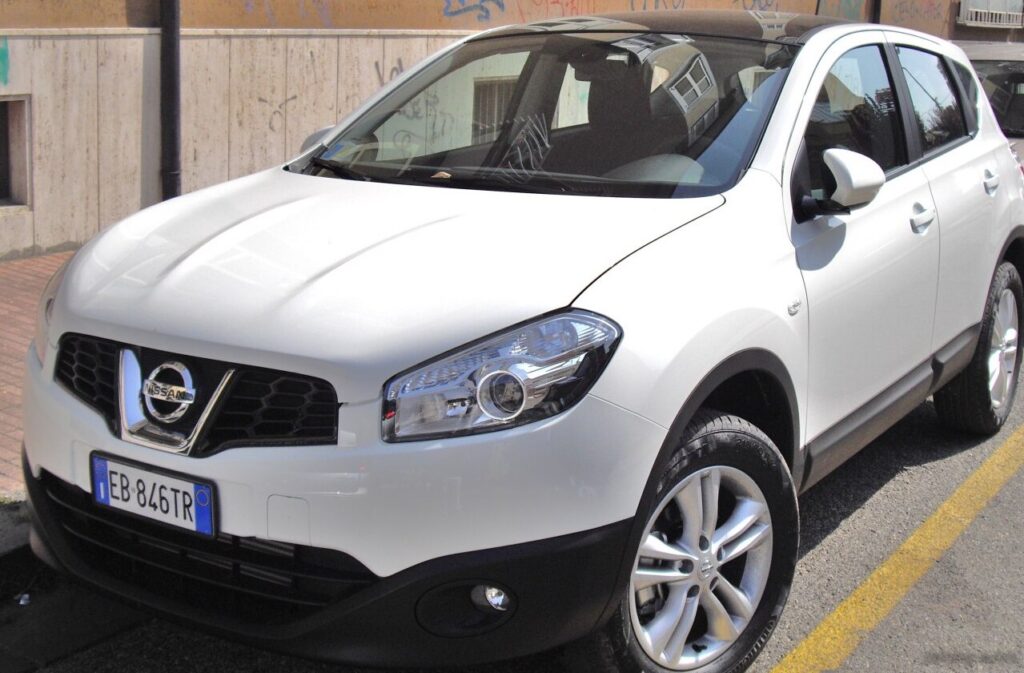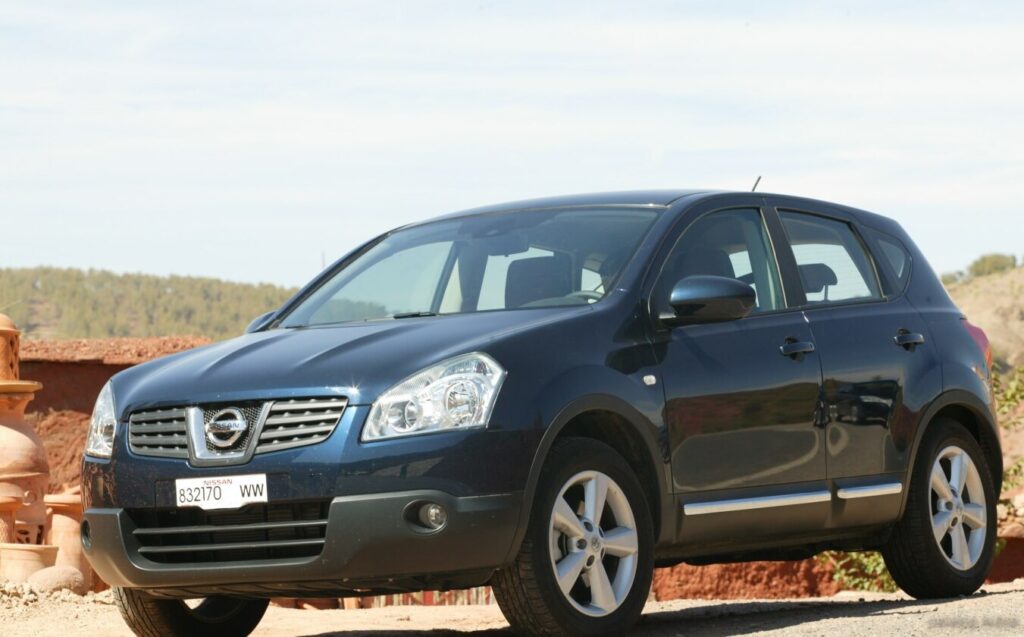
The Nissan Qashqai (known as the Dualis in some markets) represented Nissan’s entry into the burgeoning compact crossover SUV segment. Introduced in 2006 and produced through 2010 for the first generation (J10 chassis code), the Qashqai aimed to blend the practicality of a hatchback with the elevated driving position and styling of an SUV. The 2.0-liter (141 hp) 4×4 variant, launched in 2007, occupied a mid-to-upper position within the Qashqai lineup, offering all-wheel drive capability and a more powerful engine option for buyers seeking enhanced performance and all-weather traction. This model was primarily marketed in Europe and other international markets, with limited availability in North America.
Technical Specifications
| Brand | Nissan |
| Model | Qashqai |
| Generation | Qashqai I (J10) |
| Type (Engine) | 2.0 (141 Hp) 4×4 |
| Start of production | 2007 |
| End of production | 2010 |
| Powertrain Architecture | Internal Combustion engine |
| Body type | SUV, Crossover |
| Seats | 5 |
| Doors | 5 |
| Fuel consumption (urban) | 11 l/100 km (21.4 US mpg, 25.7 UK mpg, 9.1 km/l) |
| Fuel consumption (extra urban) | 7 l/100 km (33.6 US mpg, 40.4 UK mpg, 14.3 km/l) |
| Fuel consumption (combined) | 8.4 l/100 km (28 US mpg, 33.6 UK mpg, 11.9 km/l) |
| CO2 emissions | 199 g/km |
| Fuel Type | Petrol (Gasoline) |
| Acceleration 0 – 100 km/h | 10.6 sec |
| Acceleration 0 – 62 mph | 10.6 sec |
| Acceleration 0 – 60 mph | 10.1 sec |
| Maximum speed | 190 km/h (118.06 mph) |
| Emission standard | Euro 4 |
| Weight-to-power ratio | 10 kg/Hp, 99.6 Hp/tonne |
| Weight-to-torque ratio | 7.2 kg/Nm, 138.5 Nm/tonne |
| Power | 141 Hp @ 6000 rpm |
| Power per litre | 70.6 Hp/l |
| Torque | 196 Nm @ 4800 rpm (144.56 lb.-ft. @ 4800 rpm) |
| Engine layout | Front, Transverse |
| Engine Model/Code | MR20DE |
| Engine displacement | 1997 cm3 (121.86 cu. in.) |
| Number of cylinders | 4 |
| Engine configuration | Inline |
| Cylinder Bore | 84 mm (3.31 in.) |
| Piston Stroke | 90.1 mm (3.55 in.) |
| Compression ratio | 10:1 |
| Number of valves per cylinder | 4 |
| Fuel injection system | Multi-port manifold injection |
| Engine aspiration | Naturally aspirated engine |
| Valvetrain | DOHC |
| Engine oil capacity | 4.4 l (4.65 US qt | 3.87 UK qt) |
| Coolant | 7 l (7.4 US qt | 6.16 UK qt) |
| Kerb Weight | 1415 kg (3119.54 lbs.) |
| Max. weight | 1960 kg (4321.06 lbs.) |
| Max load | 545 kg (1201.52 lbs.) |
| Trunk (boot) space – minimum | 410 l (14.48 cu. ft.) |
| Trunk (boot) space – maximum | 1513 l (53.43 cu. ft.) |
| Fuel tank capacity | 65 l (17.17 US gal | 14.3 UK gal) |
| Max. roof load | 75 kg (165.35 lbs.) |
| Permitted trailer load with brakes (12%) | 1400 kg (3086.47 lbs.) |
| Permitted trailer load without brakes | 740 kg (1631.42 lbs.) |
| Permitted towbar download | 75 kg (165.35 lbs.) |
| Length | 4315 mm (169.88 in.) |
| Width | 1780 mm (70.08 in.) |
| Height | 1605 mm (63.19 in.) |
| Wheelbase | 2630 mm (103.54 in.) |
| Front track | 1540 mm (60.63 in.) |
| Rear (Back) track | 1545 mm (60.83 in.) |
| Ride height (ground clearance) | 200 mm (7.87 in.) |
| Minimum turning circle (turning diameter) | 10.6 m (34.78 ft.) |
| Approach angle | 19.2° |
| Departure angle | 30.2° |
| Ramp-over (brakeover) angle | 17.0° |
| Wading depth | 350 mm (13.78 in.) |
| Drive wheel | All wheel drive (4×4) |
| Number of gears and type of gearbox | 6 gears, manual transmission |
| Front suspension | Independent, type McPherson with coil spring and anti-roll bar |
| Rear suspension | Independent multi-link spring suspension with stabilizer |
| Front brakes | Ventilated discs |
| Rear brakes | Disc |
| Assisting systems | ABS (Anti-lock braking system) |
| Steering type | Steering rack and pinion |
| Power steering | Electric Steering |
| Tires size | 215/65 R16; 215/60 R17 |
| Wheel rims size | 5.5J x 16; 6.5J x 17 |
INTRODUCTION
The Nissan Qashqai J10 2.0 (141 Hp) 4×4, introduced in 2007, was a key variant in the first-generation Qashqai lineup. Built on the Nissan C platform (shared with the Renault Mégane), the Qashqai aimed to offer a more stylish and practical alternative to traditional small family cars. The 2.0-liter engine and all-wheel-drive system positioned this trim as a more capable and premium offering, appealing to buyers who desired enhanced performance and all-weather confidence. It was a significant model for Nissan in Europe, contributing to the brand’s growing presence in the crossover segment.
Powertrain & Engine Architecture
The heart of the Qashqai 2.0 4×4 is the MR20DE 2.0-liter inline-four cylinder gasoline engine. This engine, a member of Nissan’s MR series, features multi-point fuel injection and a double overhead camshaft (DOHC) valvetrain with four valves per cylinder. The MR20DE produces 141 horsepower at 6,000 rpm and 196 Nm (144.56 lb-ft) of torque at 4,800 rpm. The engine’s design prioritizes smooth operation and reasonable fuel efficiency over outright performance. The 4×4 system utilizes Nissan’s electronically controlled all-wheel drive, featuring a center differential that automatically distributes torque between the front and rear axles based on traction conditions. The transmission is a six-speed manual gearbox, providing precise gear changes and driver control.
Driving Characteristics
The Qashqai 2.0 4×4 offers a noticeable step up in performance compared to the lower-powered 1.6-liter variants. While not a sports car, the 141 hp engine provides adequate acceleration for everyday driving and highway cruising. The six-speed manual transmission allows drivers to keep the engine in its optimal power band. The all-wheel-drive system enhances traction, particularly on slippery surfaces, providing a more secure and confident driving experience. However, the added weight of the 4×4 system and the engine itself does slightly impact fuel economy and handling agility compared to the front-wheel-drive models. The gear ratios are tuned for a balance between acceleration and fuel efficiency, with a relatively long final drive.
Equipment & Trim Levels
The 2.0 4×4 trim typically included a generous level of standard equipment. This often included air conditioning, power windows and mirrors, a CD player with auxiliary input, and alloy wheels. Higher-spec versions could be equipped with features such as automatic climate control, a panoramic sunroof, leather upholstery, and a navigation system. Safety features such as ABS, electronic brakeforce distribution (EBD), and front and side airbags were standard. The interior design was functional and modern, with a focus on practicality and ease of use. Upholstery options typically included cloth or leather, with a range of color choices available.
Chassis & Braking
The Qashqai J10 features an independent suspension setup at all four corners. The front suspension utilizes a McPherson strut design with a coil spring and anti-roll bar, while the rear suspension employs a multi-link system, also with a stabilizer bar. This setup provides a comfortable ride quality and decent handling characteristics. The braking system consists of ventilated discs at the front and solid discs at the rear, providing adequate stopping power for the vehicle’s weight and performance. ABS (Anti-lock Braking System) is standard, enhancing braking performance and stability in emergency situations.
Market Reception & Comparison
The Qashqai 2.0 4×4 was generally well-received by automotive critics. It was praised for its stylish design, spacious interior, and comfortable ride. The all-wheel-drive system was seen as a valuable addition for buyers in regions with inclement weather. Compared to the 1.6-liter variants, the 2.0 4×4 offered a more refined driving experience and greater performance. However, it was also criticized for its relatively high price and slightly compromised fuel economy. Compared to rivals like the Volkswagen Tiguan and the Mitsubishi Outlander, the Qashqai offered a compelling combination of value, style, and practicality.
Legacy
The Nissan Qashqai J10 2.0 4×4 has proven to be a relatively reliable vehicle in the used car market. The MR20DE engine is known for its durability and longevity, provided it has been properly maintained. Common issues include occasional oil leaks and sensor failures, but these are generally not major concerns. The all-wheel-drive system is also generally reliable, although regular maintenance of the transfer case and differentials is recommended. Today, the Qashqai J10 2.0 4×4 remains a popular choice for buyers seeking an affordable and practical crossover SUV with all-weather capability.