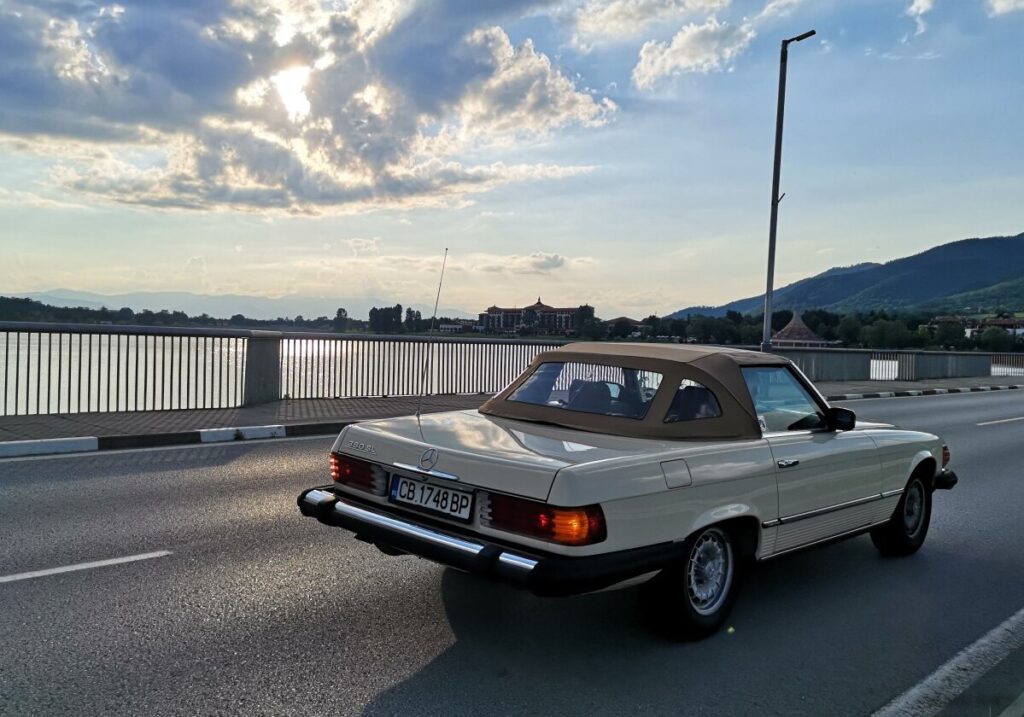
The Mercedes-Benz SL (R107) 280 SL, produced from May 1974 to August 1985, represents a significant evolution in the iconic SL lineage. Positioned as a mid-range offering within the R107 generation – which spanned from the 280 SL to the potent 560 SL – this variant aimed to balance performance with a more accessible price point. The R107 series, designed as a successor to the popular W113 “Pagoda” SL, was intended to blend luxury, comfort, and sporting character, appealing to a broader audience than its predecessor. The 280 SL, with its 2.8-liter inline-six engine, became a popular choice for buyers seeking a refined and capable roadster.
Technical Specifications
| Brand | Mercedes-Benz |
| Model | SL |
| Generation | SL (R107) |
| Type (Engine) | 280 SL (185 Hp) |
| Start of production | May, 1974 |
| End of production | August, 1985 |
| Powertrain Architecture | Internal Combustion engine |
| Body type | Roadster |
| Seats | 2 |
| Doors | 2 |
| Fuel consumption (urban) | 17.7 l/100 km (13.3 US mpg, 16 UK mpg, 5.6 km/l) |
| Fuel consumption (extra urban) | 9.3 l/100 km (25.3 US mpg, 30.4 UK mpg, 10.8 km/l) |
| Fuel Type | Petrol (Gasoline) |
| Acceleration 0 – 100 km/h | 10.1 sec |
| Acceleration 0 – 62 mph | 10.1 sec |
| Acceleration 0 – 60 mph | 9.6 sec |
| Maximum speed | 200 km/h (124.27 mph) |
| Weight-to-power ratio | 8.1 kg/Hp, 123.3 Hp/tonne |
| Weight-to-torque ratio | 6.3 kg/Nm, 160 Nm/tonne |
| Power | 185 Hp @ 5800 rpm |
| Power per litre | 67.4 Hp/l |
| Torque | 240 Nm @ 4500 rpm (177.01 lb.-ft. @ 4500 rpm) |
| Engine layout | Front, Longitudinal |
| Engine Model/Code | M 110.982 |
| Engine displacement | 2746 cm3 (167.57 cu. in.) |
| Number of cylinders | 6 |
| Engine configuration | Inline |
| Cylinder Bore | 86 mm (3.39 in.) |
| Piston Stroke | 78.8 mm (3.1 in.) |
| Compression ratio | 9:1 |
| Number of valves per cylinder | 4 |
| Fuel injection system | Multi-port manifold injection |
| Engine aspiration | Naturally aspirated engine |
| Valvetrain | DOHC |
| Engine oil capacity | 6 l (6.34 US qt | 5.28 UK qt) |
| Coolant | 12 l (12.68 US qt | 10.56 UK qt) |
| Kerb Weight | 1500 kg (3306.93 lbs.) |
| Max. weight | 1920 kg (4232.88 lbs.) |
| Max load | 420 kg (925.94 lbs.) |
| Trunk (boot) space – maximum | 261 l (9.22 cu. ft.) |
| Fuel tank capacity | 90 l (23.78 US gal | 19.8 UK gal) |
| Permitted trailer load with brakes (12%) | 1500 kg (3306.93 lbs.) |
| Permitted trailer load without brakes | 750 kg (1653.47 lbs.) |
| Length | 4390 mm (172.83 in.) |
| Width | 1790 mm (70.47 in.) |
| Height | 1300 mm (51.18 in.) |
| Wheelbase | 2460 mm (96.85 in.) |
| Front track | 1452 mm (57.17 in.) |
| Rear (Back) track | 1440 mm (56.69 in.) |
| Minimum turning circle | 10.34 m (33.92 ft.) |
| Drivetrain Architecture | Rear wheel drive |
| Number of gears and type of gearbox | 5 gears, manual transmission |
| Front suspension | Coil spring, Double wishbone |
| Rear suspension | Transverse stabilizer, Trailing arm, Coil spring |
| Front brakes | Ventilated discs, 278 mm |
| Rear brakes | Disc, 279 mm |
| Steering type | Cone worm with recirculation balls |
| Power steering | Hydraulic Steering |
| Tires size | Front wheel tires: 195/75 R14Rear wheel tires: 195/75 R14 |
| Wheel rims size | Front wheel rims: 6.5J x 14Rear wheel rims: 6.5J x 14 |
Powertrain & Engine Architecture
The heart of the 280 SL is the M110.982 engine, a 2.8-liter (2746 cc) inline-six cylinder powerplant. This engine, a descendant of Mercedes-Benz’s long-running M110 family, featured a cast-iron block and an aluminum cylinder head. It employed a dual overhead camshaft (DOHC) valvetrain, operating four valves per cylinder, contributing to its relatively high specific output for the era. Fuel delivery was managed by a Bosch K-Jetronic mechanical fuel injection system, known for its reliability and precise metering. The engine produced 185 horsepower at 5800 rpm and 240 Nm (177 lb-ft) of torque at 4500 rpm. The standard transmission was a five-speed manual, though a four-speed automatic transmission was also available, impacting performance and driving experience.
Driving Characteristics
The 280 SL offered a balanced driving experience. With the five-speed manual, acceleration to 60 mph took around 9.6 seconds, and it could reach a top speed of 200 km/h (124 mph). The automatic transmission added approximately a second to the 0-60 mph time. While not a sports car in the modern sense, the 280 SL provided ample power for comfortable cruising and spirited driving. The inline-six engine delivered smooth, linear power delivery, making it easy to modulate throttle and maintain control. The relatively long wheelbase and well-tuned suspension contributed to a comfortable ride, even on less-than-perfect road surfaces. Compared to the later 300 SL and 560 SL variants, the 280 SL offered a more economical and manageable driving experience, prioritizing refinement over outright performance.
Equipment & Trim Levels
The 280 SL came reasonably well-equipped as standard. Interior appointments included leatherette upholstery (leather was optional), wood trim, and a comprehensive instrument cluster. Standard features included power steering, power-assisted disc brakes, and central locking. Optional extras were plentiful, including air conditioning, leather upholstery, a sunroof, and upgraded audio systems. Trim levels were relatively simple, with most variations stemming from the selection of optional equipment. The 280 SL aimed for a luxurious feel without the extensive customization options of some of its competitors.
Chassis & Braking
The R107 chassis featured independent suspension all around. The front suspension utilized coil springs and double wishbones, while the rear employed a trailing arm setup with coil springs and a transverse stabilizer bar. This configuration provided a good balance of ride comfort and handling. Brakes were power-assisted discs on all four wheels, offering adequate stopping power for the vehicle’s weight and performance. The 280 SL’s weight of approximately 1500 kg (3307 lbs) was relatively moderate for a grand tourer of its era, contributing to its manageable handling characteristics.
Market Reception & Comparison
The 280 SL was generally well-received by automotive critics. It was praised for its comfortable ride, refined engine, and elegant styling. However, some critics noted that its performance was not as exhilarating as some of its rivals, particularly the Porsche 911. Compared to the 300 SL, the 280 SL offered better fuel economy and a slightly more nimble feel. Compared to the 560 SL, it was more affordable and less demanding on fuel, making it a more practical choice for everyday driving. The 280 SL’s reliability was also a strong point, contributing to its enduring popularity.
Legacy
The Mercedes-Benz SL (R107) 280 SL has proven to be a remarkably durable and reliable vehicle. The M110 engine is known for its longevity, and many examples are still on the road today. While maintenance costs can be significant due to the vehicle’s age and complexity, parts availability is generally good. In the used car market, the 280 SL is highly sought after by enthusiasts who appreciate its classic styling, comfortable driving experience, and relatively straightforward mechanicals. It represents a sweet spot in the R107 range, offering a blend of luxury, performance, and affordability that continues to appeal to collectors and drivers alike.