
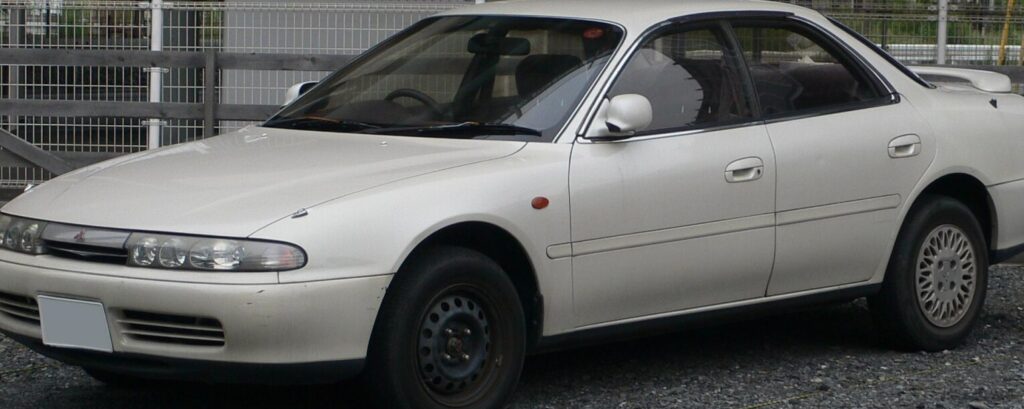
The Mitsubishi Emeraude (E54A) was a mid-size sedan produced by Mitsubishi Motors between 1992 and 1995. Positioned as a more upscale offering within Mitsubishi’s lineup, the Emeraude aimed to compete with established Japanese and European sedans. The 2.0 i V6 24V variant, producing 200 horsepower, represented the top-of-the-line engine option for the E54A, offering a blend of performance and refinement. It was primarily sold in the Japanese domestic market (JDM), with limited exports to select regions. The Emeraude was built on Mitsubishi’s E50 series platform, sharing some components with other Mitsubishi models of the era.
Technical Specifications
| Brand | Mitsubishi |
| Model | Emeraude |
| Generation | Emeraude (E54A) |
| Type (Engine) | 2.0 i V6 24V (200 Hp) |
| Start of production | 1992 |
| End of production | 1995 |
| Powertrain Architecture | Internal Combustion engine |
| Body type | Sedan |
| Seats | 5 |
| Doors | 4 |
| Fuel consumption (combined) | 6.3 l/100 km (37.3 US mpg, 44.8 UK mpg, 15.9 km/l) |
| Fuel Type | Petrol (Gasoline) |
| Weight-to-power ratio | 6.6 kg/Hp, 152.7 Hp/tonne |
| Weight-to-torque ratio | 6.6 kg/Nm, 152.7 Nm/tonne |
| Power | 200 Hp @ 7500 rpm |
| Power per litre | 100.1 Hp/l |
| Torque | 200 Nm @ 6000 rpm (147.51 lb.-ft. @ 6000 rpm) |
| Engine layout | Front, Transverse |
| Engine displacement | 1998 cm3 (121.93 cu. in.) |
| Number of cylinders | 6 |
| Engine configuration | V-engine |
| Cylinder Bore | 78.4 mm (3.09 in.) |
| Piston Stroke | 69 mm (2.72 in.) |
| Compression ratio | 10:1 |
| Number of valves per cylinder | 4 |
| Fuel injection system | Multi-port manifold injection |
| Engine aspiration | Naturally aspirated engine |
| Valvetrain | DOHC |
| Kerb Weight | 1310 kg (2888.06 lbs.) |
| Fuel tank capacity | 64 l (16.91 US gal | 14.08 UK gal) |
| Length | 4610 mm (181.5 in.) |
| Width | 1730 mm (68.11 in.) |
| Height | 1370 mm (53.94 in.) |
| Wheelbase | 2635 mm (103.74 in.) |
| Front track | 1510 mm (59.45 in.) |
| Rear track | 1505 mm (59.25 in.) |
| Drivetrain Architecture | The Internal combustion engine (ICE) drives the front wheels of the vehicle. |
| Drive wheel | Front wheel drive |
| Number of gears and type of gearbox | 5 gears, manual transmission |
| Front suspension | Coil spring |
| Rear suspension | Coil spring |
| Front brakes | Ventilated discs |
| Rear brakes | Disc |
| Assisting systems | ABS (Anti-lock braking system) |
| Steering type | Steering rack and pinion |
| Power steering | Hydraulic Steering |
| Tires size | 205/60 R15 H |
Powertrain & Engine Architecture
The heart of the Emeraude 2.0 i V6 24V was Mitsubishi’s 6A12 engine. This 1998cc, naturally aspirated V6 featured a double overhead camshaft (DOHC) valvetrain with four valves per cylinder. The engine utilized multi-port fuel injection to deliver precise fuel metering, contributing to both performance and efficiency. The 6A12 engine was known for its smooth power delivery and relatively high-revving nature. The 200 horsepower output was a significant figure for a naturally aspirated engine of this displacement in the early 1990s. The engine’s transverse mounting within the front-wheel-drive configuration helped optimize packaging within the engine bay. The Emeraude 2.0 i V6 24V was exclusively offered with a 5-speed manual transmission, providing drivers with full control over the engine’s power band.
Driving Characteristics
The 200 hp output, combined with the relatively lightweight construction of the Emeraude (1310 kg), resulted in brisk acceleration. While not a sports car, the Emeraude 2.0 i V6 24V offered a noticeably more engaging driving experience than lower-powered variants. The 5-speed manual transmission allowed drivers to keep the engine within its optimal power range, providing responsive acceleration. The front-wheel-drive layout offered predictable handling, although it could exhibit some torque steer under hard acceleration. The suspension, tuned for comfort, provided a reasonably smooth ride, absorbing most road imperfections effectively. Compared to the lower-displacement engines available in the Emeraude lineup, the V6 offered a substantial performance advantage, making it the preferred choice for drivers seeking a more spirited driving experience.
Equipment & Trim Levels
The 2.0 i V6 24V variant of the Emeraude typically came well-equipped, reflecting its position as the top-of-the-line model. Standard features included power windows, power locks, air conditioning, and a quality audio system. Interior upholstery was typically cloth, although leather options were available. The dashboard featured a straightforward layout with easy-to-read gauges. Optional extras included a sunroof, upgraded audio systems, and alloy wheels. The overall interior design aimed for a balance of comfort and functionality, providing a pleasant environment for both driver and passengers.
Chassis & Braking
The Emeraude utilized a conventional front-wheel-drive chassis layout with independent coil spring suspension at all four corners. The front suspension incorporated MacPherson struts, while the rear utilized a multi-link setup. This suspension configuration provided a good balance of ride comfort and handling stability. Braking duties were handled by ventilated discs at the front and solid discs at the rear. An Anti-lock Braking System (ABS) was standard equipment, enhancing braking performance and safety. The steering system employed a rack-and-pinion setup with hydraulic power assistance, providing precise and responsive steering feel.
Market Reception & Comparison
The Mitsubishi Emeraude 2.0 i V6 24V was generally well-received by automotive critics in Japan. The engine was praised for its smooth power delivery and responsiveness. The car’s comfortable ride and well-equipped interior were also noted as positive attributes. Compared to other models in the Emeraude lineup, the V6 variant offered a significant performance upgrade, justifying its higher price point. Fuel economy, while respectable for a V6 engine of this era (6.3 l/100 km), was slightly lower than that of the smaller-displacement engines. However, the performance benefits were generally considered to outweigh the slight fuel economy penalty.
Legacy
The Mitsubishi Emeraude, while not a hugely popular model outside of Japan, remains a fondly remembered car among enthusiasts. The 6A12 V6 engine is known for its durability and reliability, provided it is properly maintained. Today, well-maintained examples of the Emeraude 2.0 i V6 24V are becoming increasingly collectible, particularly within the JDM car community. The car represents a unique blend of Japanese engineering and design, offering a comfortable and engaging driving experience. While parts availability can be a challenge, the 6A12 engine’s robust construction ensures that it can provide many years of reliable service with proper care.
