
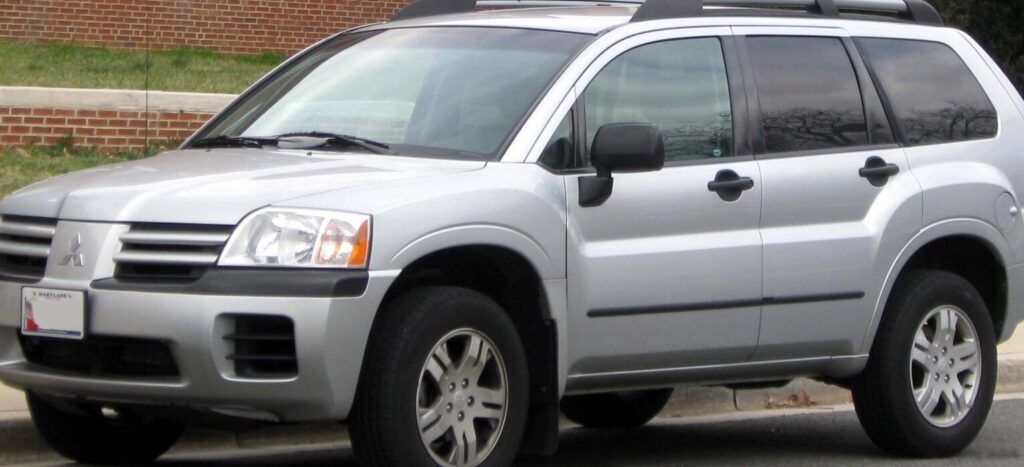
The Mitsubishi Endeavor 3.8 i V6 24V 4WD represents Mitsubishi’s entry into the mid-size SUV market in North America. Produced for the 2003 and 2004 model years, the Endeavor was designed to appeal to buyers seeking a comfortable, capable, and relatively affordable SUV. It shared its platform with the Chrysler Crossfire and Dodge Stratus, a result of the Diamond Star Motors joint venture between Mitsubishi and Chrysler. The 3.8i V6 4WD variant was positioned as a mid-range offering, balancing performance with all-weather capability, and was a popular choice within the Endeavor lineup.
Technical Specifications
| Brand | Mitsubishi |
| Model | Endeavor |
| Generation | Endeavor |
| Type (Engine) | 3.8 i V6 24V 4WD (218 Hp) |
| Start of production | 2003 |
| End of production | 2004 |
| Powertrain Architecture | Internal Combustion engine |
| Body type | SUV |
| Seats | 5 |
| Doors | 5 |
| Fuel consumption (urban) | 13.9 l/100 km (16.9 US mpg) |
| Fuel consumption (extra urban) | 11.2 l/100 km (21 US mpg) |
| Fuel Type | Petrol (Gasoline) |
| Maximum speed | 180 km/h (111.85 mph) |
| Weight-to-power ratio | 8.8 kg/Hp |
| Weight-to-torque ratio | 5.7 kg/Nm |
| Power | 218 Hp @ 5000 rpm |
| Power per litre | 56.9 Hp/l |
| Torque | 339 Nm @ 3750 rpm (250.03 lb.-ft. @ 3750 rpm) |
| Engine layout | Front, Longitudinal |
| Engine Model/Code | 6G75 |
| Engine displacement | 3828 cm3 (233.6 cu. in.) |
| Number of cylinders | 6 |
| Engine configuration | V-engine |
| Cylinder Bore | 95 mm (3.74 in.) |
| Piston Stroke | 90 mm (3.54 in.) |
| Compression ratio | 10:1 |
| Number of valves per cylinder | 4 |
| Fuel injection system | Multi-port manifold injection |
| Engine aspiration | Naturally aspirated engine |
| Valvetrain | OHC |
| Engine oil capacity | 4.3 l (4.54 US qt | 3.78 UK qt) |
| Coolant | 9 l (9.51 US qt | 7.92 UK qt) |
| Kerb Weight | 1920 kg (4232.88 lbs.) |
| Trunk (boot) space – minimum | 1153 l (40.72 cu. ft.) |
| Trunk (boot) space – maximum | 2164 l (76.42 cu. ft.) |
| Fuel tank capacity | 81 l (21.4 US gal | 17.82 UK gal) |
| Length | 4830 mm (190.16 in.) |
| Width | 1870 mm (73.62 in.) |
| Height | 1768 mm (69.61 in.) |
| Wheelbase | 2750 mm (108.27 in.) |
| Front track | 1600 mm (62.99 in.) |
| Rear (Back) track | 1600 mm (62.99 in.) |
| Drive wheel | All wheel drive (4×4) |
| Number of gears and type of gearbox | 5 gears, automatic transmission |
| Front suspension | Spring Strut |
| Rear suspension | Coil spring |
| Front brakes | Disc |
| Rear brakes | Disc |
| Assisting systems | ABS (Anti-lock braking system) |
| Tires size | P235/65 R17 |
| Wheel rims size | 7J x 17 |
Powertrain & Engine Architecture
The heart of the Endeavor 3.8i is Mitsubishi’s 6G75 engine, a 3.8-liter SOHC 24-valve V6. This engine utilizes a cast iron block with an aluminum cylinder head. The 6G75 employs multi-port fuel injection, delivering fuel directly into each intake port for optimized combustion. The engine’s design prioritized smooth power delivery over outright performance, making it well-suited for the Endeavor’s intended role as a comfortable family SUV. The automatic transmission paired with this engine is a five-speed unit, providing adequate gear ratios for both highway cruising and moderate acceleration. While not a particularly advanced transmission by modern standards, it was known for its reliability and smooth operation.
Driving Characteristics
The 218 horsepower and 250 lb-ft of torque produced by the 3.8L V6, combined with the five-speed automatic, resulted in a driving experience focused on comfort and ease of use. Acceleration was adequate for everyday driving, but the Endeavor wasn’t designed to be a sporty vehicle. The automatic transmission’s shift points were calibrated for fuel efficiency and smooth transitions, sometimes at the expense of responsiveness. Compared to the base 2.4L four-cylinder Endeavor, the 3.8i offered a significant improvement in power and towing capacity. However, it didn’t possess the same level of driver engagement as a manual transmission equipped model (which wasn’t offered in the US market). The all-wheel-drive system provided enhanced traction in inclement weather, making it a capable vehicle for a variety of conditions.
Equipment & Trim Levels
The Endeavor 3.8i 4WD typically came standard with features such as air conditioning, power windows and locks, a CD player, and cloth upholstery. Higher trim levels, such as the Limited, added features like leather seats, a sunroof, upgraded audio systems, and alloy wheels. Optional extras included a navigation system and side airbags. The interior design was functional and straightforward, prioritizing practicality over luxury. The rear seats offered ample legroom for passengers, and the folding rear seats provided increased cargo space when needed.
Chassis & Braking
The Endeavor utilized a traditional body-on-frame construction, which contributed to its robust feel and off-road capability. The front suspension consisted of a MacPherson strut setup, while the rear employed a multi-link coil spring arrangement. This suspension configuration aimed to provide a comfortable ride while maintaining reasonable handling characteristics. Braking duties were handled by disc brakes on all four wheels, supplemented by an Anti-lock Braking System (ABS) for enhanced safety. The Endeavor’s braking performance was adequate for its weight class, but it wasn’t particularly noteworthy.
Market Reception & Comparison
The Mitsubishi Endeavor faced stiff competition in the mid-size SUV segment from established players like the Honda Pilot, Toyota Highlander, and Ford Explorer. Critics generally praised the Endeavor’s comfortable ride and spacious interior, but noted its unremarkable handling and somewhat bland styling. The 3.8i V6 engine was considered a good match for the vehicle, providing sufficient power for most driving situations. Fuel economy was average for its class, and reliability ratings were generally acceptable, though not exceptional. Compared to the base 2.4L Endeavor, the 3.8i offered a significant performance upgrade, but at a higher price point.
Legacy
The Mitsubishi Endeavor was discontinued after only two model years, largely due to declining sales and increasing competition. While it didn’t achieve the same level of success as some of its rivals, the Endeavor remains a relatively affordable and capable used SUV. The 6G75 engine is known for its durability and relatively simple maintenance requirements, making it a reasonably reliable powertrain. However, like any older vehicle, the Endeavor is prone to age-related issues such as rust and worn suspension components. Today, the Endeavor 3.8i 4WD represents a budget-friendly option for buyers seeking a spacious and capable SUV with all-wheel drive.
