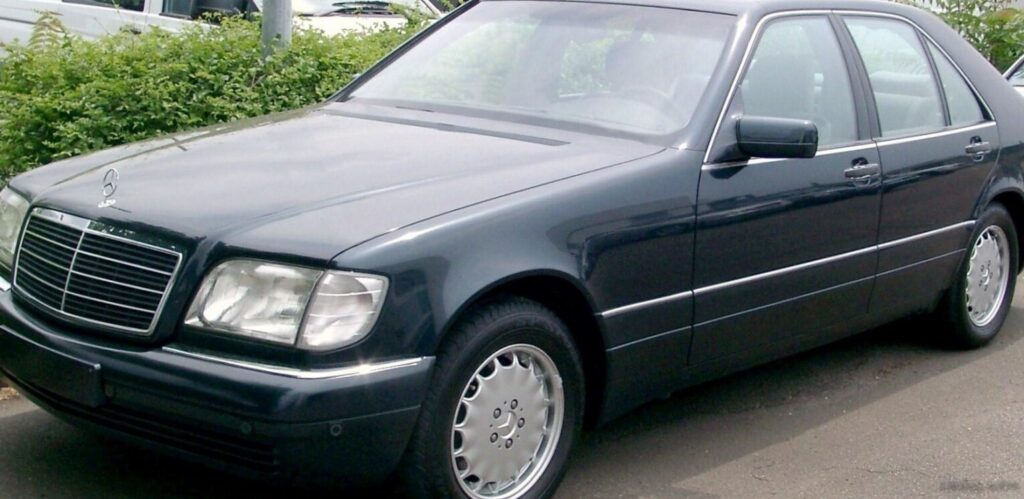
The Mercedes-Benz S 500, part of the W140 generation S-Class produced from September 1995 to August 1998, represented a pinnacle of German engineering and luxury. This variant, equipped with the M119.980 5.0-liter V8 engine and a 5G-TRONIC automatic transmission, occupied a premium position within the W140 lineup, positioned above the S320 and S420 models. The W140 S-Class, even after its 1994 facelift, continued to be a statement of status and technological advancement, offering a blend of performance, comfort, and cutting-edge features for its time. It was primarily marketed towards executives, dignitaries, and those seeking the ultimate in automotive luxury.
Technical Specifications
| Brand | Mercedes-Benz |
| Model | S-class |
| Generation | S-class (W140, facelift 1994) |
| Type (Engine) | S 500 V8 (320 Hp) 5G-TRONIC |
| Start of production | September, 1995 |
| End of production | August, 1998 |
| Powertrain Architecture | Internal Combustion engine |
| Body type | Sedan |
| Seats | 5 |
| Doors | 4 |
| Fuel consumption (economy) – urban (NEDC) | 22.1 l/100 km (10.6 US mpg, 12.8 UK mpg, 4.5 km/l) |
| Fuel consumption (economy) – extra urban (NEDC) | 11.5 l/100 km (20.5 US mpg, 24.6 UK mpg, 8.7 km/l) |
| Fuel consumption (economy) – combined (NEDC) | 15.4 l/100 km (15.3 US mpg, 18.3 UK mpg, 6.5 km/l) |
| CO2 emissions (NEDC) | 365 g/km |
| Fuel Type | Petrol (Gasoline) |
| Acceleration 0 – 100 km/h | 7.3 sec |
| Acceleration 0 – 62 mph | 7.3 sec |
| Acceleration 0 – 60 mph | 6.9 sec |
| Maximum speed | 250 km/h (155.34 mph), Electronically limited |
| Weight-to-power ratio | 6.3 kg/Hp, 160 Hp/tonne |
| Weight-to-torque ratio | 4.3 kg/Nm, 235 Nm/tonne |
| Power | 320 Hp @ 5600 rpm |
| Power per litre | 64.3 Hp/l |
| Torque | 470 Nm @ 3900 rpm (346.65 lb.-ft. @ 3900 rpm) |
| Engine layout | Front, Longitudinal |
| Engine Model/Code | M 119.980 |
| Engine displacement | 4973 cm3 (303.47 cu. in.) |
| Number of cylinders | 8 |
| Engine configuration | V-engine |
| Cylinder Bore | 96.5 mm (3.8 in.) |
| Piston Stroke | 85 mm (3.35 in.) |
| Compression ratio | 11:1 |
| Number of valves per cylinder | 4 |
| Fuel injection system | Multi-port manifold injection |
| Engine aspiration | Naturally aspirated engine |
| Valvetrain | DOHC |
| Engine oil capacity | 7.5 l (7.93 US qt | 6.6 UK qt) |
| Coolant | 16.5 l (17.44 US qt | 14.52 UK qt) |
| Kerb Weight | 2000 kg (4409.25 lbs.) |
| Max. weight | 2650 kg (5842.25 lbs.) |
| Max load | 650 kg (1433 lbs.) |
| Trunk (boot) space – minimum | 525 l (18.54 cu. ft.) |
| Fuel tank capacity | 100 l (26.42 US gal | 22 UK gal) |
| Length | 5113 mm (201.3 in.) |
| Width | 1886 mm (74.25 in.) |
| Height | 1486 mm (58.5 in.) |
| Wheelbase | 3040 mm (119.69 in.) |
| Front track | 1606 mm (63.23 in.) |
| Rear (Back) track | 1579 mm (62.17 in.) |
| Minimum turning circle (turning diameter) | 12.18 m (39.96 ft.) |
| Drivetrain Architecture | The Internal combustion engine (ICE) drives the rear wheels of the vehicle. |
| Drive wheel | Rear wheel drive |
| Number of gears and type of gearbox | 5 gears, automatic transmission G-TRONIC |
| Front suspension | Coil spring, Double wishbone, Transverse stabilizer |
| Rear suspension | Independent multi-link suspension, Transverse stabilizer, Coil spring |
| Front brakes | Ventilated discs |
| Rear brakes | Ventilated discs |
| Assisting systems | ABS (Anti-lock braking system) |
| Steering type | Cone worm with recirculation balls |
| Power steering | Hydraulic Steering |
| Tires size | 235/60 R16 |
| Wheel rims size | 7.5J x 16 |
Powertrain & Engine Architecture
The heart of the S 500 was the M119.980 4.9-liter (303.47 cu. in.) naturally aspirated V8 engine. This engine was a significant evolution of Mercedes-Benz’s V8 design, featuring all-aluminum construction, dual overhead camshafts (DOHC), and four valves per cylinder. The M119 engine was renowned for its smoothness and robust build quality. Fuel delivery was handled by a multi-port fuel injection system, carefully calibrated to deliver optimal performance and efficiency. The engine produced 320 horsepower at 5600 rpm and 470 Nm (346.65 lb-ft) of torque at 3900 rpm. Paired with the engine was the 5G-TRONIC automatic transmission, a five-speed unit that offered smooth and refined gear changes. This transmission was electronically controlled, adapting to driving conditions and driver input for optimal performance.
Driving Characteristics
The S 500 offered a distinctly grand touring experience. While not overtly sporty, the 320 hp V8 provided ample power for effortless cruising and confident overtaking. The 5G-TRONIC transmission was tuned for comfort, prioritizing smooth shifts over aggressive downshifts. Acceleration from 0 to 60 mph took approximately 6.9 seconds, and the car was electronically limited to a top speed of 250 km/h (155 mph). Compared to the S420, the S 500 offered a noticeable increase in performance, while the S320 provided a more fuel-efficient, albeit slower, alternative. The automatic transmission, while convenient, did result in a slight performance deficit compared to the available manual transmissions in other S-Class models.
Equipment & Trim Levels
The S 500 came standard with a comprehensive list of luxury features, befitting its flagship status. Leather upholstery was standard, along with wood trim, power-adjustable front seats with memory function, and a premium sound system. Climate control, power windows, and central locking were also included. Optional extras included a rear seat entertainment system, a sunroof, and upgraded leather options. The interior design emphasized elegance and sophistication, with a focus on high-quality materials and meticulous craftsmanship.
Chassis & Braking
The W140 S-Class featured a robust chassis with independent suspension all around. The front suspension utilized coil springs and a double wishbone setup, while the rear employed an independent multi-link suspension. Both ends were equipped with a transverse stabilizer bar to reduce body roll. Braking duties were handled by ventilated disc brakes on all four wheels, assisted by an Anti-lock Braking System (ABS). The S 500’s suspension was tuned for a comfortable ride, absorbing bumps and imperfections in the road with ease. The steering was a recirculating ball system with hydraulic power assistance, providing a smooth and precise driving experience.
Market Reception & Comparison
The S 500 was generally well-received by automotive critics, who praised its luxurious interior, smooth ride, and powerful engine. However, its fuel consumption was often criticized, averaging around 15.4 l/100 km (15.3 US mpg). Compared to the S420, the S 500 offered a significant performance upgrade, justifying its higher price tag for those seeking more power. The S320, while more economical, lacked the prestige and performance of the S 500. Reliability was generally good, although the complex electronics of the W140 generation could occasionally present issues.
Legacy
The W140 S 500 remains a highly sought-after classic car, appreciated for its build quality, luxurious features, and iconic design. The M119 engine is known for its durability and longevity, and well-maintained examples can still provide years of reliable service. However, maintenance costs can be high due to the car’s age and complexity. Today, the S 500 represents a bygone era of automotive excess and engineering excellence, a testament to Mercedes-Benz’s commitment to building the ultimate luxury sedan.