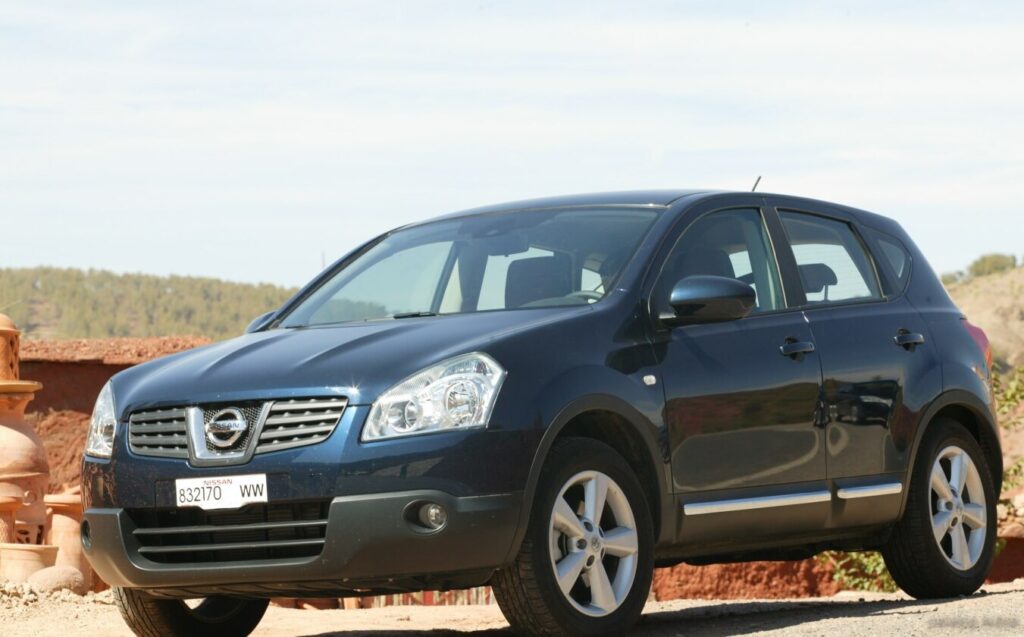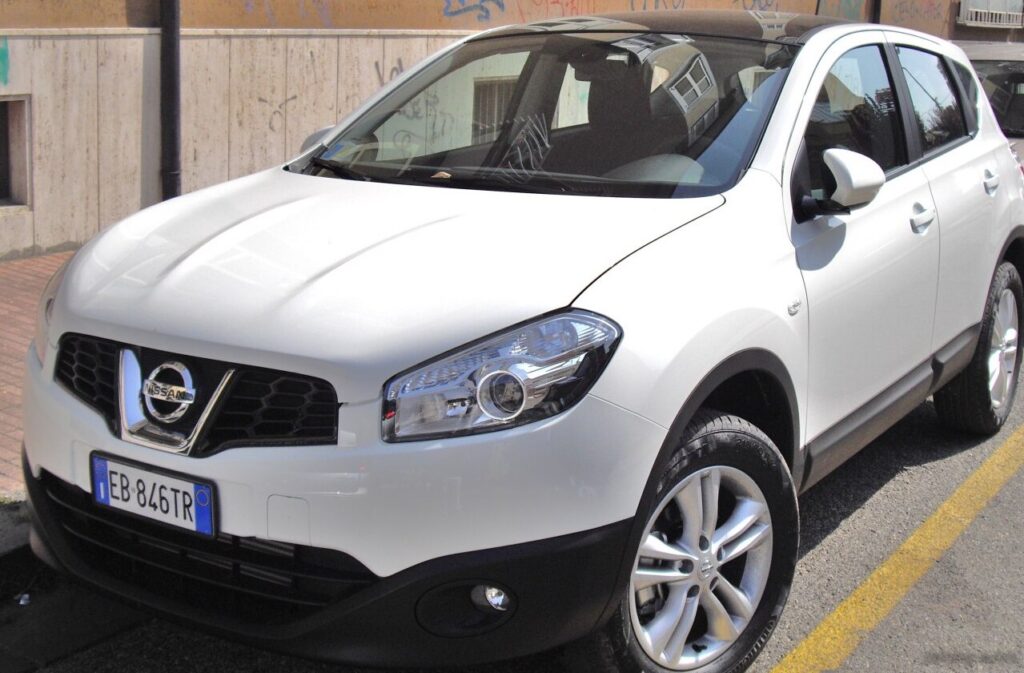
The Nissan Qashqai (marketed as the Dualis in some regions) represented Nissan’s entry into the burgeoning compact crossover SUV segment in Europe. Introduced in 2006 and receiving a significant facelift in 2010, the Qashqai aimed to blend the practicality of a hatchback with the elevated driving position and styling of an SUV. The 1.5 dCi 103 hp variant, produced during the 2010 facelift run, served as an entry-level diesel option, prioritizing fuel efficiency and affordability within the Qashqai lineup. This model year represents a refinement of the original J10 platform, addressing some early criticisms and enhancing the vehicle’s overall appeal.
Technical Specifications
| Brand | Nissan |
| Model | Qashqai |
| Generation | Qashqai I (J10, facelift 2010) |
| Type (Engine) | 1.5 dCi (103 Hp) |
| Start of production | 2010 |
| End of production | 2010 |
| Powertrain Architecture | Internal Combustion engine |
| Body type | SUV, Crossover |
| Seats | 5 |
| Doors | 5 |
| Fuel consumption (urban) | 6.3 l/100 km (37.3 US mpg, 44.8 UK mpg, 15.9 km/l) |
| Fuel consumption (extra urban) | 4.7 l/100 km (50 US mpg, 60.1 UK mpg, 21.3 km/l) |
| Fuel consumption (combined) | 5.2 l/100 km (45.2 US mpg, 54.3 UK mpg, 19.2 km/l) |
| CO2 emissions | 138 g/km |
| Fuel Type | Diesel |
| Acceleration 0 – 100 km/h | 12.5 sec |
| Acceleration 0 – 62 mph | 12.5 sec |
| Acceleration 0 – 60 mph | 11.9 sec |
| Maximum speed | 176 km/h (109.36 mph) |
| Emission standard | Euro 4 |
| Weight-to-power ratio | 13.8 kg/Hp, 72.6 Hp/tonne |
| Weight-to-torque ratio | 5.9 kg/Nm, 169.3 Nm/tonne |
| Power | 103 Hp @ 4000 rpm |
| Power per litre | 70.5 Hp/l |
| Torque | 240 Nm @ 2000 rpm (177.01 lb.-ft. @ 2000 rpm) |
| Engine layout | Front, Transverse |
| Engine Model/Code | K9K |
| Engine displacement | 1461 cm3 (89.16 cu. in.) |
| Number of cylinders | 4 |
| Engine configuration | Inline |
| Cylinder Bore | 76 mm (2.99 in.) |
| Piston Stroke | 80.5 mm (3.17 in.) |
| Number of valves per cylinder | 4 |
| Fuel injection system | Diesel Commonrail |
| Engine aspiration | Turbocharger, Intercooler |
| Valvetrain | OHC |
| Engine oil capacity | 4.6 l (4.86 US qt | 4.05 UK qt) |
| Coolant | 7 l (7.4 US qt | 6.16 UK qt) |
| Kerb Weight | 1418 kg (3126.15 lbs.) |
| Max. weight | 1930 kg (4254.92 lbs.) |
| Max load | 512 kg (1128.77 lbs.) |
| Trunk (boot) space – minimum | 410 l (14.48 cu. ft.) |
| Trunk (boot) space – maximum | 1513 l (53.43 cu. ft.) |
| Fuel tank capacity | 65 l (17.17 US gal | 14.3 UK gal) |
| Max. roof load | 75 kg (165.35 lbs.) |
| Permitted trailer load with brakes (12%) | 1200 kg (2645.55 lbs.) |
| Permitted trailer load without brakes | 740 kg (1631.42 lbs.) |
| Permitted towbar download | 75 kg (165.35 lbs.) |
| Length | 4330 mm (170.47 in.) |
| Width | 1780 mm (70.08 in.) |
| Width including mirrors | 2120 mm (83.46 in.) |
| Height | 1615-1622 mm (63.58 – 63.86 in.) |
| Wheelbase | 2630 mm (103.54 in.) |
| Front track | 1540 mm (60.63 in.) |
| Rear (Back) track | 1550 mm (61.02 in.) |
| Minimum turning circle | 10.6 m (34.78 ft.) |
| Drivetrain Architecture | Front wheel drive |
| Number of gears and type of gearbox | 6 gears, manual transmission |
| Front suspension | Independent, type McPherson with coil spring and anti-roll bar |
| Rear suspension | Independent multi-link spring suspension with stabilizer |
| Front brakes | Ventilated discs |
| Rear brakes | Disc |
| Assisting systems | ABS (Anti-lock braking system) |
| Steering type | Steering rack and pinion |
| Power steering | Electric Steering |
| Tires size | 215/65 R16; 215/60 R17 |
| Wheel rims size | 5.5J x 16; 6.5J x 17 |
INTRODUCTION
The 1.5 dCi 103 hp Qashqai, produced during the 2010 facelift, occupied the lower-mid range of the Qashqai lineup. Positioned above the base 1.6L petrol engine, it offered a more economical and torque-rich alternative for drivers prioritizing fuel efficiency and everyday usability. The facelift brought subtle styling revisions, improved interior materials, and enhancements to the suspension, aiming to address some of the criticisms leveled at the original Qashqai. Built on the Nissan/Renault CMF-C/D platform (also known as the 1HX0), the Qashqai aimed to provide a comfortable and practical crossover experience, appealing to families and individuals seeking a versatile vehicle.
Powertrain & Engine Architecture
The heart of this Qashqai variant is the K9K 1.5-liter four-cylinder diesel engine. This engine, a product of the Renault-Nissan Alliance, is known for its robust design and fuel efficiency. The K9K utilizes a common rail direct injection system, delivering fuel directly into the combustion chamber at extremely high pressure for optimized combustion. A turbocharger with an intercooler further enhances performance by forcing more air into the engine. The engine features an overhead camshaft (OHC) valvetrain with four valves per cylinder. The 103 hp output is achieved at 4000 rpm, while peak torque of 240 Nm (177 lb-ft) is available from just 2000 rpm, providing ample pulling power for everyday driving. The engine is transversely mounted at the front of the vehicle. Typically paired with a six-speed manual transmission, this configuration prioritized fuel economy over outright performance.
Driving Characteristics
The 1.5 dCi 103 hp Qashqai delivers a comfortable, if not particularly exhilarating, driving experience. Acceleration from 0-60 mph takes around 11.9 seconds, and top speed is approximately 109 mph. The engine’s strong low-end torque makes it well-suited for urban driving and overtaking maneuvers. The six-speed manual transmission allows for efficient cruising on the highway, while the relatively long gearing contributes to fuel economy. Compared to higher-output Qashqai variants, such as the 1.6 dCi, this version feels noticeably less powerful, particularly when fully loaded or tackling steep inclines. However, the trade-off is significantly improved fuel economy and lower running costs. The steering is light and precise, making it easy to maneuver in tight spaces, but lacks the feedback desired by more enthusiastic drivers.
Equipment & Trim Levels
The 1.5 dCi 103 hp Qashqai typically came equipped with a reasonable level of standard features. These generally included air conditioning, electric front windows, a CD player with auxiliary input, and ABS brakes. Higher trim levels, such as Visia, Acenta, and Tekna, added features like alloy wheels, climate control, rear parking sensors, and a more sophisticated audio system. Interior upholstery was typically cloth, with options for upgraded materials on higher trims. Optional extras included satellite navigation, leather seats, and a panoramic sunroof.
Chassis & Braking
The Qashqai’s chassis features independent suspension all around, with a McPherson strut setup at the front and a multi-link arrangement at the rear. This configuration provides a comfortable ride quality, absorbing bumps and imperfections in the road surface effectively. The front brakes are ventilated discs, while the rear brakes are solid discs. ABS (Anti-lock Braking System) is standard, enhancing safety by preventing wheel lockup during hard braking. The suspension tuning is geared towards comfort rather than sporty handling, resulting in a slight degree of body roll in corners.
Market Reception & Comparison
The 1.5 dCi Qashqai was generally well-received by critics as a practical and economical crossover. It was praised for its fuel efficiency, comfortable ride, and spacious interior. However, some reviewers noted its lack of outright performance compared to more powerful rivals. Compared to the 1.6 dCi variant, the 1.5 dCi offered better fuel economy but less power. The 1.6L petrol engine was cheaper to purchase but significantly less fuel-efficient. The Qashqai competed with other compact crossovers such as the Kia Sportage, Hyundai ix35, and Volkswagen Tiguan.
Legacy
The K9K 1.5 dCi engine has proven to be a reliable and durable unit, and well-maintained examples of the 1.5 dCi Qashqai continue to be a popular choice in the used car market. While diesel engines have faced increased scrutiny in recent years due to emissions concerns, the K9K remains a relatively clean and efficient option. Common issues include turbocharger wear and potential problems with the diesel particulate filter (DPF), particularly on vehicles that have primarily been used for short journeys. Overall, the 1.5 dCi Qashqai represents a solid and practical crossover that offers a good balance of fuel economy, comfort, and reliability.