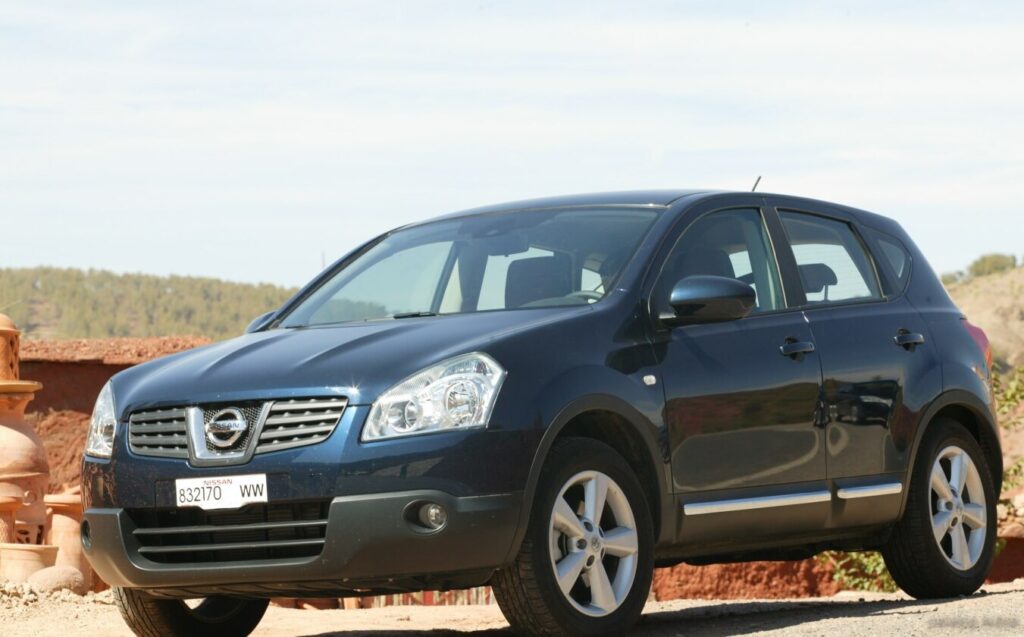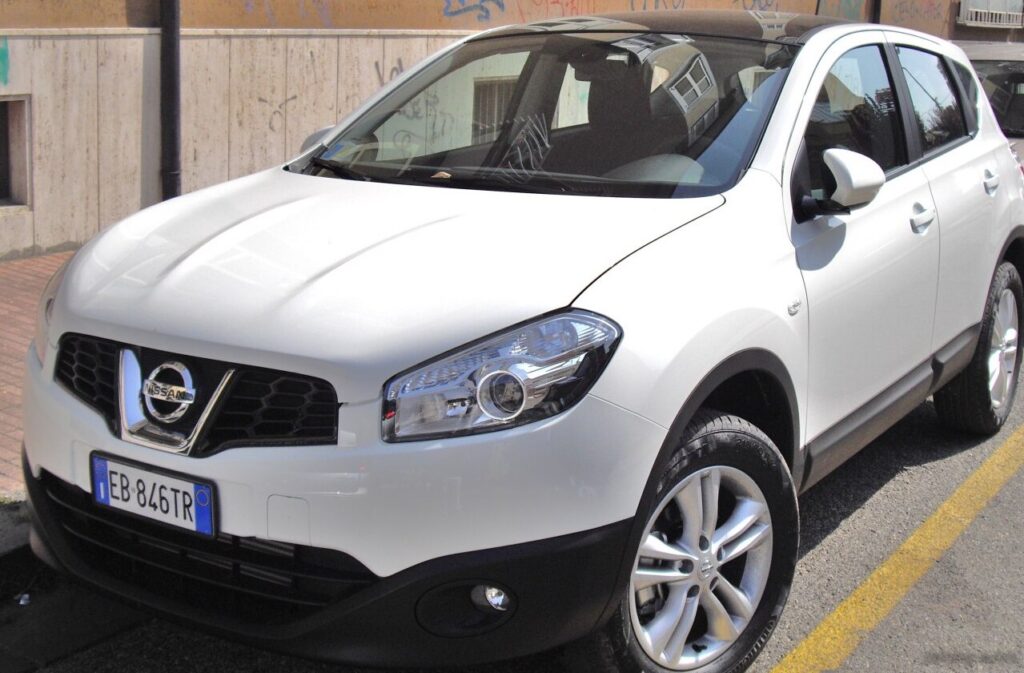
The Nissan Qashqai (known as the Dualis in some markets) represented Nissan’s entry into the burgeoning compact crossover segment in Europe. Introduced in 2007, the first generation Qashqai (internal code J10) quickly gained popularity for its blend of practicality, affordability, and relatively stylish design. The facelifted version, released in 2010, brought subtle cosmetic updates and refinements to the powertrain lineup. This article focuses specifically on the 1.5 dCi variant, producing 106 horsepower, offered during the 2010 model year, and its position within the broader Qashqai range.
Technical Specifications
| Brand | Nissan |
| Model | Qashqai |
| Generation | Qashqai I (J10, facelift 2010) |
| Type (Engine) | 1.5 dCi (106 Hp) |
| Start of production | 2010 |
| End of production | 2010 |
| Powertrain Architecture | Internal Combustion engine |
| Body type | SUV, Crossover |
| Seats | 5 |
| Doors | 5 |
| Fuel consumption (urban) | 5.6 l/100 km (42 US mpg, 50.4 UK mpg, 17.9 km/l) |
| Fuel consumption (extra urban) | 4.5 l/100 km (52.3 US mpg, 62.8 UK mpg, 22.2 km/l) |
| Fuel consumption (combined) | 4.9 l/100 km (48 US mpg, 57.6 UK mpg, 20.4 km/l) |
| CO2 emissions | 129 g/km |
| Fuel Type | Diesel |
| Acceleration 0 – 100 km/h | 12.8 sec |
| Acceleration 0 – 62 mph | 12.8 sec |
| Acceleration 0 – 60 mph | 12.2 sec |
| Maximum speed | 176 km/h (109.36 mph) |
| Emission standard | Euro 4 |
| Weight-to-power ratio | 13.3 kg/Hp, 75.3 Hp/tonne |
| Weight-to-torque ratio | 5.9 kg/Nm, 170.6 Nm/tonne |
| Power | 106 Hp @ 4000 rpm |
| Power per litre | 72.6 Hp/l |
| Torque | 240 Nm @ 2000 rpm (177.01 lb.-ft. @ 2000 rpm) |
| Engine layout | Front, Transverse |
| Engine Model/Code | K9K |
| Engine displacement | 1461 cm3 (89.16 cu. in.) |
| Number of cylinders | 4 |
| Engine configuration | Inline |
| Cylinder Bore | 76 mm (2.99 in.) |
| Piston Stroke | 80.5 mm (3.17 in.) |
| Number of valves per cylinder | 4 |
| Fuel injection system | Diesel Commonrail |
| Engine aspiration | Turbocharger, Intercooler |
| Valvetrain | OHC |
| Engine oil capacity | 4.6 l (4.86 US qt | 4.05 UK qt) |
| Coolant | 7 l (7.4 US qt | 6.16 UK qt) |
| Kerb Weight | 1407 kg (3101.9 lbs.) |
| Max. weight | 1930 kg (4254.92 lbs.) |
| Max load | 523 kg (1153.02 lbs.) |
| Trunk (boot) space – minimum | 410 l (14.48 cu. ft.) |
| Trunk (boot) space – maximum | 1513 l (53.43 cu. ft.) |
| Fuel tank capacity | 65 l (17.17 US gal | 14.3 UK gal) |
| Max. roof load | 75 kg (165.35 lbs.) |
| Permitted trailer load with brakes (12%) | 1200 kg (2645.55 lbs.) |
| Permitted trailer load without brakes | 740 kg (1631.42 lbs.) |
| Permitted towbar download | 75 kg (165.35 lbs.) |
| Length | 4330 mm (170.47 in.) |
| Width | 1780 mm (70.08 in.) |
| Width including mirrors | 2120 mm (83.46 in.) |
| Height | 1615-1622 mm (63.58 – 63.86 in.) |
| Wheelbase | 2630 mm (103.54 in.) |
| Front track | 1540 mm (60.63 in.) |
| Rear (Back) track | 1550 mm (61.02 in.) |
| Minimum turning circle | 10.6 m (34.78 ft.) |
| Drivetrain Architecture | Front wheel drive |
| Drive wheel | Front wheel drive |
| Number of gears and type of gearbox | 6 gears, manual transmission |
| Front suspension | Independent, type McPherson with coil spring and anti-roll bar |
| Rear suspension | Independent multi-link spring suspension with stabilizer |
| Front brakes | Ventilated discs |
| Rear brakes | Disc |
| Assisting systems | ABS (Anti-lock braking system) |
| Steering type | Steering rack and pinion |
| Power steering | Electric Steering |
| Tires size | 215/65 R16; 215/60 R17 |
| Wheel rims size | 5.5J x 16; 6.5J x 17 |
INTRODUCTION
The 2010 Nissan Qashqai 1.5 dCi (106 Hp) was positioned as the entry-level diesel offering in the Qashqai lineup. Built on the Nissan/Renault CMF-C/D platform (also known as the 1HX0/A3 platform), the Qashqai aimed to bridge the gap between traditional hatchbacks and larger SUVs. The facelifted model, released in 2010, featured revised front and rear styling, interior upgrades, and improvements to the suspension. The 1.5 dCi engine was a key component of Nissan’s strategy to offer fuel-efficient options to European buyers, where diesel engines held a significant market share. This particular variant was aimed at buyers prioritizing economy and practicality over outright performance.
Powertrain & Engine Architecture
The heart of the Qashqai 1.5 dCi is the K9K engine, a 1.5-liter inline-four cylinder diesel engine. This engine, developed jointly by Renault and Nissan, is known for its relatively compact size and fuel efficiency. The 2010 version produced 106 horsepower at 4000 rpm and 240 Nm (177 lb-ft) of torque at 2000 rpm. It utilizes a diesel commonrail direct injection system, delivering fuel directly into the cylinders at high pressure for improved combustion. The engine also features a turbocharger with an intercooler, boosting power and torque output. The valvetrain employs an overhead camshaft (OHC) configuration. The 6-speed manual transmission was standard on this model, offering a good balance between fuel economy and drivability. The engine’s transverse mounting and front-wheel-drive configuration contribute to its compact footprint.
Driving Characteristics
The Qashqai 1.5 dCi with the manual transmission delivers adequate, though not exhilarating, performance. Acceleration from 0-60 mph takes around 12.2 seconds, and the top speed is approximately 109 mph. The engine’s torque is readily available from low revs, making it suitable for everyday driving and overtaking maneuvers. However, it can feel strained when pushed hard, particularly when fully loaded or climbing hills. The gear ratios are well-chosen to maximize fuel efficiency, but this sometimes comes at the expense of responsiveness. Compared to the higher-output 1.6 dCi or petrol variants, the 1.5 dCi feels noticeably slower. The manual gearbox provides a more engaging driving experience than an automatic, allowing drivers to better control the engine’s power delivery.
Equipment & Trim Levels
The 1.5 dCi typically came equipped with a reasonable level of standard features, though it was generally positioned as the base trim. Standard equipment often included air conditioning, electric front windows, a CD player with auxiliary input, and ABS brakes. Higher trim levels, such as Visia, Acenta, and Tekna, added features like alloy wheels, climate control, rear parking sensors, and a navigation system. Interior upholstery was typically cloth, and the dashboard featured a functional, if somewhat basic, design. Optional extras included metallic paint, a panoramic sunroof, and leather upholstery.
Chassis & Braking
The Qashqai’s chassis features independent suspension all around, with a McPherson strut setup at the front and a multi-link arrangement at the rear. This provides a comfortable ride quality, absorbing bumps and imperfections in the road surface effectively. The front brakes are ventilated discs, offering good stopping power, while the rear brakes are solid discs. The electric power steering provides light and precise control. Stabilizer bars are fitted to both the front and rear axles to reduce body roll during cornering. The Qashqai’s weight of around 1407 kg (3101.9 lbs) contributes to its stable handling characteristics.
Market Reception & Comparison
The Qashqai 1.5 dCi was generally well-received by critics for its fuel efficiency and practicality. It offered a compelling alternative to traditional hatchbacks, providing more space and a higher driving position. However, some reviewers criticized its lack of outright performance and its somewhat basic interior. Compared to the 1.6 dCi variant, the 1.5 dCi offered better fuel economy but significantly less power. The petrol-powered models provided more responsive acceleration but at the cost of increased fuel consumption. The Qashqai’s fuel economy of around 48 US mpg combined made it an attractive option for drivers covering long distances.
Legacy
The K9K 1.5 dCi engine has proven to be a relatively reliable unit, although it is not without its potential issues. Common problems include turbocharger failure, injector issues, and occasional problems with the diesel particulate filter (DPF). Regular maintenance, including oil changes and filter replacements, is crucial for ensuring long-term reliability. On the used car market, the Qashqai 1.5 dCi remains a popular choice due to its affordability and fuel efficiency. However, potential buyers should be aware of the potential maintenance costs associated with diesel engines, particularly the DPF. The Qashqai’s success paved the way for a new generation of compact crossovers, and it remains a significant model in Nissan’s history.