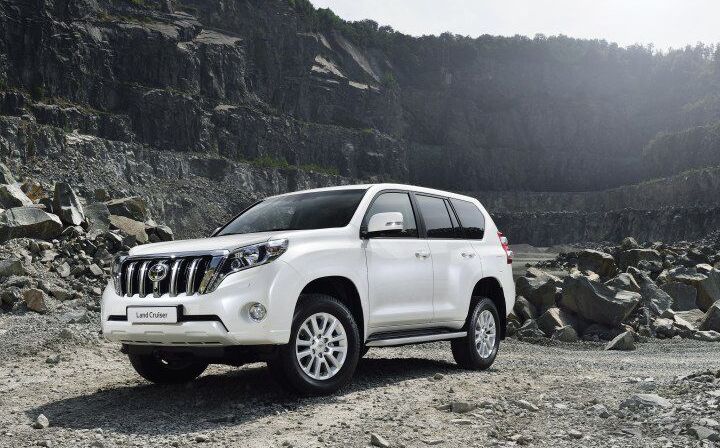
The Toyota Land Cruiser Prado (J150 series, specifically the 2013 facelift) 5-door model powered by the 2.7-liter VVT-i engine producing 163 horsepower was a significant offering in Toyota’s globally renowned SUV lineup. Produced from 2013 to 2015, this variant occupied a crucial position as an entry-level option within the Prado range, particularly in markets where larger engines faced higher taxation or where fuel efficiency was a primary concern. The J150 Prado, introduced in 2009, represented a shift towards a more comfortable and refined SUV experience compared to its predecessors, while retaining the Land Cruiser’s legendary off-road capability. This 2.7L version aimed to broaden the Prado’s appeal to families and individuals seeking a reliable and capable SUV without the expense of the more powerful options.
Technical Specifications
| Brand | Toyota |
| Model | Land Cruiser Prado |
| Generation | Land Cruiser Prado (J150, facelift 2013) 5-door |
| Type (Engine) | 2.7 VVT-i (163 Hp) |
| Start of production | 2013 |
| End of production | 2015 |
| Powertrain Architecture | Internal Combustion engine |
| Body type | SUV |
| Seats | 5 |
| Doors | 5 |
| Fuel consumption (combined) | 12.3 l/100 km (19.1 US mpg, 23 UK mpg, 8.1 km/l) |
| Fuel Type | Petrol (Gasoline) |
| Acceleration 0 – 100 km/h | 10.9 sec |
| Acceleration 0 – 62 mph | 10.9 sec |
| Acceleration 0 – 60 mph | 10.4 sec |
| Maximum speed | 165 km/h (102.53 mph) |
| Emission standard | Euro 4 |
| Weight-to-power ratio | 17.5 kg/Hp, 57.2 Hp/tonne |
| Weight-to-torque ratio | 11.6 kg/Nm, 86.3 Nm/tonne |
| Power | 163 Hp @ 5200 rpm |
| Power per litre | 60.5 Hp/l |
| Torque | 246 Nm @ 3800-3800 rpm (181.44 lb.-ft. @ 3800-3800 rpm) |
| Engine layout | Front, Transverse |
| Engine Model/Code | 2TR-FE |
| Engine displacement | 2694 cm3 (164.4 cu. in.) |
| Number of cylinders | 4 |
| Engine configuration | Inline |
| Cylinder Bore | 95 mm (3.74 in.) |
| Piston Stroke | 95 mm (3.74 in.) |
| Compression ratio | 9.6:1 |
| Number of valves per cylinder | 4 |
| Fuel injection system | Multi-port manifold injection |
| Engine aspiration | Naturally aspirated engine |
| Valvetrain | DOHC – VVT-i |
| Engine oil capacity | 5.6 l (5.92 US qt | 4.93 UK qt) |
| Coolant | 8.3 l (8.77 US qt | 7.3 UK qt) |
| Kerb Weight | 2850 kg (6283.17 lbs.) |
| Trunk (boot) space – minimum | 621 l (21.93 cu. ft.) |
| Fuel tank capacity | 87 l (22.98 US gal | 19.14 UK gal) |
| Length | 4780 mm (188.19 in.) |
| Width | 1885 mm (74.21 in.) |
| Height | 1845 mm (72.64 in.) |
| Wheelbase | 2790 mm (109.84 in.) |
| Front track | 1585 mm (62.4 in.) |
| Rear (Back) track | 1585 mm (62.4 in.) |
| Minimum turning circle | 11.6 m (38.06 ft.) |
| Drivetrain Architecture | All wheel drive (4×4). ICE drives permanently the four wheels. |
| Number of gears and type of gearbox | 5 gears, manual transmission |
| Front suspension | Double wishbone |
| Rear suspension | Dependent, multi-link spring with telescopic shock absorbers |
| Front brakes | Ventilated discs |
| Rear brakes | Ventilated discs |
| Assisting systems | ABS (Anti-lock braking system) |
| Steering type | Steering rack and pinion |
| Power steering | Electric Steering |
| Tires size | 265/65 R17; 265/60 R18 |
| Wheel rims size | 7.5J x 17; 7.5J x 18 |
INTRODUCTION
The 2013-2015 Toyota Land Cruiser Prado 2.7 VVT-i 5-door represented a pragmatic choice for buyers seeking the Land Cruiser’s renowned durability and off-road prowess in a more accessible package. Positioned as the entry point to the J150 Prado series, it catered to customers who prioritized fuel economy and lower running costs over outright performance. Built on the robust J150 platform, known for its body-on-frame construction, this variant was particularly popular in regions where gasoline prices were high or where larger displacement engines were subject to significant taxation. It offered a compelling blend of comfort, capability, and reliability, making it a popular choice for families and individuals alike.
Powertrain & Engine Architecture
At the heart of this Prado variant lies the 2TR-FE engine, a 2.7-liter inline-four cylinder gasoline engine. This engine is a naturally aspirated unit, meaning it doesn’t utilize a turbocharger or supercharger. It features Toyota’s Variable Valve Timing-intelligent (VVT-i) system, which optimizes valve timing for improved fuel efficiency and power delivery across the rev range. The 2TR-FE employs multi-port fuel injection, delivering fuel directly into the intake ports. The engine produces 163 horsepower at 5200 rpm and 246 Nm (181.44 lb-ft) of torque between 3800 and 3800 rpm. Paired with a 5-speed manual transmission, the powertrain delivers power to all four wheels via a full-time four-wheel-drive system. The transmission’s gear ratios are tuned for a balance of fuel economy and usability, prioritizing smooth operation over sporty acceleration.
Driving Characteristics
The driving experience in the 2.7L Prado is characterized by its smooth and predictable nature. While not particularly quick, with a 0-60 mph time of around 10.4 seconds, it provides adequate power for everyday driving and highway cruising. The manual transmission allows for greater driver control, but the engine’s relatively low torque output means frequent downshifts are often necessary, especially when tackling inclines or overtaking. Compared to the more powerful 4.0-liter V6 versions of the Prado, the 2.7L feels noticeably less responsive. However, it excels in off-road situations, where its manageable power delivery and robust four-wheel-drive system provide excellent traction and control. The suspension, tuned for comfort, absorbs bumps and irregularities effectively, providing a comfortable ride even on rough terrain.
Equipment & Trim Levels
The 2.7L Prado typically came equipped with a respectable level of standard features, though these varied depending on the specific market. Common features included air conditioning, power windows and locks, a basic audio system, and alloy wheels. Interior upholstery was typically cloth, though leather options were available as upgrades. Higher trim levels offered additional features such as a sunroof, upgraded audio system, automatic climate control, and parking sensors. The dashboard layout was functional and straightforward, prioritizing usability over flashy design. Optional extras included a rear-view camera, navigation system, and a limited-slip differential for enhanced off-road capability.
Chassis & Braking
The Prado’s chassis is a traditional body-on-frame construction, providing exceptional strength and durability. The front suspension utilizes a double wishbone setup, while the rear features a dependent, multi-link spring system with telescopic shock absorbers. This configuration provides a good balance of on-road comfort and off-road capability. Braking duties are handled by ventilated discs on all four wheels, providing adequate stopping power. An Anti-lock Braking System (ABS) is standard, enhancing safety during emergency braking situations. The steering is rack and pinion with electric power assistance, offering a responsive and precise feel.
Market Reception & Comparison
The 2.7L Prado was generally well-received by critics as a practical and reliable SUV. It was praised for its fuel efficiency, comfortable ride, and legendary Toyota reliability. However, some reviewers noted its lack of outright performance compared to the more powerful Prado variants. Compared to the 4.0L V6 models, the 2.7L offered significantly better fuel economy, making it a more attractive option for budget-conscious buyers. It also benefited from lower running costs due to its simpler engine design. Against competitors like the Mitsubishi Pajero and Nissan Patrol, the Prado 2.7L stood out for its refined interior, comfortable ride, and strong resale value.
Legacy
The Toyota Land Cruiser Prado 2.7 VVT-i (J150) has proven to be a remarkably durable and reliable vehicle. The 2TR-FE engine is known for its longevity and relatively low maintenance requirements. In the used car market, these Prados continue to hold their value well, particularly those that have been well-maintained. They remain a popular choice for buyers seeking a capable and dependable SUV for both on-road and off-road adventures. The combination of Toyota’s engineering expertise and the Prado’s robust construction ensures that these vehicles continue to provide years of reliable service.