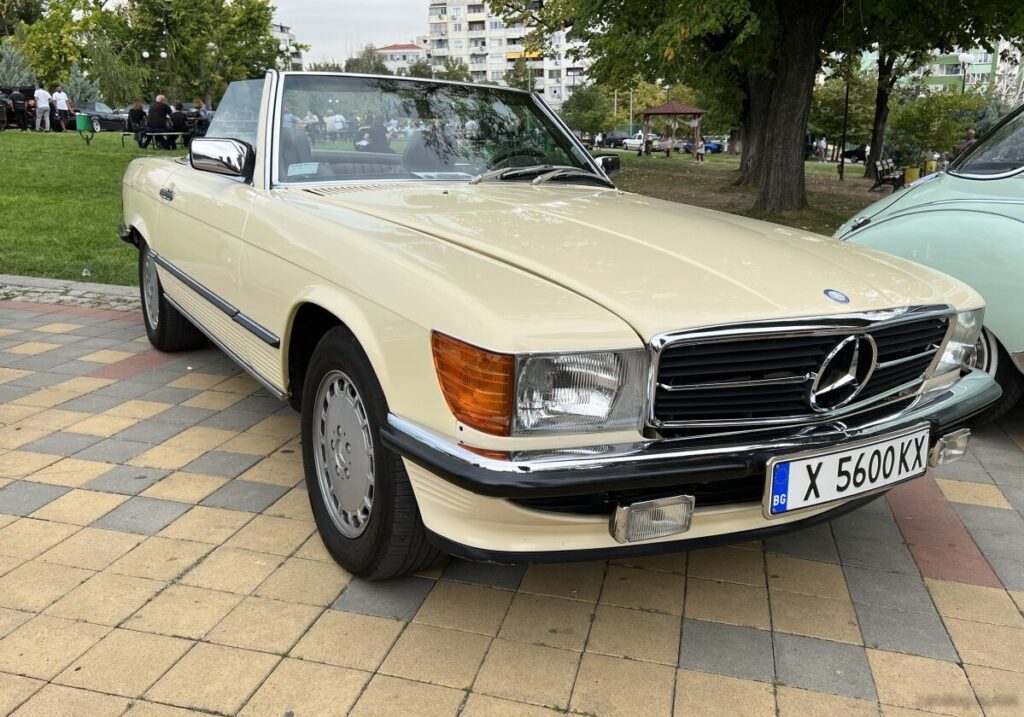
The Mercedes-Benz 300 SL (chassis R107, post-facelift 1985-1989) represented a significant evolution of the iconic R107 SL series. Introduced in 1971, the R107 aimed to blend the luxury of a grand tourer with the open-air experience of a roadster. The 300 SL, positioned as a mid-range offering within the lineup, arrived with the 1985 facelift, bringing updated styling and, crucially, a more modern engine. This variant occupied a sweet spot, offering a balance of performance and refinement that appealed to buyers seeking a comfortable and capable luxury roadster. Production continued through 1989, solidifying its place as a popular iteration of the R107.
Technical Specifications
| Brand | Mercedes-Benz |
| Model | SL |
| Generation | SL (R107, facelift 1985) |
| Type (Engine) | 300 SL (188 Hp) Automatic |
| Start of production | 1985 |
| End of production | 1989 |
| Powertrain Architecture | Internal Combustion engine |
| Body type | Roadster |
| Seats | 2 |
| Doors | 2 |
| Fuel consumption (urban) | 14 l/100 km (16.8 US mpg, 20.2 UK mpg, 7.1 km/l) |
| Fuel consumption (extra urban) | 9.4 l/100 km (25 US mpg, 30.1 UK mpg, 10.6 km/l) |
| Fuel Type | Petrol (Gasoline) |
| Acceleration 0 – 100 km/h | 9.4 sec |
| Acceleration 0 – 62 mph | 9.4 sec |
| Acceleration 0 – 60 mph | 8.9 sec |
| Maximum speed | 198 km/h (123.03 mph) |
| Weight-to-power ratio | 8 kg/Hp, 124.5 Hp/tonne |
| Weight-to-torque ratio | 5.9 kg/Nm, 168.9 Nm/tonne |
| Power | 188 Hp @ 5700 rpm |
| Power per litre | 63.5 Hp/l |
| Torque | 255 Nm @ 4400 rpm (188.08 lb.-ft. @ 4400 rpm) |
| Engine layout | Front, Longitudinal |
| Engine Model/Code | M 103 E 30 / 103.982 |
| Engine displacement | 2962 cm3 (180.75 cu. in.) |
| Number of cylinders | 6 |
| Engine configuration | Inline |
| Cylinder Bore | 88.49 mm (3.48 in.) |
| Piston Stroke | 80.25 mm (3.16 in.) |
| Compression ratio | 9.2:1 |
| Number of valves per cylinder | 2 |
| Fuel injection system | Multi-port manifold injection |
| Engine aspiration | Naturally aspirated engine |
| Valvetrain | SOHC |
| Engine oil capacity | 6 l (6.34 US qt | 5.28 UK qt) |
| Coolant | 8 l (8.45 US qt | 7.04 UK qt) |
| Kerb Weight | 1510 kg (3328.98 lbs.) |
| Max. weight | 1930 kg (4254.92 lbs.) |
| Max load | 420 kg (925.94 lbs.) |
| Trunk (boot) space – maximum | 261 l (9.22 cu. ft.) |
| Fuel tank capacity | 90 l (23.78 US gal | 19.8 UK gal) |
| Permitted trailer load with brakes (12%) | 1500 kg (3306.93 lbs.) |
| Permitted trailer load without brakes | 750 kg (1653.47 lbs.) |
| Length | 4390 mm (172.83 in.) |
| Width | 1790 mm (70.47 in.) |
| Height | 1300 mm (51.18 in.) |
| Wheelbase | 2460 mm (96.85 in.) |
| Front track | 1465 mm (57.68 in.) |
| Rear (Back) track | 1466 mm (57.72 in.) |
| Minimum turning circle | 10.34 m (33.92 ft.) |
| Drivetrain Architecture | Rear wheel drive |
| Number of gears and type of gearbox | 4 gears, automatic transmission |
| Front suspension | Double wishbone |
| Rear suspension | Trailing arm |
| Front brakes | Ventilated discs, 284 mm |
| Rear brakes | Disc, 279 mm |
| Steering type | Cone worm with recirculation balls |
| Power steering | Hydraulic Steering |
| Tires size | Front wheel tires: 205/65 R15Rear wheel tires: 205/65 R15 |
| Wheel rims size | Front wheel rims: 7J x 15Rear wheel rims: 7J x 15 |
Powertrain & Engine Architecture
The heart of the 300 SL was the M103 E 30 inline-six engine, a 2.962-liter (180.75 cubic inch) unit producing 188 horsepower at 5700 rpm and 255 Nm (188 lb-ft) of torque at 4400 rpm. This engine represented a significant upgrade over the earlier six-cylinder offerings in the R107 range. It featured a single overhead camshaft (SOHC) valvetrain, operating two valves per cylinder. Crucially, the M103 employed Bosch K-Jetronic fuel injection, a mechanical system known for its reliability and consistent fuel delivery. This system, while not as sophisticated as later electronic injection systems, provided smooth operation and good performance. The engine’s robust construction and relatively simple design contributed to its longevity. The 300 SL was exclusively paired with a four-speed automatic transmission, designed to provide smooth and effortless cruising. This transmission was a torque converter type, prioritizing comfort over outright performance.
Driving Characteristics
The 300 SL Automatic offered a distinctly relaxed driving experience. The automatic transmission, while not offering the driver engagement of a manual, provided seamless gear changes and made the car exceptionally easy to drive in city traffic or on long highway journeys. Acceleration to 60 mph took around 8.9 seconds, respectable for the era, but noticeably slower than the manual transmission equipped 300 SL or the more powerful 560 SL. The automatic’s gear ratios were geared towards comfort and fuel economy, rather than maximizing acceleration. The car felt stable and planted at highway speeds, thanks to its well-tuned suspension and relatively heavy weight. However, the automatic transmission did slightly diminish the engine’s responsiveness compared to the manual version.
Equipment & Trim Levels
The 300 SL Automatic came reasonably well-equipped as standard. Interior appointments typically included leather upholstery, power windows, central locking, and a basic sound system. The dashboard layout was functional and straightforward, reflecting the era’s design sensibilities. Optional extras were plentiful, including air conditioning (almost a necessity in warmer climates), a sunroof, upgraded sound systems, and even cruise control. The level of trim could vary depending on the market, with some regions offering more luxurious options than others. The 300 SL generally sat in the middle of the R107 range, offering a step up in luxury and performance from the base 280 SL, but falling short of the flagship 560 SL in terms of outright power and prestige.
Chassis & Braking
The R107 chassis featured independent suspension all around, with double wishbones at the front and a trailing arm setup at the rear. This configuration provided a comfortable ride and good handling characteristics. The 300 SL utilized ventilated disc brakes at the front and solid discs at the rear, providing adequate stopping power for the car’s weight and performance. Power-assisted steering was standard, making the car easy to maneuver at low speeds. Stabilizer bars were fitted front and rear to reduce body roll during cornering.
Market Reception & Comparison
The 300 SL Automatic was generally well-received by automotive critics. It was praised for its comfortable ride, refined engine, and overall build quality. However, some reviewers noted that the automatic transmission dulled the engine’s performance and that the car wasn’t as sporty as some of its rivals. Compared to the manual transmission 300 SL, the automatic version offered less driver engagement but greater convenience. Against the 560 SL, the 300 SL provided a more affordable entry point into the R107 range, albeit with less power. Fuel economy was reasonable for a car of its size and era, averaging around 20 mpg combined.
Legacy
The Mercedes-Benz 300 SL (R107) has proven to be a remarkably durable and reliable classic. The M103 engine is known for its longevity, and many examples have exceeded 200,000 miles with proper maintenance. The automatic transmission, while not as sought after by enthusiasts as the manual, is generally reliable. Today, the 300 SL Automatic remains a popular choice among collectors and enthusiasts seeking a stylish and comfortable classic roadster. Values have been steadily increasing in recent years, reflecting the car’s enduring appeal and its status as a well-engineered and beautifully designed automobile. Finding well-maintained examples is becoming increasingly difficult, but the 300 SL continues to offer a rewarding ownership experience.