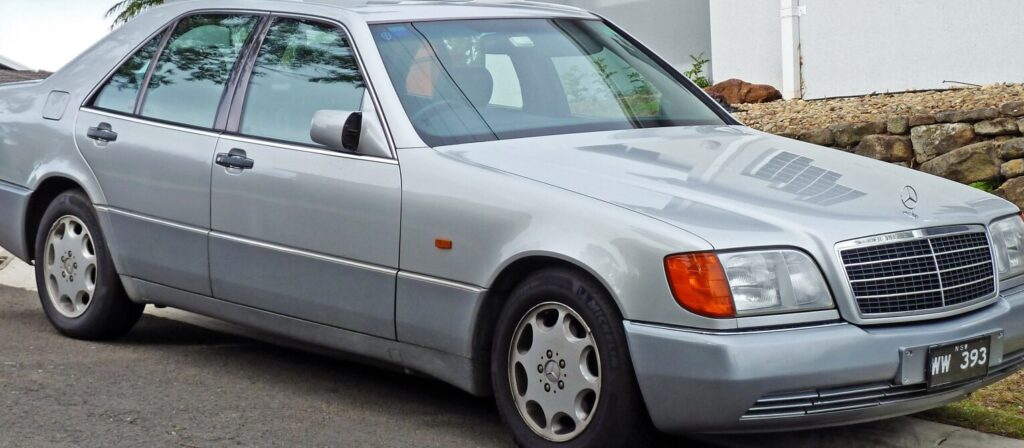
The Mercedes-Benz S 500, produced between 1993 and 1994, represented a significant iteration of the W140 S-Class, a generation renowned for its robust engineering and luxurious appointments. Positioned as a high-performance variant within the W140 range, the S 500 featured a naturally aspirated 5.0-liter V8 engine paired exclusively with a four-speed automatic transmission. This combination aimed to deliver a blend of effortless power and refined comfort, appealing to buyers seeking a flagship sedan with genuine performance credentials. The W140 S-Class, overall, was a pivotal model for Mercedes-Benz, establishing new benchmarks for safety, technology, and build quality in the luxury car segment.
Technical Specifications
| Brand | Mercedes-Benz |
| Model | S-class |
| Generation | S-class (W140) |
| Type (Engine) | S 500 V8 (320 Hp) Automatic |
| Start of production | 1993 |
| End of production | 1994 |
| Powertrain Architecture | Internal Combustion engine |
| Body type | Sedan |
| Seats | 5 |
| Doors | 4 |
| Fuel consumption (economy) – urban | 17.2 l/100 km (13.7 US mpg, 16.4 UK mpg, 5.8 km/l) |
| Fuel consumption (economy) – extra urban | 10 l/100 km (23.5 US mpg, 28.2 UK mpg, 10 km/l) |
| Fuel consumption (economy) – combined | 13 l/100 km (18.1 US mpg, 21.7 UK mpg, 7.7 km/l) |
| Fuel Type | Petrol (Gasoline) |
| Acceleration 0 – 100 km/h | 7.3 sec |
| Acceleration 0 – 62 mph | 7.3 sec |
| Acceleration 0 – 60 mph | 6.9 sec |
| Maximum speed | 250 km/h (155.34 mph) |
| Weight-to-power ratio | 6.3 kg/Hp, 160 Hp/tonne |
| Weight-to-torque ratio | 4.3 kg/Nm, 235 Nm/tonne |
| Power | 320 Hp @ 5600 rpm |
| Power per litre | 64.3 Hp/l |
| Torque | 470 Nm @ 3900 rpm (346.65 lb.-ft. @ 3900 rpm) |
| Engine layout | Front, Longitudinal |
| Engine Model/Code | M 119 E 50 |
| Engine displacement | 4973 cm3 (303.47 cu. in.) |
| Number of cylinders | 8 |
| Engine configuration | V-engine |
| Cylinder Bore | 96.5 mm (3.8 in.) |
| Piston Stroke | 85 mm (3.35 in.) |
| Compression ratio | 10:1 |
| Number of valves per cylinder | 4 |
| Fuel injection system | Multi-port manifold injection |
| Engine aspiration | Naturally aspirated engine |
| Valvetrain | DOHC |
| Engine oil capacity | 8 l (8.45 US qt | 7.04 UK qt) |
| Coolant | 16.5 l (17.44 US qt | 14.52 UK qt) |
| Kerb Weight | 2000 kg (4409.25 lbs.) |
| Max. weight | 2650 kg (5842.25 lbs.) |
| Max load | 650 kg (1433 lbs.) |
| Trunk (boot) space – minimum | 525 l (18.54 cu. ft.) |
| Fuel tank capacity | 100 l (26.42 US gal | 22 UK gal) |
| Length | 5113 mm (201.3 in.) |
| Width | 1886 mm (74.25 in.) |
| Height | 1486 mm (58.5 in.) |
| Wheelbase | 3040 mm (119.69 in.) |
| Front track | 1606 mm (63.23 in.) |
| Rear (Back) track | 1579 mm (62.17 in.) |
| Drivetrain Architecture | The Internal combustion engine (ICE) drives the rear wheels of the vehicle. |
| Drive wheel | Rear wheel drive |
| Number of gears and type of gearbox | 4 gears, automatic transmission |
| Front suspension | Double wishbone |
| Rear suspension | Independent multi-link spring suspension with stabilizer |
| Front brakes | Ventilated discs |
| Rear brakes | Ventilated discs |
| Assisting systems | ABS (Anti-lock braking system) |
| Steering type | Worm-reduction unit |
| Power steering | Hydraulic Steering |
| Tires size | 235/60 R16 |
| Wheel rims size | 16 |
Powertrain & Engine Architecture
The heart of the S 500 was the M119 E 50 engine, a 4.973-liter (303.47 cubic inches) naturally aspirated V8. This engine was a significant departure from earlier Mercedes-Benz V8s, featuring all-aluminum construction, a short-stroke design, and dual overhead camshafts (DOHC) with four valves per cylinder. The M119 benefited from Bosch Motronic fuel injection and a relatively high 10:1 compression ratio, contributing to its impressive power output. The engine produced 320 horsepower at 5600 rpm and 470 Nm (346.65 lb-ft) of torque at 3900 rpm. The four-speed automatic transmission, a 722.3 unit, was specifically calibrated to handle the engine’s torque and provide smooth, refined shifts. While not offering the outright acceleration of some contemporary sports sedans, the S 500 delivered strong, linear power delivery, well-suited for effortless highway cruising and confident overtaking.
Driving Characteristics
The S 500’s driving experience was defined by its smoothness and composure. The automatic transmission, while lacking the number of gears found in modern transmissions, was well-matched to the engine’s characteristics. Gear ratios were optimized for comfortable cruising, with a focus on minimizing engine noise and maximizing fuel efficiency (relative to the engine’s size and output). Compared to the base S 320, the S 500 offered noticeably stronger acceleration, particularly in the mid-range. However, it didn’t possess the same sharp responsiveness as the later S 500 AMG models. The suspension, tuned for comfort, absorbed bumps and imperfections in the road effectively, providing a plush ride. The steering, while hydraulically assisted, lacked the direct feel of some competitors.
Equipment & Trim Levels
The S 500 came standard with a comprehensive array of luxury features, befitting its flagship status. These included leather upholstery, power-adjustable front seats with memory function, automatic climate control, a premium sound system, and wood trim throughout the cabin. Optional extras were plentiful, including a rear seat entertainment system, a sunroof, and upgraded leather options. The interior design emphasized elegance and sophistication, with a focus on high-quality materials and meticulous craftsmanship. The S 500’s trim level was generally considered the top-of-the-line non-AMG offering within the W140 range.
Chassis & Braking
The W140 S-Class featured a robust chassis with double wishbone front suspension and an independent multi-link rear suspension, incorporating a stabilizer bar for improved handling. The S 500 was equipped with ventilated disc brakes on all four wheels, providing ample stopping power. An Anti-lock Braking System (ABS) was standard, enhancing safety and stability during emergency braking. The suspension was tuned to prioritize ride comfort, resulting in a slightly softer setup compared to sportier variants. The S 500’s weight, approximately 2000 kg (4409.25 lbs), contributed to its stable and planted feel on the road.
Market Reception & Comparison
The S 500 was generally well-received by automotive critics, who praised its powerful engine, luxurious interior, and refined driving experience. However, some reviewers noted the relatively high fuel consumption and the lack of a more modern automatic transmission. Compared to the S 320, the S 500 offered a significant performance upgrade, but at a higher price point. The S 500 also faced competition from other luxury sedans, such as the BMW 750iL and the Lexus LS 400. In terms of reliability, the M119 engine proved to be remarkably durable, although maintenance costs could be substantial due to the complexity of the engine and the vehicle’s overall sophistication.
Legacy
The W140 S 500 remains a highly regarded classic Mercedes-Benz. The M119 engine is considered one of the most robust and reliable V8 engines ever produced by Mercedes-Benz. Well-maintained examples are sought after by collectors and enthusiasts. While fuel economy is not a strong point, the S 500 offers a unique blend of performance, luxury, and build quality that is difficult to replicate in modern vehicles. Today, the S 500 represents a high-water mark for traditional Mercedes-Benz engineering and a testament to the brand’s commitment to creating exceptional automobiles.