
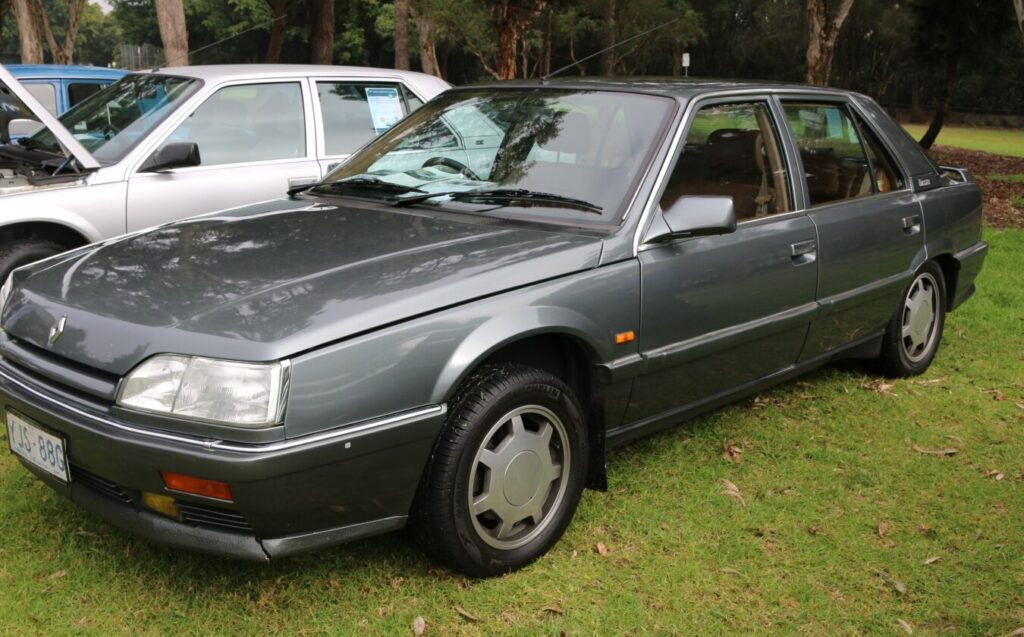
The Renault 25 (B29) 2.0 i 12V, produced between 1989 and 1993, represented a significant offering in Renault’s upper-midsize segment. Positioned as a more performance-oriented variant within the B29 range, it aimed to provide a balance between comfort and driving enjoyment. The 25, intended as a replacement for the Renault 20/30, was Renault’s flagship saloon and hatchback, competing with vehicles like the Ford Granada and Opel/Vauxhall Senator in European markets. This 2.0-liter, 12-valve engine and five-speed manual transmission combination offered a step up in power compared to the base models, appealing to drivers seeking a more engaging experience.
Technical Specifications
| Brand | Renault |
| Model | 25 |
| Generation | 25 (B29) |
| Type (Engine) | 2.0 i 12V (136 Hp) |
| Start of production | 1989 |
| End of production | 1993 |
| Powertrain Architecture | Internal Combustion engine |
| Body type | Hatchback |
| Seats | 5 |
| Doors | 5 |
| Fuel consumption (urban) | 12.6 l/100 km (18.7 US mpg, 22.4 UK mpg, 7.9 km/l) |
| Fuel consumption (extra urban) | 6.8 l/100 km (34.6 US mpg, 41.5 UK mpg, 14.7 km/l) |
| Fuel consumption (combined) | 8.5 l/100 km (27.7 US mpg, 33.2 UK mpg, 11.8 km/l) |
| Fuel Type | Petrol (Gasoline) |
| Acceleration 0 – 100 km/h | 9.9 sec |
| Acceleration 0 – 62 mph | 9.9 sec |
| Acceleration 0 – 60 mph | 9.4 sec |
| Maximum speed | 203 km/h (126.14 mph) |
| Weight-to-power ratio | 9.3 kg/Hp, 107.1 Hp/tonne |
| Weight-to-torque ratio | 7.3 kg/Nm, 137 Nm/tonne |
| Power | 136 Hp @ 6000 rpm |
| Power per litre | 68.2 Hp/l |
| Torque | 174 Nm @ 4300 rpm (128.34 lb.-ft. @ 4300 rpm) |
| Engine layout | Front, Longitudinal |
| Engine Model/Code | J7R12S |
| Engine displacement | 1995 cm3 (121.74 cu. in.) |
| Number of cylinders | 4 |
| Engine configuration | Inline |
| Cylinder Bore | 88 mm (3.46 in.) |
| Piston Stroke | 82 mm (3.23 in.) |
| Compression ratio | 9.3:1 |
| Number of valves per cylinder | 3 |
| Fuel injection system | Multi-port manifold injection |
| Engine aspiration | Naturally aspirated engine |
| Valvetrain | OHC |
| Engine oil capacity | 5.3 l (5.6 US qt | 4.66 UK qt) |
| Coolant capacity | 7.1 l (7.5 US qt | 6.25 UK qt) |
| Kerb Weight | 1270 kg (2799.87 lbs.) |
| Max. weight | 1710 kg (3769.9 lbs.) |
| Max load | 440 kg (970.03 lbs.) |
| Trunk (boot) space – minimum | 440 l (15.54 cu. ft.) |
| Trunk (boot) space – maximum | 1240 l (43.79 cu. ft.) |
| Fuel tank capacity | 72 l (19.02 US gal | 15.84 UK gal) |
| Length | 4715 mm (185.63 in.) |
| Width | 1805 mm (71.06 in.) |
| Height | 1415 mm (55.71 in.) |
| Wheelbase | 2725 mm (107.28 in.) |
| Front track | 1495 mm (58.86 in.) |
| Rear track | 1475 mm (58.07 in.) |
| Drivetrain Architecture | Front wheel drive |
| Number of gears | 5 |
| Gearbox type | Manual transmission |
| Front suspension | Coil spring |
| Rear suspension | Coil spring |
| Front brakes | Disc |
| Rear brakes | Drum |
| Assisting systems | ABS (Anti-lock braking system) |
| Steering type | Steering rack and pinion |
| Power steering | Hydraulic |
| Tires size | 195/60 R15 |
| Wheel rims size | 15 |
Powertrain & Engine Architecture
The heart of the Renault 25 2.0 i 12V is the J7R12S engine, a 1995cc inline-four cylinder unit. This engine featured a single overhead camshaft (OHC) design operating 12 valves – three per cylinder. The engine utilized Bosch multi-point fuel injection, a relatively advanced system for its time, contributing to improved fuel efficiency and smoother power delivery. The 12-valve configuration, compared to the earlier 8-valve engines, allowed for improved breathing and higher engine speeds. The engine’s longitudinal mounting within the front-wheel-drive chassis was a notable design characteristic. The five-speed manual transmission provided precise control and allowed the driver to fully utilize the engine’s power band. Gear ratios were fairly standard for the era, prioritizing acceleration in the lower gears and comfortable cruising at highway speeds.
Driving Characteristics
The 2.0-liter 12V engine in the Renault 25 delivered a noticeable improvement in performance over the lower-displacement options. Acceleration to 60 mph was achieved in approximately 9.4 seconds, and the car could reach a top speed of 126 mph. While not a sports car, the 136 horsepower output provided sufficient power for confident overtaking and comfortable long-distance cruising. The manual transmission allowed for a more engaging driving experience than the available automatic options. The suspension, tuned for comfort, provided a relatively smooth ride, although body roll was present during cornering. Compared to the more powerful V6 versions of the Renault 25, the 2.0-liter offered a more economical and accessible option, sacrificing some outright performance for improved fuel efficiency.
Equipment & Trim Levels
The Renault 25 2.0 i 12V typically came equipped with a reasonable level of standard features. Interior upholstery was usually cloth, with options for velour or leather available at extra cost. Power steering, central locking, and electric front windows were common features. Higher trim levels could include features such as a sunroof, upgraded audio systems, and climate control. The dashboard layout was functional and ergonomically designed, with clear instrumentation. Optional extras included alloy wheels, metallic paint, and a trip computer.
Chassis & Braking
The Renault 25 utilized a front-wheel-drive chassis with coil spring suspension at all four corners. The front suspension featured independent MacPherson struts, while the rear employed a torsion beam setup. Braking was provided by disc brakes at the front and drum brakes at the rear. An Anti-lock Braking System (ABS) was available, enhancing safety by preventing wheel lockup during hard braking. The steering was a rack-and-pinion system with hydraulic power assistance, providing light and precise steering feel. The 195/60 R15 tires offered a good balance of grip and ride comfort.
Market Reception & Comparison
The Renault 25 2.0 i 12V was generally well-received by automotive critics as a competent and comfortable family car. It was praised for its spacious interior, comfortable ride, and relatively fuel-efficient engine. However, some critics noted that the styling was somewhat conservative compared to its rivals. Compared to the V6 models, the 2.0-liter version offered a more affordable entry point into the Renault 25 range, appealing to a wider range of buyers. Fuel economy was a key advantage over the V6, making it a more practical choice for everyday use. Reliability was generally good, although some owners reported issues with the electrical system.
Legacy
The Renault 25, while not a groundbreaking vehicle, played an important role in establishing Renault as a manufacturer of well-built and comfortable family cars. The J7R engine, in its various iterations, proved to be a durable and reliable powerplant. Today, the Renault 25 2.0 i 12V is a relatively rare sight on the roads, but it has gained a following among classic car enthusiasts. Parts availability can be challenging, but the engine is generally considered to be relatively easy to maintain. Well-maintained examples are becoming increasingly collectible, representing a piece of 1980s and early 1990s automotive history.
