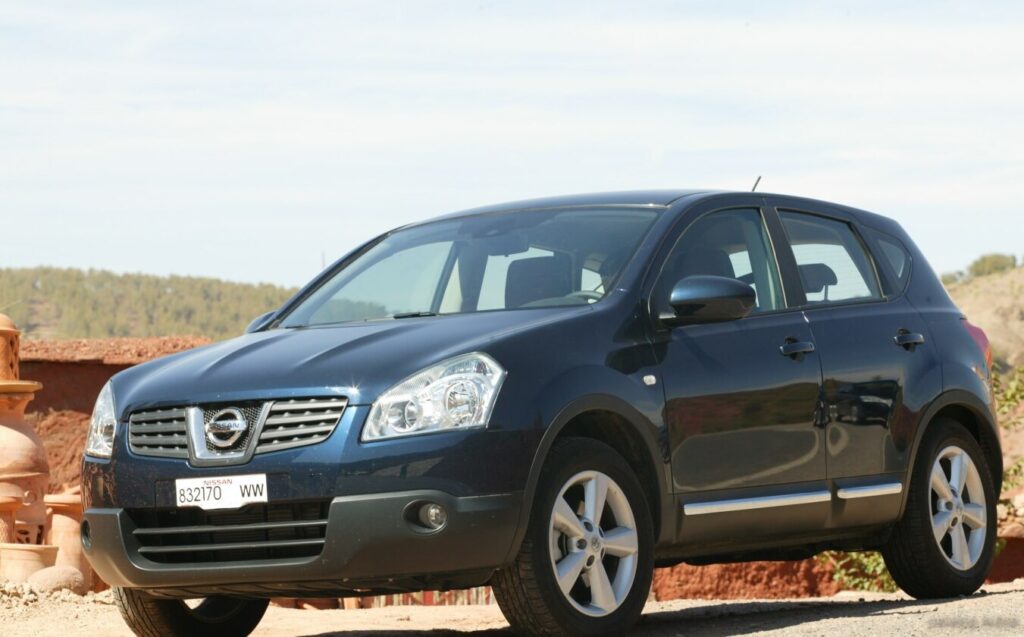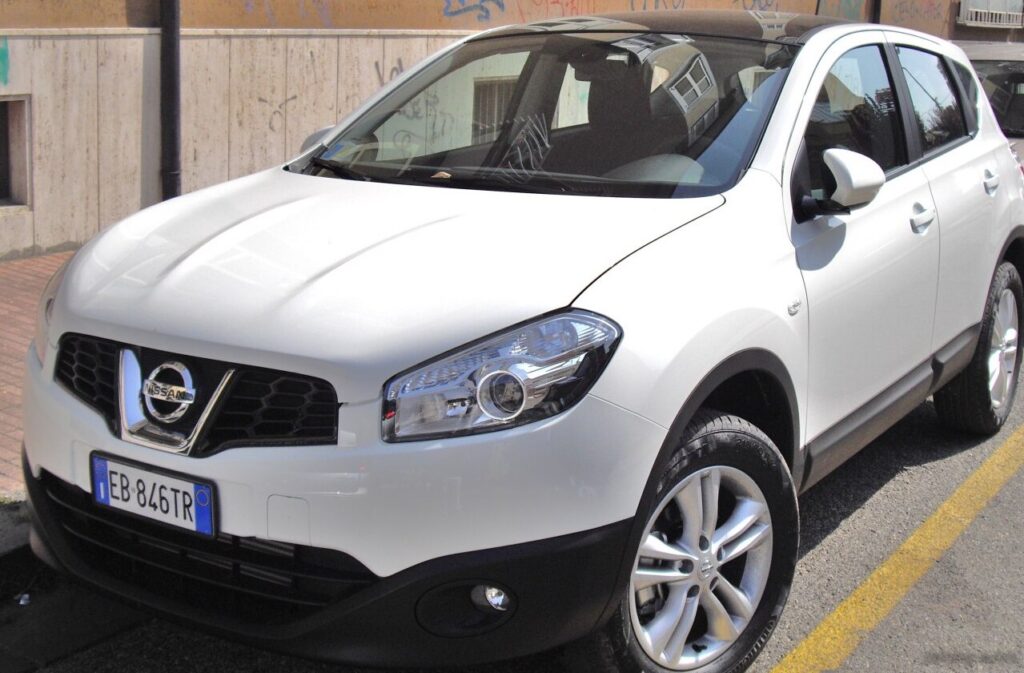
The Nissan Qashqai (known as the Dualis in some markets) represented Nissan’s entry into the burgeoning compact crossover segment in Europe. Introduced in 2007, the first generation Qashqai (internal code J10) quickly gained popularity for its blend of hatchback practicality and SUV styling. The facelifted version, launched in 2010, brought revised styling, improved interior materials, and crucially, a new range of diesel engines, including the 1.6 dCi with 131 horsepower and available all-wheel drive. Production of this specific configuration ran from 2011 to 2014, positioning it as a mid-range offering within the Qashqai lineup, appealing to buyers seeking improved fuel economy and all-weather capability without the expense of the higher-powered models.
Technical Specifications
| Brand | Nissan |
| Model | Qashqai |
| Generation | Qashqai I (J10, facelift 2010) |
| Type (Engine) | 1.6 dCi (131 Hp) 4×4 |
| Start of production | 2011 |
| End of production | 2014 |
| Powertrain Architecture | Internal Combustion engine |
| Body type | SUV, Crossover |
| Seats | 5 |
| Doors | 5 |
| Fuel consumption (urban) | 6.1 l/100 km (38.6 US mpg, 46.3 UK mpg, 16.4 km/l) |
| Fuel consumption (extra urban) | 4.6 l/100 km (51.1 US mpg, 61.4 UK mpg, 21.7 km/l) |
| Fuel consumption (combined) | 5.1 l/100 km (46.1 US mpg, 55.4 UK mpg, 19.6 km/l) |
| Fuel Type | Diesel |
| Acceleration 0 – 100 km/h | 10.9 sec |
| Acceleration 0 – 62 mph | 10.9 sec |
| Acceleration 0 – 60 mph | 10.4 sec |
| Maximum speed | 190 km/h (118.06 mph) |
| Emission standard | Euro 5 |
| Weight-to-power ratio | 11.9 kg/Hp, 83.9 Hp/tonne |
| Weight-to-torque ratio | 4.9 kg/Nm, 204.9 Nm/tonne |
| Power | 131 Hp @ 4000 rpm |
| Power per litre | 82 Hp/l |
| Torque | 320 Nm @ 1750 rpm (236.02 lb.-ft. @ 1750 rpm) |
| Engine layout | Front, Transverse |
| Engine Model/Code | R9M |
| Engine displacement | 1598 cm3 (97.52 cu. in.) |
| Number of cylinders | 4 |
| Engine configuration | Inline |
| Cylinder Bore | 80 mm (3.15 in.) |
| Piston Stroke | 79.5 mm (3.13 in.) |
| Compression ratio | 15.4:1 |
| Number of valves per cylinder | 4 |
| Fuel injection system | Diesel Commonrail |
| Engine aspiration | Turbocharger, Intercooler |
| Engine oil capacity | 5.5 l (5.81 US qt | 4.84 UK qt) |
| Coolant | 8 l (8.45 US qt | 7.04 UK qt) |
| Kerb Weight | 1562-1630 kg (3443.62 – 3593.53 lbs.) |
| Max. weight | 2100 kg (4629.71 lbs.) |
| Max load | 470-538 kg (1036.17 – 1186.09 lbs.) |
| Trunk (boot) space – minimum | 410 l (14.48 cu. ft.) |
| Trunk (boot) space – maximum | 1513 l (53.43 cu. ft.) |
| Fuel tank capacity | 65 l (17.17 US gal | 14.3 UK gal) |
| Max. roof load | 75 kg (165.35 lbs.) |
| Permitted trailer load with brakes (12%) | 1400 kg (3086.47 lbs.) |
| Permitted trailer load without brakes | 750 kg (1653.47 lbs.) |
| Permitted towbar download | 75 kg (165.35 lbs.) |
| Length | 4330 mm (170.47 in.) |
| Width | 1780 mm (70.08 in.) |
| Width including mirrors | 2120 mm (83.46 in.) |
| Height | 1615-1622 mm (63.58 – 63.86 in.) |
| Wheelbase | 2630 mm (103.54 in.) |
| Front track | 1540 mm (60.63 in.) |
| Rear (Back) track | 1550 mm (61.02 in.) |
| Minimum turning circle | 10.6 m (34.78 ft.) |
| Drive wheel | All wheel drive (4×4) |
| Number of gears and type of gearbox | 6 gears, manual transmission |
| Front suspension | Independent, type McPherson with coil spring and anti-roll bar |
| Rear suspension | Independent multi-link spring suspension with stabilizer |
| Front brakes | Ventilated discs |
| Rear brakes | Disc |
| Assisting systems | ABS (Anti-lock braking system) |
| Steering type | Steering rack and pinion |
| Power steering | Electric Steering |
| Tires size | 215/55 R18 |
| Wheel rims size | 6.5J x 18 |
Powertrain & Engine Architecture
The heart of this Qashqai variant is the Renault-Nissan Alliance’s R9M engine, a 1.6-liter four-cylinder diesel. This engine was a significant upgrade over the previous 1.5 dCi unit, offering improved refinement and power output. The R9M utilizes a common-rail direct injection system, delivering fuel at extremely high pressure for optimized combustion. A turbocharger with an intercooler further enhances performance, boosting power to 131 horsepower and torque to a substantial 320 Nm (236 lb-ft). The engine features four valves per cylinder and a compression ratio of 15.4:1. The 4×4 system employed a viscous coupling, automatically engaging the rear wheels when front wheel slip was detected. The transmission offered was a six-speed manual, chosen for its efficiency and driver engagement, although a continuously variable transmission (CVT) was available on some trims.
Driving Characteristics
The 1.6 dCi 4×4 Qashqai offered a good balance between performance and economy. While not a sports car, the 131 hp engine provided adequate power for everyday driving and overtaking maneuvers. The 320 Nm of torque, available from a low 1750 rpm, meant strong pulling power in most situations. The six-speed manual transmission allowed drivers to keep the engine in its optimal power band. Compared to the lower-powered 1.5 dCi models, the 1.6 dCi felt noticeably more responsive. Against the higher-output 1.6 dCi variants (often exceeding 150 hp), this version offered a more economical driving experience, albeit with slightly slower acceleration. The all-wheel-drive system provided enhanced traction in slippery conditions, making it a practical choice for those living in areas with inclement weather.
Equipment & Trim Levels
The 1.6 dCi 4×4 typically fell into the mid-range of the Qashqai lineup. Standard equipment generally included air conditioning, electric front and rear windows, a CD player with auxiliary input, and alloy wheels. Safety features such as ABS, electronic brakeforce distribution (EBD), and multiple airbags were also standard. Higher trim levels, such as the Tekna, added features like climate control, a touchscreen infotainment system, rear parking sensors, and automatic headlights and wipers. Interior upholstery was typically cloth, with options for leather available on higher trims.
Chassis & Braking
The Qashqai J10 utilized a McPherson strut front suspension and a multi-link rear suspension, providing a comfortable ride and decent handling. The 4×4 models featured a slightly stiffer suspension setup to cope with the added weight and all-wheel-drive components. Braking duties were handled by ventilated discs at the front and solid discs at the rear. The braking system was generally considered adequate for the vehicle’s weight and performance, with ABS providing additional safety.
Market Reception & Comparison
The 1.6 dCi 4×4 Qashqai was well-received by automotive critics. It was praised for its fuel efficiency, comfortable ride, and practical interior. The all-wheel-drive system was seen as a valuable addition for those seeking added security in challenging weather conditions. Compared to competitors like the Volkswagen Tiguan and Kia Sportage, the Qashqai offered a compelling combination of value, practicality, and style. Fuel economy was a strong point, consistently achieving around 5.1 l/100 km in combined driving. Reliability was generally good, although some owners reported minor issues with the diesel particulate filter (DPF).
Legacy
The Nissan Qashqai J10, particularly the 1.6 dCi 4×4 variant, proved to be a popular and influential vehicle. It helped establish the compact crossover segment and paved the way for numerous competitors. The R9M engine, while not without its issues (particularly concerning the DPF), proved to be a durable and relatively efficient powerplant. Today, used examples of this Qashqai are readily available and represent a good value proposition for buyers seeking a practical, economical, and capable crossover. Regular maintenance, including timely DPF regeneration, is crucial for ensuring the long-term reliability of this powertrain.