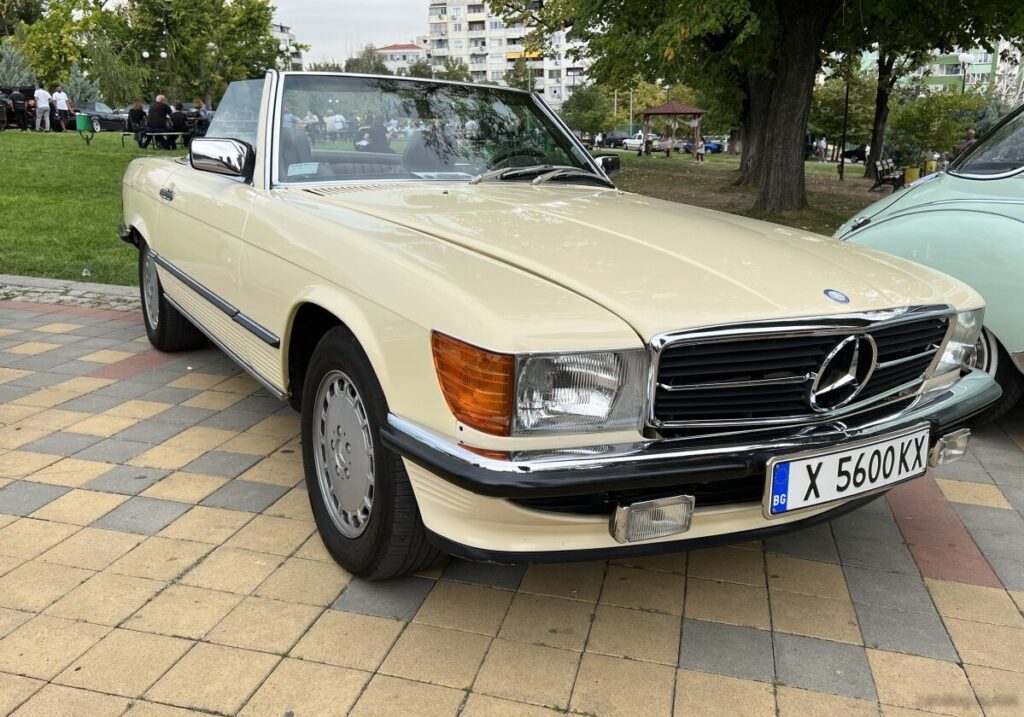
The Mercedes-Benz 300 SL (C107) with the 180 horsepower engine and automatic transmission, produced from May 1985 to August 1989, represents a refined iteration of the iconic R107 SL-Class roadster. Positioned as a mid-range offering within the facelifted R107 lineup, it bridged the gap between the entry-level 280 SL and the more potent 560 SL. This variant was primarily aimed at buyers seeking a comfortable, stylish grand tourer with adequate performance, prioritizing ease of use over outright speed. The “CAT” designation refers to the catalytic converter equipped for emissions control, a key feature for markets increasingly focused on environmental regulations.
Technical Specifications
| Brand | Mercedes-Benz |
| Model | SL |
| Generation | SL (R107, facelift 1985) |
| Type (Engine) | 300 SL CAT (180 Hp) Automatic |
| Start of production | May, 1985 |
| End of production | August, 1989 |
| Powertrain Architecture | Internal Combustion engine |
| Body type | Roadster |
| Seats | 2 |
| Doors | 2 |
| Fuel consumption (urban) | 14.4 l/100 km (16.3 US mpg, 19.6 UK mpg, 6.9 km/l) |
| Fuel consumption (extra urban) | 9.8 l/100 km (24 US mpg, 28.8 UK mpg, 10.2 km/l) |
| Fuel Type | Petrol (Gasoline) |
| Acceleration 0 – 100 km/h | 9.8 sec |
| Acceleration 0 – 62 mph | 9.8 sec |
| Acceleration 0 – 60 mph | 9.3 sec |
| Maximum speed | 195 km/h (121.17 mph) |
| Weight-to-power ratio | 8.4 kg/Hp, 119.2 Hp/tonne |
| Weight-to-torque ratio | 6 kg/Nm, 165.6 Nm/tonne |
| Power | 180 Hp @ 5700 rpm |
| Power per litre | 60.8 Hp/l |
| Torque | 250 Nm @ 4400 rpm (184.39 lb.-ft. @ 4400 rpm) |
| Engine layout | Front, Longitudinal |
| Engine Model/Code | M 103 E 30 / 103.982 |
| Engine displacement | 2962 cm3 (180.75 cu. in.) |
| Number of cylinders | 6 |
| Engine configuration | Inline |
| Cylinder Bore | 88.5 mm (3.48 in.) |
| Piston Stroke | 80.25 mm (3.16 in.) |
| Compression ratio | 9.2:1 |
| Number of valves per cylinder | 2 |
| Fuel injection system | Multi-port manifold injection |
| Engine aspiration | Naturally aspirated engine |
| Valvetrain | SOHC |
| Engine oil capacity | 6 l (6.34 US qt | 5.28 UK qt) |
| Coolant capacity | 8 l (8.45 US qt | 7.04 UK qt) |
| Kerb Weight | 1510 kg (3328.98 lbs.) |
| Max. weight | 1930 kg (4254.92 lbs.) |
| Max load | 420 kg (925.94 lbs.) |
| Fuel tank capacity | 85 l (22.45 US gal | 18.7 UK gal) |
| Length | 4390 mm (172.83 in.) |
| Width | 1790 mm (70.47 in.) |
| Height | 1305 mm (51.38 in.) |
| Wheelbase | 2460 mm (96.85 in.) |
| Front track | 1465 mm (57.68 in.) |
| Rear track | 1466 mm (57.72 in.) |
| Drivetrain Architecture | Rear wheel drive |
| Number of gears | 4 |
| Gearbox type | Automatic transmission |
| Front suspension | Double wishbone |
| Rear suspension | Trailing arm |
| Front brakes | Ventilated discs |
| Rear brakes | Disc |
| Assisting systems | ABS (Anti-lock braking system) |
| Steering type | Cone worm with recirculation balls |
| Tires size | Front: 205/65 R15, Rear: 205/65 R15 |
| Wheel rims size | Front: 7J x 15, Rear: 7J x 15 |
Powertrain & Engine Architecture
The heart of the 300 SL was the M103 E 30 inline-six engine, a 2.962-liter (180.75 cubic inch) powerplant. This engine featured a single overhead camshaft (SOHC) design and utilized Bosch K-Jetronic multi-port fuel injection. The M103 was known for its smoothness and durability, and the catalytic converter (hence the “CAT” designation) helped it meet increasingly stringent emissions standards. The engine produced 180 horsepower at 5700 rpm and 250 Nm (184 lb-ft) of torque at 4400 rpm. This power was delivered to the rear wheels through a four-speed automatic transmission, a common pairing for this trim level. The automatic transmission, while providing convenience, did slightly diminish acceleration compared to the available five-speed manual.
Driving Characteristics
The 300 SL Automatic offered a comfortable and relaxed driving experience. Acceleration from 0 to 60 mph took approximately 9.3-9.8 seconds, and it could reach a top speed of around 195 km/h (121 mph). While not a sports car in the modern sense, the 300 SL provided sufficient power for effortless cruising and overtaking. The automatic transmission, while smooth, had relatively widely spaced gear ratios, which could sometimes feel sluggish during quick acceleration. Compared to the manual transmission version, the automatic traded some responsiveness for ease of use. The 300 SL also felt less nimble than the lighter 280 SL, but offered a more refined experience than the more powerful, but heavier, 560 SL.
Equipment & Trim Levels
The 300 SL CAT came standard with features expected of a luxury roadster of its time, including leather upholstery, power windows, central locking, and an AM/FM stereo. The interior typically featured wood trim on the dashboard and center console. Optional extras included air conditioning (often specified), a sunroof, and upgraded sound systems. The 300 SL occupied a middle ground in terms of trim; it wasn’t as sparsely equipped as the base 280 SL, but lacked some of the more opulent features found on the 560 SL.
Chassis & Braking
The R107 SL chassis featured independent suspension all around, with double wishbones at the front and a trailing arm setup at the rear. This provided a comfortable ride, although it wasn’t particularly sporty in handling. The 300 SL was equipped with ventilated disc brakes at the front and solid discs at the rear. Anti-lock braking system (ABS) was standard, enhancing safety. The suspension was tuned for comfort, with stabilizer bars to reduce body roll, but the overall setup was geared towards grand touring rather than aggressive cornering.
Market Reception & Comparison
The 300 SL Automatic was generally well-received by automotive critics as a comfortable and capable grand tourer. It was praised for its smooth engine, refined ride, and luxurious interior. However, some reviewers noted that the automatic transmission dulled the driving experience compared to the manual version. Compared to the 280 SL, the 300 SL offered more power and a slightly more upscale feel. Against the 560 SL, it provided a better balance of performance and fuel economy, although it lacked the 560 SL’s outright power. Fuel economy was reasonable for a vehicle of its size and era, averaging around 14.4 l/100 km (16.3 US mpg) in the city and 9.8 l/100 km (24 US mpg) on the highway.
Legacy
The Mercedes-Benz 300 SL (R107) with the automatic transmission has proven to be a relatively reliable classic. The M103 engine is known for its longevity, and the automatic transmission, while not as sophisticated as modern units, is generally durable. Today, these cars are sought after by collectors and enthusiasts who appreciate their classic styling, comfortable ride, and relatively straightforward maintenance. Parts availability is generally good, although some specific trim pieces can be difficult to find. The 300 SL Automatic represents a sweet spot in the R107 lineup, offering a blend of luxury, performance, and reliability that continues to appeal to drivers today. Well-maintained examples command respectable prices in the used car market, reflecting their enduring appeal and status as a desirable classic Mercedes-Benz.