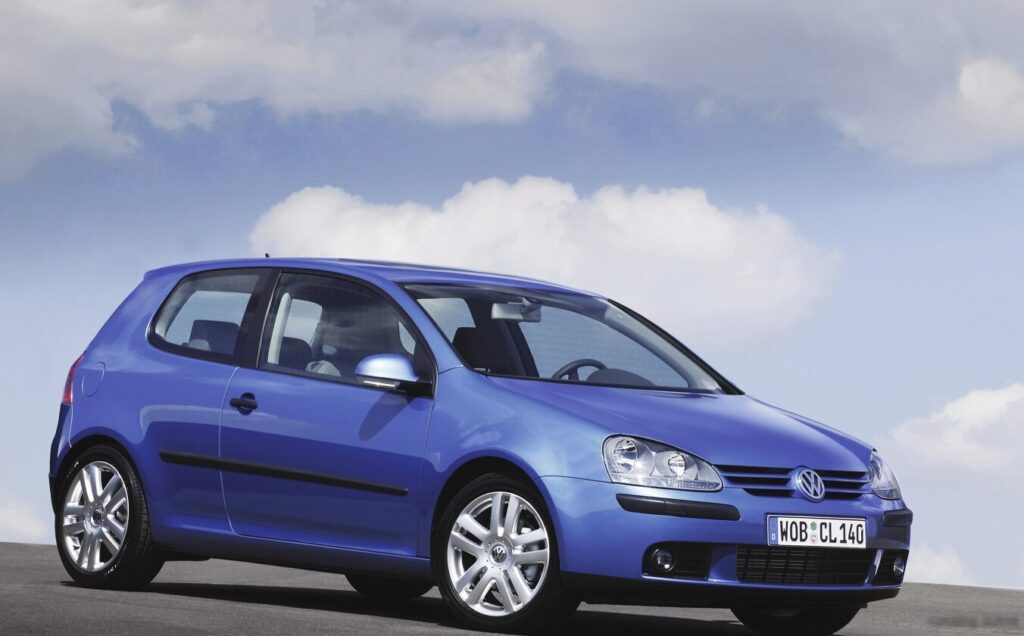
The Volkswagen Golf Mk V, produced from 2003 to 2009, represented a significant leap forward for the iconic hatchback. Within the Mk V range, the 3-door 1.4 TSI (170 hp) variant equipped with the Direct-Shift Gearbox (DSG) – manufactured from 2005 to 2008 – occupied a compelling middle ground. It aimed to deliver a blend of performance and efficiency, appealing to drivers seeking a more engaging experience than the base models, but without the higher costs associated with the range-topping trims like the GTI or those equipped with larger engines. This model was primarily marketed in Europe, where smaller displacement, turbocharged engines were gaining popularity due to tax incentives and fuel economy concerns.
Technical Specifications
| Brand | Volkswagen |
| Model | Golf |
| Generation | Golf V (3-door) |
| Type (Engine) | 1.4 TSI (170 Hp) DSG |
| Start of production | 2005 |
| End of production | 2008 |
| Powertrain Architecture | Internal Combustion engine |
| Body type | Hatchback |
| Seats | 5 |
| Doors | 3 |
| Fuel consumption (urban) | 9.9-10 l/100 km (23.8 – 23.5 US mpg, 28.5 – 28.2 UK mpg, 10.1 – 10 km/l) |
| Fuel consumption (extra urban) | 5.8-5.9 l/100 km (40.6 – 39.9 US mpg, 48.7 – 47.9 UK mpg, 17.2 – 16.9 km/l) |
| Fuel consumption (combined) | 7.3-7.4 l/100 km (32.2 – 31.8 US mpg, 38.7 – 38.2 UK mpg, 13.7 – 13.5 km/l) |
| CO2 emissions | 174-178 g/km |
| Fuel Type | Petrol (Gasoline) |
| Acceleration 0 – 100 km/h | 7.7 sec |
| Acceleration 0 – 62 mph | 7.7 sec |
| Acceleration 0 – 60 mph | 7.3 sec |
| Maximum speed | 218 km/h (135.46 mph) |
| Emission standard | Euro 4 |
| Weight-to-power ratio | 7.6 kg/Hp, 131.5 Hp/tonne |
| Weight-to-torque ratio | 5.4 kg/Nm, 185.6 Nm/tonne |
| Power | 170 Hp @ 6000 rpm |
| Power per litre | 122.3 Hp/l |
| Torque | 240 Nm @ 1750-5000 rpm (177.01 lb.-ft. @ 1750-5000 rpm) |
| Engine layout | Front, Transverse |
| Engine Model/Code | BLG |
| Engine displacement | 1390 cm3 (84.82 cu. in.) |
| Number of cylinders | 4 |
| Engine configuration | Inline |
| Cylinder Bore | 76.5 mm (3.01 in.) |
| Piston Stroke | 75.6 mm (2.98 in.) |
| Compression ratio | 9.7:1 |
| Number of valves per cylinder | 4 |
| Fuel injection system | Direct injection |
| Engine aspiration | Turbocharging and Supercharger, Intercooler |
| Valvetrain | DOHC |
| Engine oil capacity | 3.6 l (3.8 US qt | 3.17 UK qt) |
| Coolant capacity | 5.6 l (5.92 US qt | 4.93 UK qt) |
| Kerb Weight | 1293-1451 kg (2850.58 – 3198.91 lbs.) |
| Max. weight | 1870 kg (4122.64 lbs.) |
| Max load | 419-577 kg (923.74 – 1272.07 lbs.) |
| Trunk (boot) space – minimum | 350 l (12.36 cu. ft.) |
| Trunk (boot) space – maximum | 1305 l (46.09 cu. ft.) |
| Fuel tank capacity | 55 l (14.53 US gal | 12.1 UK gal) |
| Max. roof load | 75 kg (165.35 lbs.) |
| Permitted trailer load with brakes (8%) | 1700 kg (3747.86 lbs.) |
| Permitted trailer load with brakes (12%) | 1400 kg (3086.47 lbs.) |
| Permitted trailer load without brakes | 680 kg (1499.14 lbs.) |
| Permitted towbar download | 75 kg (165.35 lbs.) |
| Length | 4204 mm (165.51 in.) |
| Width | 1759 mm (69.25 in.) |
| Width including mirrors | 2010 mm (79.13 in.) |
| Height | 1479 mm (58.23 in.) |
| Wheelbase | 2578 mm (101.5 in.) |
| Front track | 1539 mm (60.59 in.) |
| Rear track | 1528 mm (60.16 in.) |
| Front overhang | 880 mm (34.65 in.) |
| Rear overhang | 746 mm (29.37 in.) |
| Minimum turning circle | 10.9 m (35.76 ft.) |
| Drivetrain | Front wheel drive |
| Number of gears and type of gearbox | 6 gears, automatic transmission DSG |
| Front suspension | Independent, type McPherson with coil spring and anti-roll bar |
| Rear suspension | Independent multi-link spring suspension with stabilizer |
| Front brakes | Ventilated discs |
| Rear brakes | Disc |
INTRODUCTION
The Volkswagen Golf Mk V 1.4 TSI (170 hp) DSG, launched in 2005, represented a significant step in engine technology for the Golf range. Built on the A5 platform (internally designated 1HX0 for the 3-door), this variant aimed to bridge the gap between the more economical, lower-powered engines and the performance-oriented GTI. The 1.4 TSI engine, a key feature, combined direct fuel injection with both a turbocharger and a supercharger – a relatively uncommon configuration at the time – to deliver a broad torque curve and responsive performance. The DSG transmission further enhanced the driving experience, offering quick and smooth gear changes. This trim level was positioned as a mid-range option, appealing to buyers who wanted a sporty and refined hatchback without the higher price tag of the GTI.
Powertrain & Engine Architecture
The heart of this Golf variant is the 1.4-liter TSI engine, specifically the BLG engine code. This engine is notable for its twin-charging system. At lower engine speeds, a Roots-type supercharger provides instant boost, eliminating turbo lag. As engine speed increases, a turbocharger takes over, delivering higher peak power. This combination results in a remarkably flat torque curve, peaking at 240 Nm (177 lb-ft) between 1750 and 5000 rpm. The engine utilizes direct fuel injection, precisely metering fuel into the combustion chamber for improved efficiency and reduced emissions. The valvetrain is a dual overhead camshaft (DOHC) design with four valves per cylinder. The DSG (Direct-Shift Gearbox) is a seven-speed dual-clutch transmission. It operates like a traditional automatic but offers the efficiency and responsiveness of a manual gearbox by pre-selecting the next gear. This allows for incredibly fast shifts with minimal interruption in power delivery.
Driving Characteristics
The 1.4 TSI with DSG offers a noticeably more engaging driving experience than the base Golf models. The twin-charged engine provides strong acceleration, with the 0-60 mph sprint taking around 7.3 seconds. The DSG transmission contributes to this performance, delivering seamless gear changes and keeping the engine in its optimal power band. While not as overtly sporty as the GTI, the 1.4 TSI offers a good balance of performance and comfort. The gear ratios are tuned for both acceleration and fuel efficiency. Compared to the manual transmission versions of the 1.4 TSI, the DSG offers quicker acceleration and a more refined driving experience, but some purists may prefer the greater control of a manual gearbox. Compared to the larger 2.0 FSI engine, the 1.4 TSI offers similar performance in everyday driving, but lacks the ultimate top-end power of the larger engine.
Equipment & Trim Levels
The 1.4 TSI DSG typically came equipped with a reasonable level of standard features. These included air conditioning, alloy wheels (usually 16 or 17 inch), a CD stereo system, and electric windows and mirrors. Safety features such as ABS, traction control, and multiple airbags were also standard. Optional extras included a sunroof, upgraded stereo systems, leather upholstery, and parking sensors. Interior trim levels varied, but generally featured cloth upholstery with a sporty design. The dashboard layout was typical of the Mk V Golf, with a functional and ergonomic design.
Chassis & Braking
The Golf Mk V 1.4 TSI utilized an independent suspension setup. The front suspension featured McPherson struts with coil springs and an anti-roll bar, while the rear suspension employed a multi-link system with a stabilizer bar. This setup provided a good balance of ride comfort and handling. Braking duties were handled by ventilated discs at the front and solid discs at the rear. ABS (Anti-lock Braking System) was standard, providing enhanced braking performance and stability. The steering was a rack and pinion system with electric power assistance.
Market Reception & Comparison
The Golf Mk V 1.4 TSI DSG was generally well-received by automotive critics. It was praised for its innovative engine technology, responsive performance, and refined driving experience. Fuel economy was also a strong point, with combined fuel consumption figures around 32-33 mpg. Compared to the 1.6-liter base engine, the 1.4 TSI offered a significant performance upgrade with only a slight penalty in fuel economy. Compared to the 2.0 FSI, the 1.4 TSI offered comparable performance in most driving situations, but at a lower price point. Reliability was generally good, although some owners reported issues with the DSG transmission, particularly early units.
Legacy
The 1.4 TSI engine, and particularly its twin-charged variant, proved to be a significant development in engine technology. It showcased Volkswagen’s commitment to innovation and efficiency. The DSG transmission also became a popular choice in the Golf range and beyond. Today, the Golf Mk V 1.4 TSI DSG remains a popular choice in the used car market. Well-maintained examples are relatively reliable, although potential buyers should be aware of the possibility of DSG transmission issues and ensure that the transmission has been serviced regularly. The combination of performance, efficiency, and refinement makes this variant a compelling option for those seeking a sporty and practical hatchback.