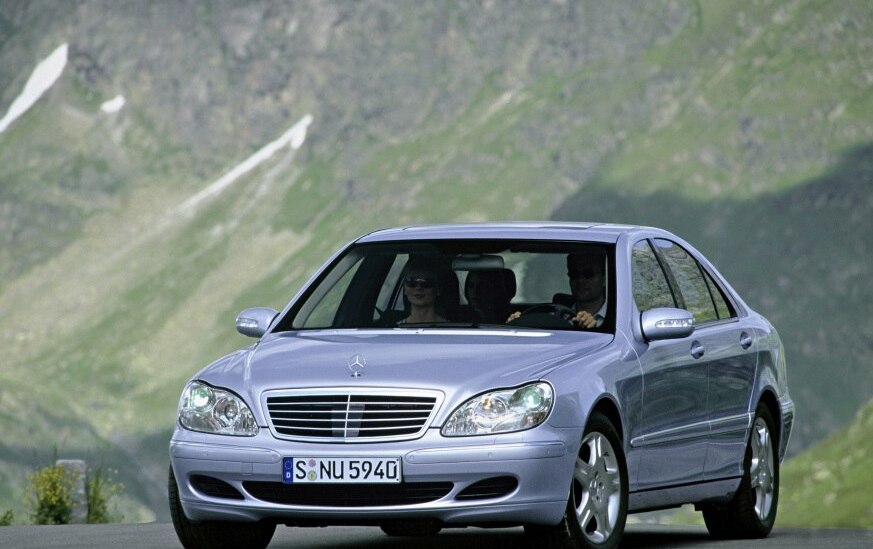
The Mercedes-Benz S 430, part of the W220 S-Class facelift introduced in 2002, represented a significant blend of luxury, performance, and technology for its time. Produced from September 2003 to July 2005, this variant occupied a middle ground within the W220 lineup, positioned above the S 320 and below the flagship S 500 and high-performance AMG models. The S 430 aimed to provide a compelling balance for buyers seeking substantial power and refinement without the outright cost of the top-tier options. It was built on the 1HX0 chassis, shared with other high-end Mercedes-Benz vehicles of the era.
The S 430: Positioning and Overview
The W220 S-Class, even after its 2002 facelift, was a technologically ambitious vehicle. The S 430 specifically targeted buyers who desired a powerful V8 engine and the advanced features of the S-Class, but perhaps didn’t require the ultimate performance or prestige of the S 500 or the AMG variants. It was a popular choice for executives and those prioritizing a comfortable, sophisticated driving experience. The facelift brought revised styling, improved reliability, and updated technology compared to the pre-2002 W220 models, addressing some of the initial criticisms leveled at the platform.
Powertrain & Engine Architecture
At the heart of the S 430 lies the M113.941 4.3-liter V8 engine. This naturally aspirated powerplant produced 279 horsepower at 5750 rpm and 400 Nm (295 lb-ft) of torque between 3000 and 4400 rpm. The engine featured a cast iron block with aluminum cylinder heads, utilizing a single overhead camshaft (SOHC) valvetrain with three valves per cylinder. Fuel delivery was handled by a multi-port manifold injection system. The M113 engine family was known for its robust construction and relatively straightforward maintenance, although it did require regular servicing to maintain optimal performance.
Paired with the M113 V8 was the 7G-TRONIC automatic transmission, a seven-speed unit that was a significant advancement over previous Mercedes-Benz automatic gearboxes. This transmission offered smoother shifts, improved fuel efficiency, and a wider range of gear ratios for enhanced performance. The 7G-TRONIC allowed the engine to operate more efficiently at highway speeds and provided quicker acceleration when needed. The transmission was electronically controlled and featured a torque converter lock-up clutch for improved efficiency.
Engine Specifications
Key engine specifications included a compression ratio of 10:1, a bore of 89.9 mm (3.54 inches), and a stroke of 84 mm (3.31 inches). Engine oil capacity was 8 liters (8.45 US quarts or 7.04 UK quarts), and the engine redlined at 6400 rpm. The engine was mounted longitudinally in the front of the vehicle, driving the rear wheels.
Driving Characteristics
The S 430 offered a refined and comfortable driving experience. Acceleration from 0 to 100 km/h (0-62 mph) took approximately 7.1 seconds, while 0-60 mph was achieved in around 6.7 seconds. While not as quick as the S 500 or AMG models, the S 430 provided ample power for effortless cruising and confident overtaking. The 7G-TRONIC transmission contributed to smooth and seamless gear changes, enhancing the overall driving experience. The gear ratios were optimized for both fuel efficiency and performance, providing a good balance between the two.
Compared to the S 320, the S 430 offered a noticeable increase in power and torque, resulting in quicker acceleration and a more responsive feel. However, it lacked the outright punch of the S 500. The S 430’s driving characteristics were geared towards comfort and refinement, with a focus on minimizing noise, vibration, and harshness. The suspension, discussed below, played a crucial role in achieving this.
Equipment & Trim Levels
The S 430 came standard with a comprehensive array of luxury features, befitting its position in the S-Class range. Standard equipment included leather upholstery, wood trim, automatic climate control, power-adjustable front seats with memory function, a premium sound system, and a sunroof. Safety features were also abundant, including anti-lock brakes (ABS), traction control, and multiple airbags.
Optional extras were plentiful, allowing buyers to customize their S 430 to their specific preferences. Popular options included a rear seat entertainment system, massaging seats, a navigation system, parking sensors, and upgraded wheels. The S 430 could also be equipped with the Airmatic suspension system, which provided an even more comfortable and controlled ride. Interior color choices were extensive, offering a wide range of leather and wood combinations.
Chassis & Braking
The S 430 featured an independent multi-link suspension system at both the front and rear. The front suspension incorporated a transverse stabilizer bar, while the rear suspension also included an air suspension system in many configurations. This air suspension allowed the ride height to be adjusted, providing a smoother ride and improved handling. The suspension was tuned to prioritize comfort, but still offered a reasonable level of control.
Braking duties were handled by ventilated discs at all four corners. The ABS system ensured optimal braking performance in a variety of conditions. The S 430’s braking system was powerful and reliable, providing confident stopping power. Steering was via a hydraulic power steering rack and pinion system, offering precise and responsive control.
Market Reception & Comparison
The S 430 was generally well-received by automotive critics. It was praised for its powerful engine, smooth transmission, luxurious interior, and advanced technology. However, some critics noted that it lacked the ultimate performance of the S 500 and AMG models. Fuel economy was also a point of concern, with combined fuel consumption rated at 10.9 l/100 km (21.6 US mpg or 25.9 UK mpg).
Compared to the S 320, the S 430 offered a significant performance upgrade, but at a higher price. The S 500 provided even more power and prestige, but came with a substantial price premium. The S 430 represented a sweet spot for buyers seeking a balance between performance, luxury, and value.
Technical Specifications
| Body Type | Sedan, 4 Doors, 5 Seats |
| Fuel Economy (Combined) | 10.9 l/100 km (21.6 US mpg, 25.9 UK mpg, 9.2 km/l) |
| CO2 Emissions | 263 g/km |
| Maximum Speed | 250 km/h (155.34 mph) – Electronically Limited |
| Acceleration 0-100 km/h | 7.1 sec |
| Acceleration 0-60 mph | 6.7 sec |
| Engine Power | 279 Hp @ 5750 rpm |
| Engine Torque | 400 Nm @ 3000-4400 rpm (295.02 lb.-ft.) |
| Engine Displacement | 4266 cm3 (260.33 cu. in.) |
| Number of Cylinders | 8 (V-engine) |
| Cylinder Bore | 89.9 mm (3.54 in.) |
| Piston Stroke | 84 mm (3.31 in.) |
| Compression Ratio | 10:1 |
| Fuel Injection System | Multi-port manifold injection |
| Engine Oil Capacity | 8 l (8.45 US qt | 7.04 UK qt) |
| Kerb Weight | 1800 kg (3968.32 lbs.) |
| Max. Weight | 2400 kg (5291.09 lbs.) |
| Trunk Space (Minimum) | 500 l (17.66 cu. ft.) |
| Fuel Tank Capacity | 88 l (23.25 US gal | 19.36 UK gal) |
| Length | 5043 mm (198.54 in.) |
| Width | 1855 mm (73.03 in.) |
| Height | 1444 mm (56.85 in.) |
| Wheelbase | 2965 mm (116.73 in.) |
| Gearbox | 7 gears, automatic transmission G-TRONIC |
| Front Suspension | Independent multi-link suspension, Transverse stabilizer, Air suspension |
| Rear Suspension | Independent multi-link suspension, Air suspension, Transverse stabilizer |
| Front Brakes | Ventilated discs |
| Rear Brakes | Ventilated discs |
Legacy
The M113 engine, found in the S 430, has proven to be a relatively reliable powerplant when properly maintained. Common issues include oil leaks and occasional problems with the cooling system. The 7G-TRONIC transmission is also generally reliable, but can require servicing to address issues with the valve body or conductor plate. Today, the W220 S 430 represents a relatively affordable entry point into the world of Mercedes-Benz luxury. Well-maintained examples can still provide a comfortable and refined driving experience, offering a compelling value proposition for buyers seeking a classic luxury sedan.