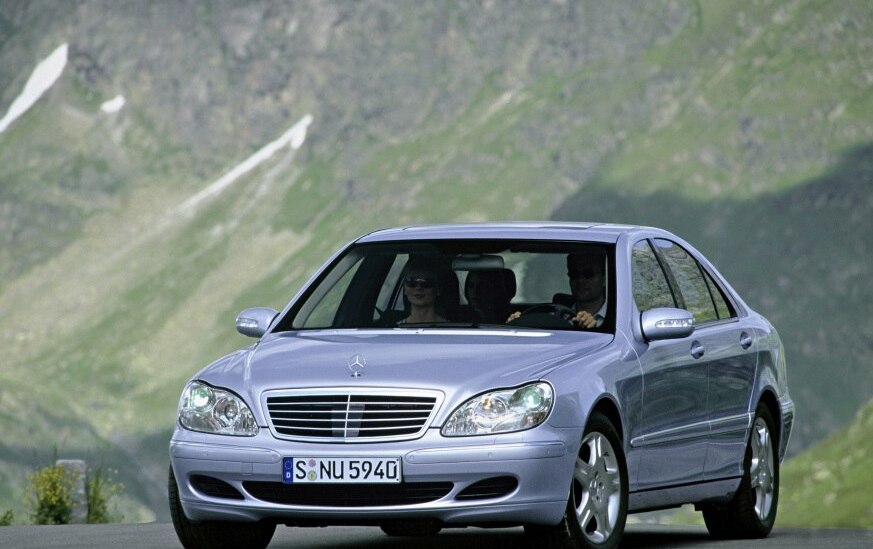
The Mercedes-Benz S 500, part of the W220 S-Class facelift introduced in 2002, represented a significant evolution of the flagship sedan. Production of this specific configuration – the 5.0-liter V8 engine paired with the 7G-TRONIC automatic transmission – ran from September 2003 to July 2005. Positioned as a mid-to-upper range offering within the W220 lineup, it bridged the gap between the entry-level S320 and the high-performance S600 models. The W220 S-Class, overall, was a technologically advanced vehicle for its time, and the facelift brought improvements to styling, interior refinement, and powertrain options.
The S 500 V8 (306 Hp) 7G-TRONIC: An Overview
The S 500 aimed to deliver a balance of performance, luxury, and refinement. It was designed for buyers who desired a powerful and comfortable grand touring experience without the outright sporting focus of the AMG models or the ultimate exclusivity of the V12-powered S600. The introduction of the 7G-TRONIC transmission was a key feature, offering smoother shifts and improved fuel efficiency compared to the previous 5-speed automatic.
Powertrain & Engine Architecture
At the heart of the S 500 lay the M113.960 5.0-liter naturally aspirated V8 engine. This engine, a mainstay of Mercedes-Benz’s upper-range vehicles for several years, featured a three-valve-per-cylinder (SOHC) design and multi-port fuel injection. The engine produced 306 horsepower at 5600 rpm and 460 Nm (339.28 lb-ft) of torque between 2700 and 4250 rpm. The 10:1 compression ratio contributed to both performance and efficiency. The engine was longitudinally mounted in the front of the vehicle.
The 7G-TRONIC automatic transmission, a seven-speed unit, was a significant advancement. It utilized a torque converter and planetary gearsets to provide a wide range of gear ratios, optimizing both acceleration and fuel economy. The transmission offered selectable driving modes, allowing the driver to tailor the shift points to their preferences. Compared to the earlier 5-speed automatic, the 7G-TRONIC provided noticeably smoother and quicker shifts, enhancing the overall driving experience.
Driving Characteristics
The S 500 offered a refined and effortless driving experience. The 5.0-liter V8 provided ample power for confident acceleration and highway cruising. The 0-60 mph sprint was achieved in approximately 6 seconds, and the car was electronically limited to a top speed of 155.34 mph (250 km/h). The 7G-TRONIC transmission played a crucial role in delivering smooth power delivery, minimizing shift shock, and keeping the engine in its optimal power band. While not as overtly sporty as some competitors, the S 500 offered a comfortable and composed ride, thanks to its sophisticated suspension system.
Compared to the S320, the S 500 provided a noticeable increase in performance, particularly in mid-range acceleration. The S600, with its V12 engine, offered even greater power and torque, but at the expense of increased weight and fuel consumption. The S 500 struck a balance, providing a substantial performance upgrade over the base model without the added cost and complexity of the flagship V12.
Equipment & Trim Levels
The S 500 came standard with a comprehensive array of luxury features. Interior appointments typically included leather upholstery, wood trim, and power-adjustable seats with memory function. Standard equipment also included automatic climate control, a premium sound system, and a multi-function steering wheel. The S-Class was renowned for its advanced safety features, and the S 500 included ABS, traction control, and a suite of airbags.
Optional extras were plentiful, allowing buyers to customize their S 500 to their exact specifications. Popular options included a panoramic sunroof, rear seat entertainment system, massaging seats, and advanced parking assist features. The availability of different wood and leather combinations further enhanced the personalization options.
Chassis & Braking
The W220 S-Class featured an independent multi-link suspension system at both the front and rear. Air suspension was standard on the S 500, providing a remarkably smooth and comfortable ride. The air suspension also allowed for adjustable ride height, enhancing both comfort and handling. Front and rear ventilated disc brakes provided ample stopping power, and ABS (Anti-lock Braking System) was standard. The S 500 typically featured a transverse stabilizer bar to reduce body roll during cornering.
The weight distribution was carefully balanced to enhance handling stability. The kerb weight of the S 500 was approximately 1800 kg (3968.32 lbs), contributing to its solid and planted feel on the road.
Market Reception & Comparison
The S 500 was generally well-received by automotive critics. It was praised for its powerful engine, smooth transmission, luxurious interior, and comfortable ride. However, some critics noted that the styling of the W220 S-Class was somewhat conservative compared to its rivals. Fuel economy, while improved with the 7G-TRONIC transmission, remained a concern, with combined fuel consumption figures around 11.4 l/100 km (20.6 US mpg).
Compared to competitors such as the BMW 7 Series and the Audi A8, the S 500 offered a unique blend of luxury, performance, and technology. The BMW 7 Series was often praised for its more dynamic handling, while the Audi A8 offered a more modern and minimalist interior design. The S 500, however, stood out for its overall refinement and its reputation for build quality.
Technical Specifications
| Brand | Mercedes-Benz |
| Model | S-class |
| Generation | S-class (W220, facelift 2002) |
| Type (Engine) | S 500 V8 (306 Hp) 7G-TRONIC |
| Start of production | September, 2003 year |
| End of production | July, 2005 year |
| Powertrain Architecture | Internal Combustion engine |
| Body type | Sedan |
| Seats | 5 |
| Doors | 4 |
| Fuel consumption (economy) – urban (NEDC) | 17.3 l/100 km (13.6 US mpg, 16.3 UK mpg, 5.8 km/l) |
| Fuel consumption (economy) – extra urban (NEDC) | 8 l/100 km (29.4 US mpg, 35.3 UK mpg, 12.5 km/l) |
| Fuel consumption (economy) – combined (NEDC) | 11.4 l/100 km (20.6 US mpg, 24.8 UK mpg, 8.8 km/l) |
| CO2 emissions (NEDC) | 270 g/km |
| Fuel Type | Petrol (Gasoline) |
| Acceleration 0 – 100 km/h | 6.3 sec |
| Acceleration 0 – 62 mph | 6.3 sec |
| Acceleration 0 – 60 mph | 6 sec (Calculated) |
| Maximum speed | 250 km/h (155.34 mph) – Electronically limited |
| Emission standard | Euro 4 |
| Weight-to-power ratio | 5.9 kg/Hp, 170 Hp/tonne |
| Weight-to-torque ratio | 3.9 kg/Nm, 255.6 Nm/tonne |
| Power | 306 Hp @ 5600 rpm |
| Torque | 460 Nm @ 2700-4250 rpm (339.28 lb.-ft. @ 2700-4250 rpm) |
| Maximum engine speed | 6400 rpm |
| Engine layout | Front, Longitudinal |
| Engine Model/Code | M 113.960 |
| Engine displacement | 4966 cm3 (303.04 cu. in.) |
| Number of cylinders | 8 |
| Engine configuration | V-engine |
| Cylinder Bore | 97 mm (3.82 in.) |
| Piston Stroke | 84 mm (3.31 in.) |
| Compression ratio | 10:1 |
| Number of valves per cylinder | 3 |
| Fuel injection system | Multi-port manifold injection |
| Engine aspiration | Naturally aspirated engine |
| Valvetrain | SOHC |
| Engine oil capacity | 8 l (8.45 US qt | 7.04 UK qt) |
| Kerb Weight | 1800 kg (3968.32 lbs.) |
| Max. weight | 2400 kg (5291.09 lbs.) |
| Max load | 600 kg (1322.77 lbs.) |
| Trunk (boot) space – minimum | 500 l (17.66 cu. ft.) |
| Fuel tank capacity | 88 l (23.25 US gal | 19.36 UK gal) |
| Length | 5043 mm (198.54 in.) |
| Width | 1855 mm (73.03 in.) |
| Width including mirrors | 2092 mm (82.36 in.) |
| Height | 1444 mm (56.85 in.) |
| Wheelbase | 2965 mm (116.73 in.) |
Legacy
The M113 engine, in general, is considered a robust and reliable powerplant, and the S 500’s configuration is no exception. With proper maintenance, these engines can accumulate high mileage. Common issues, when they arise, often relate to age-related wear and tear on components such as the cooling system, suspension components, and electrical systems. The 7G-TRONIC transmission, while advanced for its time, can be susceptible to valve body issues if not serviced regularly. Today, the W220 S 500 represents a relatively affordable entry point into the world of Mercedes-Benz luxury, offering a comfortable and well-equipped grand touring experience for those willing to accept the maintenance requirements of a vehicle of this age.