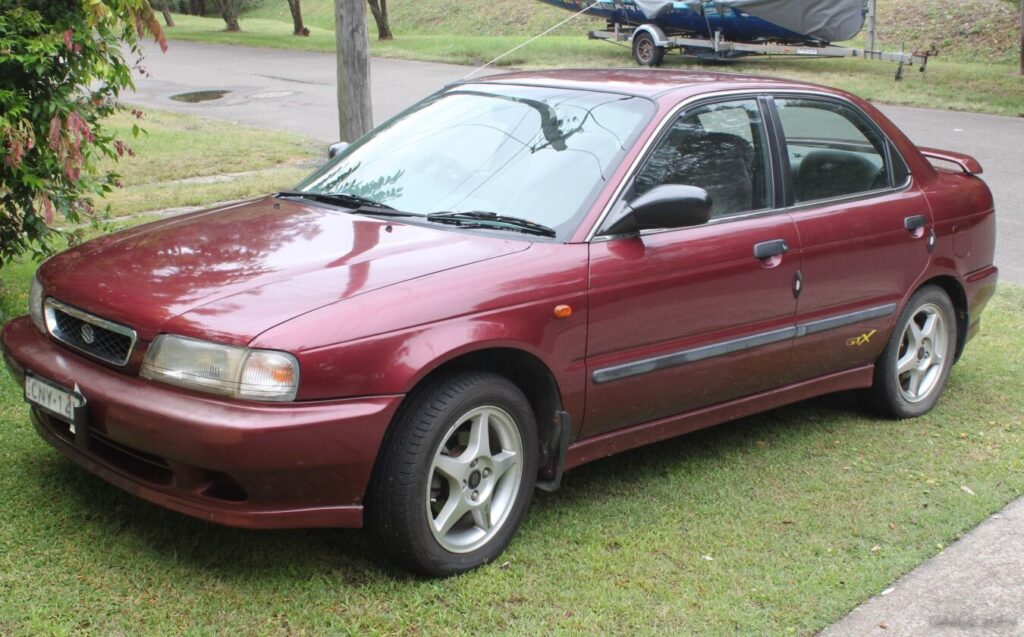
The Suzuki Baleno (EG series), launched in 1995, represented a significant step forward for Suzuki in the compact sedan market. This generation Baleno, built until 2002, was designed to offer a blend of affordability, practicality, and a degree of sophistication not previously associated with the brand. Within the EG series, the 1.6 i 16V variant, producing 98 horsepower, occupied a middle ground in the lineup, positioned above the base 1.3L models and below the more performance-oriented options available in some markets. It was aimed at buyers seeking a reasonably well-equipped and efficient family sedan.
The 1.6L 16V Baleno: Positioning and Market Role
The 1.6 i 16V Baleno was intended to appeal to a broad demographic. It wasn’t marketed as a sporty vehicle, but rather as a sensible and reliable choice for daily commuting and family transportation. Compared to the base 1.3L engine, the 1.6L offered a noticeable improvement in performance, making it more suitable for highway driving and carrying a full load of passengers. In markets where a higher-performance variant was offered (often a 1.8L or a turbocharged engine), the 1.6L served as a more economical and accessible alternative, prioritizing fuel efficiency and lower running costs over outright speed.
Powertrain & Engine Architecture
The heart of the 1.6 i 16V Baleno is the G16B engine, a 1.6-liter (1590 cc) inline-four cylinder gasoline engine. This engine utilizes a single overhead camshaft (OHC) valvetrain operating four valves per cylinder – hence the “16V” designation. This configuration allowed for improved breathing and higher engine speeds compared to engines with two valves per cylinder. The G16B employed multi-port fuel injection, delivering fuel directly into the intake ports for precise fuel metering and efficient combustion. The engine’s bore and stroke measured 75mm x 90mm, resulting in a compression ratio of 9.5:1. The G16B was known for its relatively simple design, contributing to its overall reliability.
While a five-speed manual transmission was the most common pairing for the 1.6L engine, an optional four-speed automatic transmission was also available. This automatic transmission, while providing convenience, was not known for its particularly sporty or efficient operation. It featured traditional hydraulic control and offered a relatively smooth, if somewhat slow, shifting experience. The automatic transmission was geared towards comfort and ease of use, rather than maximizing performance.
Driving Characteristics
The 1.6L 16V Baleno with the manual transmission offered a reasonably engaging driving experience. The 98 horsepower and 127 Nm (93.67 lb-ft) of torque provided adequate acceleration for everyday driving, with a 0-60 mph time of approximately 10.6 seconds. The engine felt responsive at higher RPMs, benefiting from the 16-valve head. However, it lacked significant low-end torque, requiring drivers to downshift to maintain momentum when climbing hills or overtaking. The five-speed manual transmission allowed drivers to keep the engine in its optimal power band.
The automatic transmission version, however, noticeably dulled the driving experience. The four-speed unit lacked the close ratios of a modern automatic, and the engine often felt strained during acceleration. The 0-60 mph time increased to around 11.2 seconds. While the automatic offered convenience, it came at the cost of performance and fuel economy. The gear ratios were optimized for cruising rather than spirited driving.
Equipment & Trim Levels
The standard equipment level for the 1.6 i 16V Baleno varied depending on the specific market. However, generally, it included features such as power steering, central locking, and an AM/FM radio. Higher trim levels offered options like air conditioning, power windows, and alloy wheels. Interior upholstery typically consisted of cloth seats, with higher trims offering upgraded fabric or even partial leather options. The dashboard layout was functional and straightforward, prioritizing usability over aesthetic flair. Optional extras included a sunroof, upgraded sound system, and anti-lock brakes (ABS).
Chassis & Braking
The Baleno’s chassis utilized a front-engine, front-wheel-drive layout. Suspension consisted of wishbone suspension at both the front and rear, providing a comfortable ride quality. The front brakes were ventilated discs, offering good stopping power, while the rear brakes were typically drum brakes, a cost-saving measure. ABS was available as an option, enhancing braking performance and safety. The steering system employed a hydraulic power steering rack and pinion, providing responsive and precise steering feel. The curb weight of approximately 945 kg (2083.37 lbs) contributed to the car’s relatively nimble handling.
Market Reception & Comparison
The 1.6 i 16V Baleno generally received positive reviews for its practicality, reliability, and affordability. Critics praised its comfortable ride and spacious interior. However, some reviewers noted the engine’s lack of low-end torque and the automatic transmission’s sluggish performance. Compared to other compact sedans of the era, such as the Honda Civic and Toyota Corolla, the Baleno offered a competitive price point and a generous level of standard equipment. In terms of fuel economy, the 1.6L Baleno achieved approximately 7.0 l/100 km (33.6 US mpg) combined, which was respectable for its time. Reliability was generally good, with the G16B engine proving to be durable and long-lasting.
Technical Specifications
| Brand | Suzuki |
| Model | Baleno |
| Generation | Baleno (EG, 1995) |
| Type (Engine) | 1.6 i 16V (98 Hp) |
| Start of production | 1995 |
| End of production | 2002 |
| Body type | Sedan |
| Seats | 5 |
| Doors | 4 |
| Fuel consumption (urban) | 8.9 l/100 km (26.4 US mpg) |
| Fuel consumption (extra urban) | 5.9 l/100 km (39.9 US mpg) |
| Fuel consumption (combined) | 7 l/100 km (33.6 US mpg) |
| Fuel Type | Petrol (Gasoline) |
| Acceleration 0 – 100 km/h | 11.2 sec |
| Acceleration 0 – 62 mph | 11.2 sec |
| Acceleration 0 – 60 mph | 10.6 sec |
| Maximum speed | 175 km/h (108.74 mph) |
| Engine layout | Front, Transverse |
| Engine Model/Code | G16B |
| Engine displacement | 1590 cm3 (97.03 cu. in.) |
| Number of cylinders | 4 |
| Cylinder Bore | 75 mm (2.95 in.) |
| Piston Stroke | 90 mm (3.54 in.) |
| Compression ratio | 9.5:1 |
| Engine oil capacity | 3.3 l (3.49 US qt | 2.9 UK qt) |
| Coolant capacity | 4.2 l (4.44 US qt | 3.7 UK qt) |
| Kerb Weight | 945 kg (2083.37 lbs.) |
| Max. weight | 1375 kg (3031.36 lbs.) |
| Trunk (boot) space – minimum | 210 l (7.42 cu. ft.) |
| Trunk (boot) space – maximum | 495 l (17.48 cu. ft.) |
| Fuel tank capacity | 51 l (13.47 US gal | 11.22 UK gal) |
| Length | 4195 mm (165.16 in.) |
| Width | 1690 mm (66.54 in.) |
| Height | 1390 mm (54.72 in.) |
Legacy
The 1.6L 16V Baleno, particularly when equipped with the manual transmission, has earned a reputation for being a reliable and affordable used car. The G16B engine is known for its durability, and parts availability remains relatively good. While not a particularly exciting vehicle, it provides a practical and economical transportation solution. The automatic transmission versions, while less desirable due to their reduced performance, still offer a comfortable and convenient driving experience. Today, well-maintained examples of the 1.6L Baleno are sought after by enthusiasts looking for a simple, reliable, and affordable classic car.