
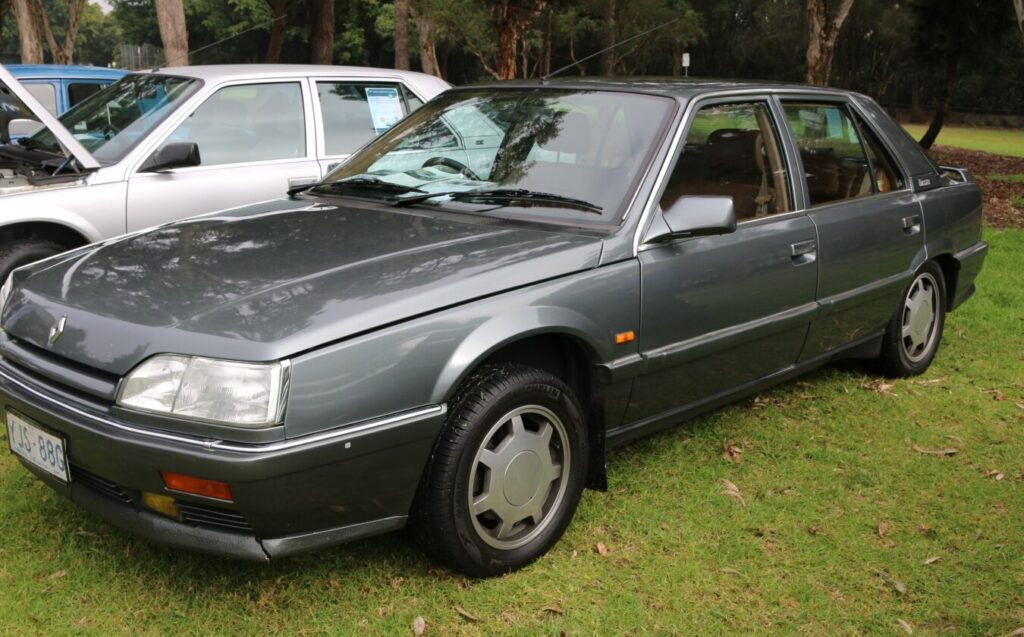
The Renault 25 (B29) 2.85 i V6, produced between 1988 and 1993, represented the top-of-the-line performance variant of Renault’s executive hatchback. Positioned as the flagship model within the B29 generation, which itself was a significant update to the original Renault 25 launched in 1984, the 2.85 i V6 offered a substantial increase in power and refinement compared to the lower-spec 1.8 and 2.0 liter four-cylinder models. The B29 series was built on the Renault 25 platform, known for its spacious interior and comfortable ride, and aimed to compete with vehicles like the Ford Sierra, Opel/Vauxhall Senator, and Peugeot 505.
Powertrain & Engine Architecture
The heart of the Renault 25 2.85 i V6 is the Z7W engine, a 2.849-liter (173.86 cubic inches) naturally aspirated V6. This engine is characterized by its 60-degree V-angle configuration, contributing to a relatively compact engine bay footprint. The Z7W utilizes a cast iron block and aluminum cylinder heads, a common construction for the era balancing durability with weight reduction. It features a single overhead camshaft (OHC) valvetrain operating two valves per cylinder. Fuel delivery is managed by a Bosch multi-port fuel injection system, providing precise fuel metering for improved performance and efficiency. The engine produces 160 horsepower at 5400 rpm and 235 Nm (173.33 lb-ft) of torque at 2500 rpm, giving it a power-to-liter ratio of 56.2 hp/l. The engine’s bore and stroke are 91 mm (3.58 in) and 73 mm (2.87 in) respectively, with a compression ratio of 9.5:1. The engine requires 5.5 liters (5.81 US quarts) of engine oil, specified to Renault standards, and 9.5 liters (10.04 US quarts) of coolant.
Transmission
While a five-speed manual transmission was available, the 2.85 i V6 was most commonly paired with a four-speed automatic transmission. This automatic, while providing convenience, was not known for its particularly quick shifts or fuel efficiency. The gear ratios were optimized for comfortable cruising rather than outright acceleration. The automatic transmission was designed to handle the V6’s torque output, but it did contribute to slightly slower acceleration times compared to the manual version.
Driving Characteristics
The Renault 25 2.85 i V6 offered a distinctly different driving experience compared to its four-cylinder siblings. The V6 engine provided smooth and responsive power delivery, making it well-suited for long-distance highway driving. Acceleration from 0 to 100 km/h (0-62 mph) took approximately 9.3 seconds, while 0-60 mph was achieved in around 8.8 seconds. The top speed was rated at 208 km/h (129.25 mph). The automatic transmission, while convenient, did detract somewhat from the overall driving engagement. The car felt stable and planted at higher speeds, thanks to its relatively long wheelbase and well-tuned suspension. However, the power steering, while light and easy to use, lacked the feedback found in more modern systems. The weight-to-power ratio of 8.1 kg/hp and weight-to-torque ratio of 5.5 kg/Nm indicated a respectable, though not exceptional, performance profile for the time.
Equipment & Trim Levels
The 2.85 i V6 was the most luxurious trim level of the Renault 25 B29. Standard features included central locking, electric windows, power steering, and an upgraded interior with velour upholstery. Higher-spec examples often featured leather seats, a sunroof, and an upgraded sound system. Air conditioning was a common option. The dashboard layout was typical of the era, featuring analog gauges and a relatively simple control layout. The interior was known for its spaciousness, offering ample headroom and legroom for both front and rear passengers. The rear seats also offered a folding function, increasing the trunk capacity from a minimum of 440 liters (15.54 cu ft) to a maximum of 1240 liters (43.79 cu ft) with the seats folded down.
Chassis & Braking
The Renault 25 B29 utilized a front-engine, front-wheel-drive layout. The suspension consisted of coil springs all around, with an independent front suspension and a semi-independent rear suspension. The front suspension featured MacPherson struts, while the rear utilized a twist beam setup. Braking duties were handled by ventilated discs on the front wheels and solid discs on the rear wheels. An Anti-lock Braking System (ABS) was standard equipment on the 2.85 i V6, enhancing safety and control during hard braking. The steering system was a rack and pinion type with hydraulic power assistance. The standard tire size was 195/60 R15, mounted on 15-inch steel wheels with wheel covers.
Market Reception & Comparison
The Renault 25 2.85 i V6 was generally well-received by automotive critics, who praised its smooth engine, comfortable ride, and spacious interior. However, the automatic transmission was often criticized for its sluggishness. Compared to the lower-spec models, the V6 offered a significant performance upgrade, but it came at a higher price. Fuel economy was also considerably lower, with combined fuel consumption figures of 9.3 l/100 km (25.3 US mpg, 30.4 UK mpg). The V6 was more expensive to maintain than the four-cylinder models, due to the increased complexity of the engine and its associated components. In terms of reliability, the Z7W engine was generally considered to be robust, but the automatic transmission could be prone to issues if not properly maintained. Compared to rivals like the Ford Sierra 2.8i and Opel Senator, the Renault 25 offered a more refined and comfortable driving experience, but it lacked the sporting pretensions of some of its competitors.
Technical Specifications
| Brand | Renault |
| Model | 25 |
| Generation | 25 (B29) |
| Type (Engine) | 2.85 i V6 (160 Hp) |
| Start of production | 1988 year |
| End of production | 1993 year |
| Fuel consumption (economy) – urban | 14.5 l/100 km (16.2 US mpg, 19.5 UK mpg) |
| Fuel consumption (economy) – extra urban | 7.4 l/100 km (31.8 US mpg, 38.2 UK mpg) |
| Fuel consumption (economy) – combined | 9.3 l/100 km (25.3 US mpg, 30.4 UK mpg) |
| Fuel Type | Petrol (Gasoline) |
| Acceleration 0 – 100 km/h | 9.3 sec |
| Acceleration 0 – 62 mph | 9.3 sec |
| Acceleration 0 – 60 mph | 8.8 sec |
| Maximum speed | 208 km/h (129.25 mph) |
| Weight-to-power ratio | 8.1 kg/Hp |
| Weight-to-torque ratio | 5.5 kg/Nm |
| Power | 160 Hp @ 5400 rpm |
| Torque | 235 Nm @ 2500 rpm (173.33 lb.-ft. @ 2500 rpm) |
| Engine layout | Front, Longitudinal |
| Engine Model/Code | Z7W |
| Engine displacement | 2849 cm3 (173.86 cu. in.) |
| Number of cylinders | 6 |
| Engine configuration | V-engine |
| Cylinder Bore | 91 mm (3.58 in.) |
| Piston Stroke | 73 mm (2.87 in.) |
| Compression ratio | 9.5:1 |
| Number of valves per cylinder | 2 |
| Fuel injection system | Multi-port manifold injection |
| Engine aspiration | Naturally aspirated engine |
| Valvetrain | OHC |
| Engine oil capacity | 5.5 l (5.81 US qt | 4.84 UK qt) |
| Coolant | 9.5 l (10.04 US qt | 8.36 UK qt) |
| Kerb Weight | 1300 kg (2866.01 lbs.) |
| Max. weight | 1755 kg (3869.11 lbs.) |
| Max load | 455 kg (1003.1 lbs.) |
| Trunk (boot) space – minimum | 440 l (15.54 cu. ft.) |
| Trunk (boot) space – maximum | 1240 l (43.79 cu. ft.) |
| Fuel tank capacity | 72 l (19.02 US gal | 15.84 UK gal) |
| Length | 4715 mm (185.63 in.) |
| Width | 1805 mm (71.06 in.) |
| Height | 1415 mm (55.71 in.) |
| Wheelbase | 2725 mm (107.28 in.) |
| Front track | 1495 mm (58.86 in.) |
| Rear (Back) track | 1475 mm (58.07 in.) |
| Drivetrain Architecture | The Internal combustion engine (ICE) drives the front wheels of the vehicle. |
| Drive wheel | Front wheel drive |
| Number of gears and type of gearbox | 5 gears, manual transmission (optional) / 4 gears, automatic transmission |
| Front suspension | Coil spring |
| Rear suspension | Coil spring |
| Front brakes | Ventilated discs |
| Rear brakes | Disc |
| Assisting systems | ABS (Anti-lock braking system) |
| Steering type | Steering rack and pinion |
| Power steering | Hydraulic Steering |
| Tires size | 195/60 R15 |
| Wheel rims size | 15 |
Legacy
Today, the Renault 25 2.85 i V6 is a relatively rare and sought-after classic car. The Z7W engine, while not without its quirks, is generally considered to be a durable and reliable unit when properly maintained. The automatic transmission remains a potential weak point, and finding parts can be challenging. The car’s spacious interior and comfortable ride continue to appeal to enthusiasts. Values for well-maintained examples have been steadily increasing in recent years, reflecting the growing interest in 1980s and 1990s European classics. The Renault 25 2.85 i V6 represents a high point in Renault’s executive car offerings, showcasing the company’s engineering prowess and commitment to comfort and refinement.
