
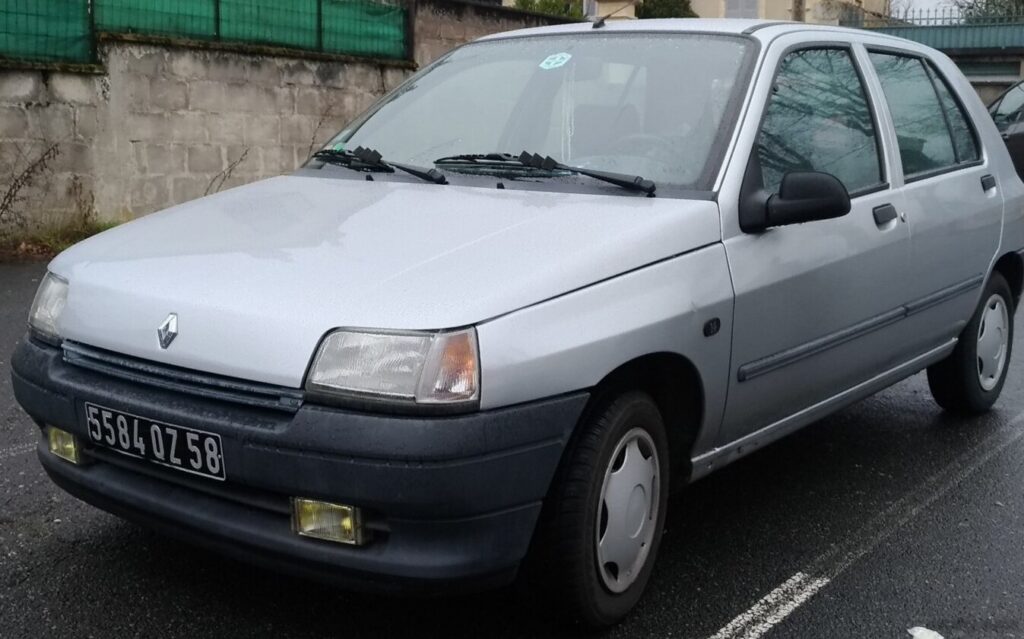
The Renault Clio I (Phase I) 1.1, produced between 1990 and 1995, represented the entry point into the first generation of Renault’s hugely successful supermini. This variant, powered by a modest 1.1-liter engine producing 49 horsepower, was designed to offer affordable and economical transportation within the broader Clio I range, which also included more powerful engine options. The Phase I models, identifiable by their distinct styling cues, were built on the Renault 8/9 platform, later designated as the X67 series, and were a significant departure from the Renault 5 they replaced. The 1.1L model was primarily aimed at first-time car buyers, city dwellers, and those prioritizing fuel efficiency over outright performance.
The 1.1L Clio: Positioning and Target Audience
Within the initial Clio I Phase I lineup, the 1.1-liter engine served as the base model. Above it sat the 1.4-liter and 1.6-liter gasoline engines, offering increased power and performance. Later in the production run, diesel variants were also introduced. The 1.1L was specifically targeted at buyers seeking a low-cost, reliable, and fuel-efficient vehicle for urban commuting and short journeys. It was often chosen by younger drivers, families on a budget, and those who didn’t require the extra power offered by the larger-displacement engines. Its simplicity and affordability made it a popular choice in many European markets.
Powertrain & Engine Architecture
The heart of the Clio I 1.1 is the Renault C1E engine, an inline four-cylinder, naturally aspirated gasoline engine displacing 1108 cc (67.61 cubic inches). This engine featured a relatively simple design, utilizing a single overhead camshaft (OHC) valvetrain with two valves per cylinder. The C1E engine employed a carburetor fuel injection system, a common feature for vehicles of this era, rather than the more advanced multi-point fuel injection found in some of its competitors. This carburetor setup contributed to its lower cost but also resulted in slightly lower fuel efficiency and increased emissions compared to fuel-injected engines.
The engine produced a maximum power output of 49 hp (36 kW) at 5250 rpm and a peak torque of 79 Nm (58.27 lb-ft) at 2500 rpm. The compression ratio was set at 8.8:1. The engine’s oil capacity is 3.5 liters (3.7 US quarts / 3.08 UK quarts), and it requires coolant totaling 5.4 liters (5.71 US quarts / 4.75 UK quarts). The engine is transversely mounted at the front of the vehicle, driving the front wheels.
Paired with the 1.1L engine was a 5-speed automatic transmission. This transmission, while offering convenience, was not known for its particularly quick shifts or sporty feel. It was geared towards smooth operation and fuel economy rather than performance. The automatic transmission contributed to the car’s ease of use, particularly in congested urban environments.
Transmission Details
The 5-speed automatic transmission used in the Clio I 1.1 was a conventional hydraulic automatic. Gear ratios were optimized for fuel efficiency and smooth acceleration, prioritizing usability over outright speed. The transmission’s design was relatively simple, contributing to its reliability, but it lacked the sophistication of more modern automatic transmissions.
Driving Characteristics
The driving experience in the Clio I 1.1 Automatic is best described as unhurried. With only 49 horsepower on tap, acceleration is modest, and overtaking requires careful planning. The 0 to 60 mph time is estimated to be around 16-18 seconds, and the top speed is approximately 90.1 mph (145 km/h). The automatic transmission further softens the driving experience, providing smooth, if somewhat slow, gear changes. The car feels most comfortable at lower speeds, making it well-suited for city driving. Compared to the manual transmission versions of the 1.1L, the automatic offers greater convenience but sacrifices some responsiveness. The higher-powered 1.4L and 1.6L models offered significantly more spirited performance, while the diesel variants provided better fuel economy but less overall power.
Equipment & Trim Levels
The Clio I 1.1 Automatic was typically offered in a fairly basic trim level, reflecting its position as the entry-level model. Standard features generally included cloth upholstery, a basic dashboard layout, and manual windows and door locks. Power steering was not always standard, and air conditioning was typically an optional extra. The interior was functional and durable, prioritizing practicality over luxury. Optional extras could include a radio cassette player, upgraded seat fabrics, and central locking. The Phase I models generally featured a simpler interior design compared to later Phase II versions.
Chassis & Braking
The Clio I 1.1 utilized a relatively simple chassis design. The front suspension consisted of a MacPherson strut setup, while the rear suspension employed a torsion beam. This configuration provided a comfortable ride, although handling was not particularly sharp. The kerb weight of the vehicle is 810 kg (1785.74 lbs), contributing to its relatively light and nimble feel. The front brakes were disc brakes, providing adequate stopping power, while the rear brakes were drum brakes, a cost-saving measure common in vehicles of this class. ABS (Anti-lock Braking System) was not standard on the base 1.1L model, but it could be specified as an optional extra. Tire size was typically 145/70 R13, mounted on 13-inch steel wheels.
Market Reception & Comparison
The Clio I 1.1 Automatic was generally well-received as an affordable and reliable city car. Critics praised its fuel economy and ease of use, but noted its lack of performance. Compared to rivals such as the Peugeot 205 and the Fiat Uno, the Clio offered a comfortable ride and a relatively spacious interior. However, its performance was generally considered to be inferior to some of its competitors. Fuel consumption figures were around 6.1 l/100 km (38.6 US mpg / 46.3 UK mpg), making it a relatively economical choice for everyday driving. Reliability was generally good, although the carburetor fuel system required periodic maintenance.
Technical Specifications
| Engine Type | Inline 4-cylinder, Naturally Aspirated |
| Engine Code | C1E |
| Displacement | 1108 cm3 (67.61 cu. in.) |
| Power | 49 hp @ 5250 rpm |
| Torque | 79 Nm (58.27 lb-ft) @ 2500 rpm |
| Fuel System | Carburetor |
| Compression Ratio | 8.8:1 |
| Transmission | 5-speed Automatic |
| Drive Wheels | Front |
| Kerb Weight | 810 kg (1785.74 lbs) |
| Maximum Speed | 145 km/h (90.1 mph) |
| Fuel Consumption (Combined) | 6.1 l/100 km (38.6 US mpg / 46.3 UK mpg) |
| Fuel Tank Capacity | 43 l (11.36 US gal / 9.46 UK gal) |
| Length | 3709 mm (146.02 in) |
| Width | 1616 mm (63.62 in) |
| Height | 1395 mm (54.92 in) |
Legacy
The Renault Clio I 1.1 Automatic, while not the most powerful or exciting variant in the range, played a crucial role in establishing the Clio as a popular and reliable supermini. The C1E engine, while simple, proved to be relatively durable, and many examples are still on the road today. In the used car market, these early Clios are increasingly sought after by enthusiasts and collectors, particularly those looking for a classic and affordable French hatchback. The automatic transmission, while not particularly sophisticated, offered a level of convenience that appealed to a wide range of buyers. The 1.1L variant remains a testament to Renault’s ability to produce affordable and practical transportation for the masses.
