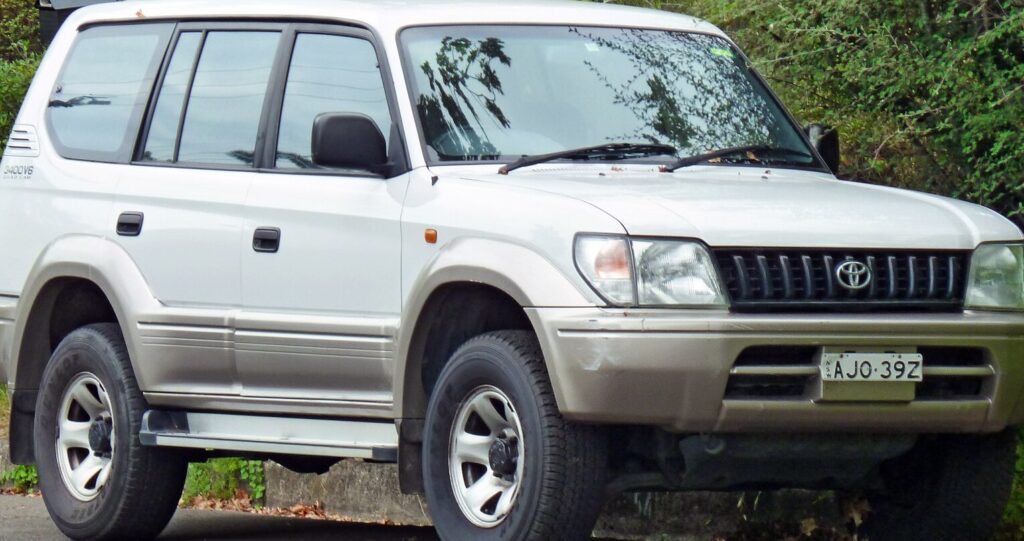
The Toyota Land Cruiser Prado J90, produced between 1996 and 1999, represented a significant evolution in Toyota’s long-running Land Cruiser lineage. This generation, designated J90, moved towards a more comfortable and family-oriented SUV while retaining the rugged capability expected of the Land Cruiser nameplate. The 5-door configuration became increasingly popular, offering enhanced passenger space and practicality. Among the engine options available, the 2.7-liter 16V (152 hp) 4WD variant occupied a crucial position as the entry-level offering in many markets, balancing affordability with Land Cruiser durability and off-road prowess. It was positioned below the more powerful 3.4-liter V6 and diesel options, targeting buyers who prioritized fuel economy and sufficient, rather than outright, performance.
The 2.7L 16V (152 Hp) Prado: A Detailed Overview
The 2.7-liter engine, designated 3RZ-FE, was a key component of Toyota’s ‘RZ’ family of inline-four engines. Introduced in the mid-1990s, it was designed for reliability and longevity, characteristics highly valued in the Land Cruiser’s target demographic. This engine was offered in conjunction with either a 5-speed manual transmission or a 4-speed automatic transmission, the latter being a common choice for buyers seeking ease of use, particularly in urban environments and off-road situations. The 1996-1999 Prado 2.7L 4WD was primarily aimed at families and individuals needing a capable and dependable SUV for both daily commuting and occasional off-road adventures.
Powertrain & Engine Architecture
The 3RZ-FE is a 2.7-liter (2694 cc) inline-four cylinder gasoline engine. It features a cast iron block and an aluminum cylinder head, contributing to its robust construction. The engine utilizes a double overhead camshaft (DOHC) valvetrain with four valves per cylinder, enhancing breathing and contributing to its 152 horsepower output at 4800 rpm and 240 Nm (177.01 lb-ft) of torque at 4000 rpm. Fuel delivery is managed by a multi-port fuel injection system, ensuring efficient combustion. The compression ratio is set at 9.5:1. The engine’s longitudinal mounting within the chassis facilitated a traditional front-engine, four-wheel-drive layout.
The 4-speed automatic transmission paired with the 3RZ-FE was a Toyota-designed unit known for its durability, though it wasn’t particularly sophisticated by modern standards. Gear ratios were optimized for a balance of on-road drivability and off-road crawling capability. The transmission lacked features like overdrive in some markets, prioritizing robustness over ultimate fuel efficiency at highway speeds. The automatic transmission was a key selling point for buyers who preferred a more relaxed driving experience, especially in challenging terrain.
Driving Characteristics
The 2.7-liter Prado, particularly with the automatic transmission, offered a comfortable but not particularly exhilarating driving experience. Acceleration was adequate for everyday driving, but the 152 hp output meant it wasn’t a performance-oriented vehicle. The automatic transmission, while smooth, could feel somewhat sluggish during quick acceleration or overtaking maneuvers. The weight of the Prado (approximately 1750 kg / 3858 lbs) further contributed to this sensation.
Off-road, the 2.7L Prado proved surprisingly capable. The four-wheel-drive system, combined with the engine’s low-end torque, allowed for confident traversal of moderately challenging terrain. The automatic transmission, while not ideal for precise off-road control, offered sufficient gear reduction for most situations. Compared to the more powerful V6 models, the 2.7L Prado required more careful throttle control and momentum management in difficult conditions. The manual transmission version offered more driver control, but was less common in many markets.
Equipment & Trim Levels
The 2.7L Prado typically came equipped with a reasonable level of standard features, though these varied depending on the specific market. Common features included air conditioning, power windows, power steering, and an AM/FM radio. Higher trim levels offered upgrades such as alloy wheels, upgraded interior upholstery (often cloth or vinyl), a CD player, and optional features like a sunroof. The interior design was functional and durable, prioritizing practicality over luxury. Seating capacity was typically eight passengers, with a split-folding rear bench seat providing flexibility for cargo space.
Chassis & Braking
The Prado J90 utilized a body-on-frame construction, providing a robust and durable platform for off-road use. The front suspension consisted of a coil spring, double wishbone setup with a transverse stabilizer bar, while the rear suspension employed a rigid axle with coil springs. This configuration offered a good balance of ride comfort and off-road articulation.
Braking duties were handled by ventilated discs on the front wheels and drum brakes on the rear. An Anti-lock Braking System (ABS) was often included as standard equipment, enhancing safety and control during emergency braking situations. The steering system was a rack and pinion setup with hydraulic power assistance, providing responsive and precise steering feel. Tire size was typically 215/80 R16, offering a good compromise between on-road comfort and off-road traction.
Market Reception & Comparison
The 2.7L Prado was generally well-received as a dependable and affordable entry point into the Land Cruiser family. Critics praised its reliability and off-road capability, but noted its relatively modest performance compared to the more powerful engine options. Fuel economy was a strong point, with reported figures of around 18 l/100 km (13.1 US mpg) in urban conditions and 10 l/100 km (23.5 US mpg) on the highway.
Compared to the 3.4-liter V6 Prado, the 2.7L model offered significantly lower running costs but lacked the V6’s effortless power and refinement. The diesel versions, while offering superior fuel economy and torque, were often more expensive to purchase and maintain. The 2.7L Prado appealed to buyers who prioritized value, reliability, and sufficient capability over outright performance.
Technical Specifications
| Brand | Toyota |
| Model | Land Cruiser Prado |
| Generation | Land Cruiser Prado (J90) 5-door |
| Type | 2.7 16V (152 Hp) 4WD |
| Start of production | 1996 |
| End of production | 1999 |
| Engine Model/Code | 3RZ-FE |
| Engine displacement | 2694 cm3 (164.4 cu. in.) |
| Number of cylinders | 4 |
| Engine configuration | Inline |
| Cylinder Bore | 95 mm (3.74 in.) |
| Piston Stroke | 95 mm (3.74 in.) |
| Compression ratio | 9.5:1 |
| Power | 152 Hp @ 4800 rpm |
| Torque | 240 Nm @ 4000 rpm (177.01 lb.-ft. @ 4000 rpm) |
| Fuel injection system | Multi-port manifold injection |
| Engine oil capacity | 5.4 l (5.71 US qt | 4.75 UK qt) |
| Coolant capacity | 10 l (10.57 US qt | 8.8 UK qt) |
| Kerb Weight | 1750 kg (3858.09 lbs.) |
| Max. weight | 2680 kg (5908.39 lbs.) |
| Fuel tank capacity | 90 l (23.78 US gal | 19.8 UK gal) |
| Length | 4675 mm (184.06 in.) |
| Width | 1820 mm (71.65 in.) |
| Height | 1880 mm (74.02 in.) |
| Wheelbase | 2675 mm (105.31 in.) |
| Tires size | 215/80 R16 |
| Transmission | 4-speed Automatic |
Legacy
The 3RZ-FE engine, and the Prado J90 as a whole, have earned a reputation for exceptional reliability and durability. Even today, well-maintained examples of the 2.7L Prado are sought after in the used car market, particularly in regions where ruggedness and dependability are highly valued. While not as desirable as the higher-spec models, the 2.7L Prado offers a cost-effective entry point into Land Cruiser ownership. The engine itself is known for its longevity, with many examples exceeding 200,000 miles with minimal major repairs. Its simplicity and robust design contribute to its continued appeal among owners and mechanics alike. The 2.7L Prado remains a testament to Toyota’s commitment to building vehicles that stand the test of time.