
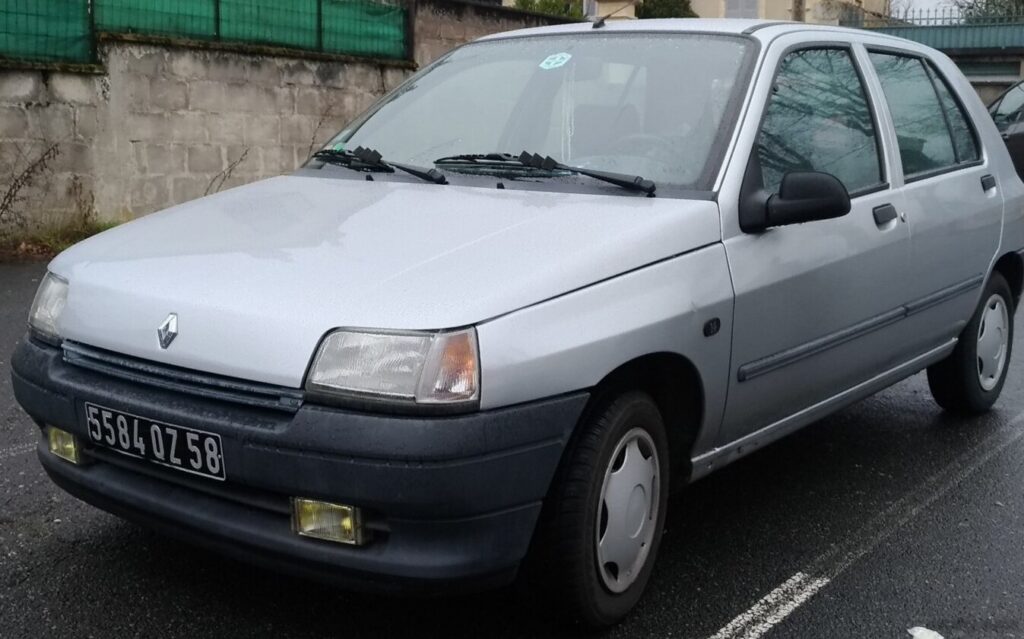
The Renault Clio I (Phase I) 1.2 i, producing 58 horsepower, was an entry-level variant of the first-generation Clio, produced between 1996 and 1998. Positioned as the most affordable option in the Clio I range, it served as a practical and economical choice for budget-conscious buyers. This model was part of the broader Clio I series (codename X5/6), which represented Renault’s significant move into the supermini segment, replacing the Renault 5. The Phase I models, produced from 1990-1993, featured a distinct aesthetic and mechanical setup compared to later revisions.
Powertrain & Engine Architecture
The heart of the Clio I 1.2 i was the Renault D7F engine, a 1.2-liter (1171 cc) inline-four cylinder petrol engine. This engine utilized a single-point fuel injection system, a relatively simple and cost-effective technology for the time. The D7F engine featured an overhead camshaft (OHC) valvetrain with two valves per cylinder. Its bore and stroke measured 75.8 mm and 64.9 mm respectively, resulting in a compression ratio of 8.8:1. The engine produced a maximum power output of 58 hp (43 kW) at 6000 rpm and 84 Nm (62 lb-ft) of torque at 3500 rpm. The engine’s power per liter was 49.5 hp/l.
While a five-speed manual transmission was the most common pairing for this engine, a four-speed automatic transmission was also offered, though less frequently. The automatic transmission was a conventional hydraulic unit, designed for smooth, if not particularly sporty, operation. The automatic version significantly impacted acceleration times, as detailed below.
Engine Code Specifics
The D7F engine code encompasses several variations, but the 58 hp version found in the Clio I Phase I was a relatively basic configuration. Later iterations of the D7F engine would receive upgrades such as multi-point fuel injection and improved cylinder heads, resulting in increased power output. The single-point injection system of the early D7F was known for its simplicity and reliability, but also for its less-than-optimal fuel efficiency compared to more modern systems.
Driving Characteristics
The Clio I 1.2 i, particularly in its automatic guise, was not known for its blistering performance. Acceleration from 0 to 100 km/h (0-62 mph) took approximately 14 seconds. The 0-60 mph time was calculated at 13.3 seconds. The top speed was limited to 155 km/h (96.31 mph). The automatic transmission, while providing convenience, resulted in noticeable power loss and slower acceleration compared to the manual transmission version. The gear ratios were optimized for fuel economy rather than outright performance.
In real-world driving, the 1.2-liter engine felt adequate for urban commutes and short trips. However, overtaking maneuvers required careful planning, and the engine could feel strained when fully loaded or climbing hills. The automatic transmission offered smooth shifts, but lacked the responsiveness of a manual gearbox. The overall driving experience was characterized by its practicality and ease of use, rather than its excitement.
Equipment & Trim Levels
The 1.2 i variant of the Clio I Phase I was typically offered in a basic trim level, reflecting its position as the entry point to the range. Standard equipment generally included cloth upholstery, a basic dashboard layout, and manual windows and door locks. Power steering was not always standard, and air conditioning was typically an optional extra. The interior was designed with functionality in mind, prioritizing durability and ease of maintenance over luxury.
Optional extras included upgraded upholstery, a radio/cassette player, and, as mentioned, air conditioning. Higher trim levels, available with the more powerful engines, offered features such as alloy wheels, electric windows, and a more sophisticated interior design. The 3-door and 5-door body styles were both available with the 1.2 i engine, offering buyers a choice based on their practicality needs.
Chassis & Braking
The Clio I 1.2 i utilized a relatively simple chassis design. The front suspension consisted of MacPherson strut springs, while the rear suspension employed a torsion beam setup. This configuration provided a comfortable ride, but did not offer particularly sporty handling characteristics. The kerb weight of the vehicle was 830 kg (1829.84 lbs), contributing to its relatively modest performance.
The braking system featured disc brakes on the front wheels and drum brakes on the rear wheels. This configuration was typical for vehicles in this price range during the 1990s. The steering was a rack and pinion system, providing reasonably precise steering feel. The standard tire size was 155/70 R13 S, mounted on 13-inch steel wheels.
Market Reception & Comparison
The Clio I 1.2 i was generally well-received as an affordable and reliable supermini. Critics praised its fuel economy, which was rated at 6.2 l/100 km (37.9 US mpg) combined, and its practicality. However, its lack of power and somewhat basic interior were often noted. Compared to the more powerful Clio variants, such as the 1.4 and 1.8 models, the 1.2 i offered significantly less performance. The 1.9 TDI diesel version provided superior fuel economy but lacked the refinement of the petrol engine.
The 1.2 i appealed to buyers who prioritized economy and practicality over performance. It was a popular choice for first-time car owners, city dwellers, and those seeking a reliable and inexpensive mode of transportation. Its lower price point made it an attractive alternative to competitors such as the Peugeot 205 and the Fiat Punto.
Technical Specifications
| Brand | Renault |
| Model | Clio I (Phase I) |
| Type (Engine) | 1.2 i (58 Hp) |
| Start of production | 1996 |
| End of production | 1998 |
| Fuel consumption (urban) | 8 l/100 km (29.4 US mpg) |
| Fuel consumption (extra urban) | 4.7 l/100 km (50 US mpg) |
| Fuel consumption (combined) | 6.2 l/100 km (37.9 US mpg) |
| Fuel Type | Petrol (Gasoline) |
| Acceleration 0 – 100 km/h | 14 sec |
| Acceleration 0 – 62 mph | 14 sec |
| Acceleration 0 – 60 mph | 13.3 sec |
| Maximum speed | 155 km/h (96.31 mph) |
| Weight-to-power ratio | 14.3 kg/Hp |
| Power | 58 Hp @ 6000 rpm |
| Torque | 84 Nm @ 3500 rpm (61.96 lb.-ft. @ 3500 rpm) |
| Engine layout | Front, Transverse |
| Engine Model/Code | D7F |
| Engine displacement | 1171 cm3 (71.46 cu. in.) |
| Number of cylinders | 4 |
| Cylinder Bore | 75.8 mm (2.98 in.) |
| Piston Stroke | 64.9 mm (2.56 in.) |
| Compression ratio | 8.8:1 |
| Number of valves per cylinder | 2 |
| Fuel injection system | Single-point injection |
| Engine oil capacity | 4 l (4.23 US qt | 3.52 UK qt) |
| Kerb Weight | 830 kg (1829.84 lbs.) |
| Max. weight | 1265 kg (2788.85 lbs.) |
| Trunk (boot) space – minimum | 265 l (9.36 cu. ft.) |
| Trunk (boot) space – maximum | 1055 l (37.26 cu. ft.) |
| Fuel tank capacity | 43 l (11.36 US gal | 9.46 UK gal) |
| Length | 3709 mm (146.02 in.) |
| Width | 1616 mm (63.62 in.) |
| Height | 1395 mm (54.92 in.) |
Legacy
The Renault Clio I 1.2 i, while not a performance icon, proved to be a reliable and durable vehicle. The D7F engine, despite its relatively simple design, was known for its longevity, and many examples remain on the road today. The automatic transmission, while less desirable than the manual, also proved to be reasonably robust. In the used car market, the 1.2 i variant remains an affordable option for those seeking a basic and economical supermini. Its simplicity and low running costs make it an attractive choice for budget-conscious buyers. However, potential buyers should be aware of the engine’s limited power output and the potential for age-related issues, such as corrosion and wear and tear on suspension components.
